Fields and Field Extensions - Dummit and Foote, Ch. 13 .... .

  • Context: Undergrad 
  • Thread starter Thread starter Math Amateur
  • Start date Start date
  • Tags Tags
    Field Fields
Click For Summary

Discussion Overview

The discussion revolves around the proof of Theorem 3 in Dummit and Foote's Chapter 13 on Field Theory, specifically focusing on the relationship between a polynomial evaluated at an image under a homomorphism and the image of the polynomial evaluated at an element of a field extension. Participants seek clarification on the necessity of the homomorphism property in this context.

Discussion Character

  • Technical explanation
  • Debate/contested

Main Points Raised

  • Peter questions where the proof of ##p(\overline{x}) = \overline{p(x)}## depends on ##\pi## being a homomorphism, seeking a formal demonstration of this dependency.
  • Andrew points out that the proof does not explicitly demonstrate that ##p(\overline{x}) = \overline{p(x)}## and suggests that it is left as an exercise for the reader, providing missing steps that utilize the homomorphism property.
  • Peter further questions the necessity of considering a mapping/homomorphism in proving ##p(\overline{x}) = \overline{p(x)}##, suggesting that it could be shown by examining the nature of cosets in the quotient field.
  • Andrew responds by emphasizing that the definition of ##\overline{x}## as ##\pi(x)## is crucial for stating the claim, and discusses the importance of the homomorphism in establishing the isomorphic relationship between fields.

Areas of Agreement / Disagreement

Participants express differing views on the necessity of the homomorphism in the proof of Theorem 3. While some acknowledge its importance for defining the relationship between the elements, others propose alternative approaches that may not require it. The discussion remains unresolved regarding the best method to demonstrate the theorem.

Contextual Notes

There are unresolved aspects regarding the interpretation of the author's statement about ##\overline{x}## and the definitions involved in the proof, which may affect the clarity of the claim ##p(\overline{x}) = \overline{p(x)}##.

Math Amateur
Gold Member
MHB
Messages
3,920
Reaction score
48
I am reading Dummit and Foote, Chapter 13 - Field Theory.

I am currently studying Theorem 3 [pages 512 - 513]

I need some help with an aspect the proof of Theorem 3 ... ...

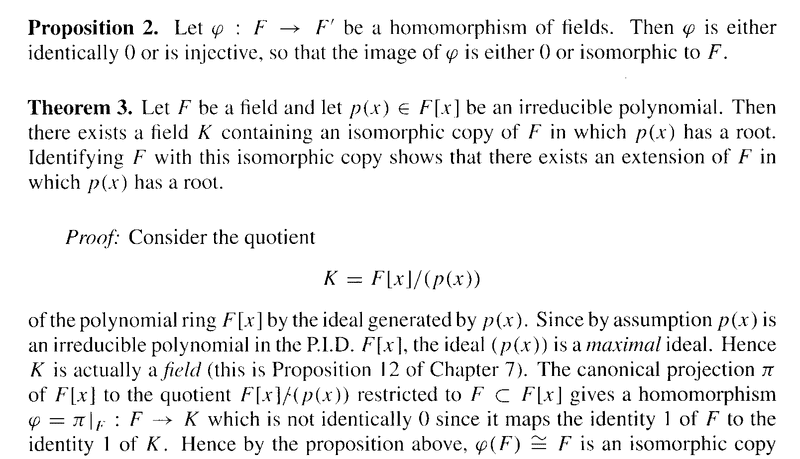
Theorem 3 on pages 512-513 reads as follows:
?temp_hash=fe36f5a47fc27d01f829e59ddf52c9e4.png

?temp_hash=fe36f5a47fc27d01f829e59ddf52c9e4.png

In the above text from Dummit and Foote, we read the following:

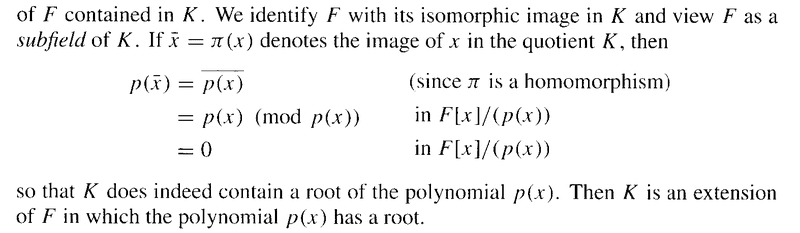
" ... ... We identify ##F## with its isomorphic image in ##K## and view ##F## as a subfield of ##K##. If ##\overline{x} = \pi (x)## denotes the image of ##x## in the quotient ##K##, then

##p( \overline{x} ) = \overline{ p(x) }## ... ... (since ##\pi## is a homomorphism)

... ... "My question is as follows: ... where in the proof of ##p( \overline{x} ) = \overline{ p(x) }## does it depend on ##\pi## being a homomorphism ... ...

... indeed, how does one formally and rigorously demonstrate that ##p( \overline{x} ) = \overline{ p(x) }## ... ... and how does this proof depend on ##\pi## being a homomorphism ...
To make my question clearer consider the case of ##p(x) = x^2 - 5## ... ...

Then ...

##p( \overline{x} ) = \overline{x}^2 - 5_K##

##= ( x + ( p(x) ) ( x + ( p(x) ) - ( 5 + ( p(x) )##

##= ( x^2 + ( p(x) ) - ( 5 + ( p(x) )##

##= (x^2 - 5) + ( p(x) ) = 0##

##= \overline{ p(x) }##... ... in the above case, my question is ... where does the above calculation depend on ##\pi## being a homomorphism ... ?
Hope someone can help ...

Peter
 

Attachments

  • D&F - 1 - Theorem 2, Ch 13 - PART 1 ... ....png
    D&F - 1 - Theorem 2, Ch 13 - PART 1 ... ....png
    41.5 KB · Views: 685
  • D&F - 2 - Theorem 2, Ch 13 - PART 2 ... ....png
    D&F - 2 - Theorem 2, Ch 13 - PART 2 ... ....png
    17 KB · Views: 587
Last edited:
Physics news on Phys.org
The proof does not demonstrate that ##p(\overline x)=\overline{p(x)}## *. It is left 'as an exercise for the reader'.

Here are the missing steps. We write ##p(x)=\sum_{k=0}^n a_kx^k##:

\begin{align*}
p(\overline x)&=
\sum_{k=0}^n a_k\overline x^k\\
&=\sum_{k=0}^n a_k\pi(x)^k\\
&=\pi\left(\sum_{k=0}^n a_kx^k\right)\\
&\quad\quad\quad\textrm{[HERE we have used the homomorphism property to move the additions and multiplications inside the }\pi\textrm{ operator}]\\
&=\left(\sum_{k=0}^n a_kx^k\right) + (p(x))\\
&=p(x)+(px(x))\\
&=(p(x))\\
&=0_K
\end{align*}

* Indeed, depending on how one interprets the author's statement that ##\overline x=\pi(x)##, the symbol string ##\overline{p(x)}## may not even be defined.
 
  • Like
Likes   Reactions: Math Amateur
andrewkirk said:
The proof does not demonstrate that ##p(\overline x)=\overline{p(x)}## *. It is left 'as an exercise for the reader'.

Here are the missing steps. We write ##p(x)=\sum_{k=0}^n a_kx^k##:

\begin{align*}
p(\overline x)&=
\sum_{k=0}^n a_k\overline x^k\\
&=\sum_{k=0}^n a_k\pi(x)^k\\
&=\pi\left(\sum_{k=0}^n a_kx^k\right)\\
&\quad\quad\quad\textrm{[HERE we have used the homomorphism property to move the additions and multiplications inside the }\pi\textrm{ operator}]\\
&=\left(\sum_{k=0}^n a_kx^k\right) + (p(x))\\
&=p(x)+(px(x))\\
&=(p(x))\\
&=0_K
\end{align*}

* Indeed, depending on how one interprets the author's statement that ##\overline x=\pi(x)##, the symbol string ##\overline{p(x)}## may not even be defined.
Thanks for the help, Andrew ...

Just now reflecting on what you have written... but at first sight, it seems very clear ...

Thanks again,

Peter
 
Hi Andrew,

Thanks for you help ... BUT ... just a further issue on this topic ...

Why do we need to consider a mapping/homomorphism at all in proving that ##p( \overline{x} ) = \overline{ p(x) }## ...

Surely we can just prove that ##p( \overline{x} ) = \overline{ p(x) }## in the field ##F[x] / ( p(x) )## by simply considering the nature of the cosets of the quotient ... and in particular the rules for adding and multiplying cosets ...

I wonder whether we need ##\pi## at all in the proof of Theorem 3 ...

Can you comment ... ?

Peter
 
Math Amateur said:
Surely we can just prove that ##p( \overline{x} ) = \overline{ p(x) }## in the field ##F[x] / ( p(x) )## by simply considering the nature of the cosets of the quotient ... and in particular the rules for adding and multiplying cosets ...
The difficulty is that ##\overline x## is defined as ##\pi(x)##, so we cannot even state the claim ##p( \overline{x} ) = \overline{ p(x) }##, let alone prove it, unless we have defined ##\pi##.

Also, recall that the key claim of Theorem 3 is that ##K## contains an isomorphic copy of ##F##. The easiest way to demonstrate that is to create an injective homomorphism into ##K## from a field that is isomorphic to ##F##. That injective homomorphism is ##\pi|_{F'}## where ##F'## is the subring of ##F[x]## consisting of polynomials of degree 0, which is isomorphic to ##F##.

So we have ##F\cong F'\cong Im\ \pi|_{F'}##. In the book they identify ##F'## with ##F## but I find it clearer in this context to highlight the difference.
 

Similar threads

  • · Replies 2 ·
Replies
2
Views
2K
  • · Replies 3 ·
Replies
3
Views
2K
  • · Replies 21 ·
Replies
21
Views
2K
  • · Replies 1 ·
Replies
1
Views
2K
  • · Replies 4 ·
Replies
4
Views
2K
  • · Replies 2 ·
Replies
2
Views
2K
  • · Replies 4 ·
Replies
4
Views
2K
  • · Replies 3 ·
Replies
3
Views
3K
  • · Replies 2 ·
Replies
2
Views
3K
  • · Replies 6 ·
Replies
6
Views
3K