Find Derivative - Get Guidance Here

  • Thread starter Thread starter npellegrino
  • Start date Start date
  • Tags Tags
    Derivative
Join the discussion
Ask a follow-up here, or get your own question answered by working scientists, mathematicians and engineers — people, not an autocomplete.
Real named experts · corrections over time · the nuance an AI answer skips
3 replies · 1K views
npellegrino
Messages
17
Reaction score
0
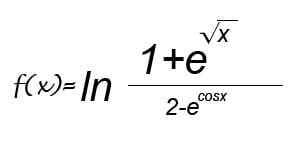
I am having difficulty figuring this one, any guidance will be appreciated.

24mz1bb.jpg
 
Physics news on Phys.org
This is what I have so far.

I believe i use this rule d/dx log a ^ u = 1/(lna)u

so ln = 1
a = ln
u = (1+e^sqrtX)/(2-e^cosx)

now i need to take the derivative of u, does e^sqrtX = e^sqrtX or is it e^sqrtX * derivative of sqrtX making it e^sqrtX * 1/2sqrtX

d/dx u =
 
I believe i use this rule d/dx log a ^ u = 1/(lna)u

This 'rule' makes no sense whatsoever.

now i need to take the derivative of u, does e^sqrtX = e^sqrtX or is it e^sqrtX * derivative of sqrtX making it e^sqrtX * 1/2sqrtX

This is also pretty hard to read. Yes [itex]\exp(\sqrt{x})=\exp(\sqrt{x})[/itex]. This is no surprise since everything equals itself. What you probably mean is [itex]\frac{d}{dx}\exp(\sqrt{x})=\exp(\sqrt{x})[/itex]. That is wrong since you have to use the chain rule therefore your second guess,[itex]\frac{d}{dx}\exp(\sqrt{x})=\exp(\sqrt{x}) \frac{1}{2 \sqrt{x}}[/itex], is correct.