rachelmaddiee
- 67
- 5
- Homework Statement
- I need help with a question
- Relevant Equations
- N/A
Is everything correct?
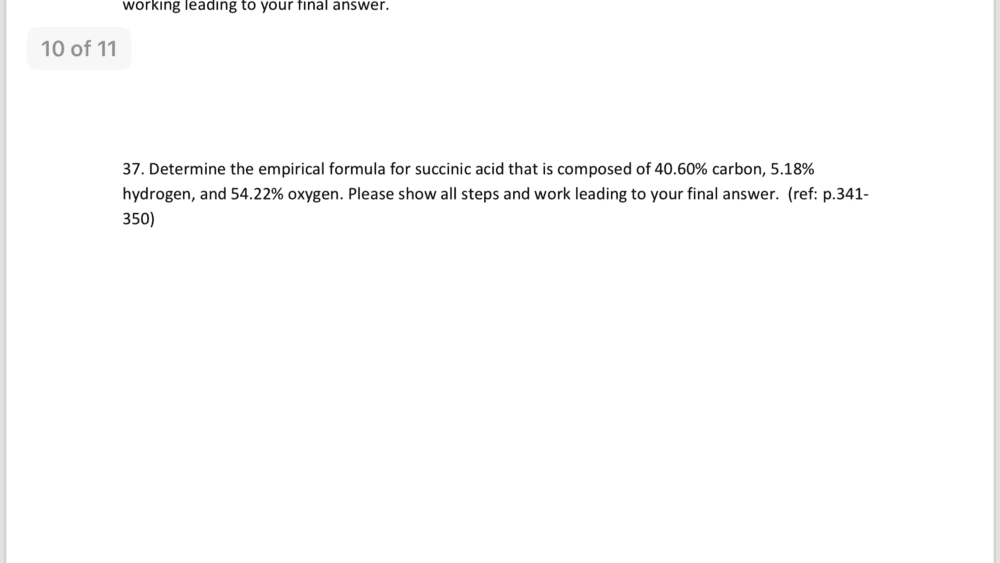
Percent by mass C = 40.60%
Percent by mass H = 5.18%
Percent by mass O = 54.22%
Empirical formula = ? (unknown)
Inverse molar mass C = 1 mol/12.01 g
Inverse molar mass H = 1 mol/1.008 g
Inverse molar mass O = 1 mol/16.00 g
Convert the masses to moles.
C = 40.60 g/12.01 g/mol = 3.380 mol
H = 5.18 g/1.008 g/mol = 5.138 mol
O = 54.22 g/16.00 g/mol = 3.388 mol
Divide by the lowest, seeking the smallest whole-number ratio
C = 3.380/3.380 = 1 = 1 mol C
H = 5.138/3.380 = 1.52 = 1.5 mol H
O = 3.388/3.380 = 1.00 = 1 mol O
The simplest mole ratio is (1 mol C):(1.5 mol H):(1 mol O).
2 x 1 mol C = 2 mol C
2 x 1.5 mol H = 3 mol H
2 x 1 mol O = 2 mol O
The simplest whole-number ratio of atoms is (2 atoms C):(3 atoms H):(2 atoms O). The empirical formula of succinic acid is C2H3O2.
Percent by mass C = 40.60%
Percent by mass H = 5.18%
Percent by mass O = 54.22%
Empirical formula = ? (unknown)
Inverse molar mass C = 1 mol/12.01 g
Inverse molar mass H = 1 mol/1.008 g
Inverse molar mass O = 1 mol/16.00 g
Convert the masses to moles.
C = 40.60 g/12.01 g/mol = 3.380 mol
H = 5.18 g/1.008 g/mol = 5.138 mol
O = 54.22 g/16.00 g/mol = 3.388 mol
Divide by the lowest, seeking the smallest whole-number ratio
C = 3.380/3.380 = 1 = 1 mol C
H = 5.138/3.380 = 1.52 = 1.5 mol H
O = 3.388/3.380 = 1.00 = 1 mol O
The simplest mole ratio is (1 mol C):(1.5 mol H):(1 mol O).
2 x 1 mol C = 2 mol C
2 x 1.5 mol H = 3 mol H
2 x 1 mol O = 2 mol O
The simplest whole-number ratio of atoms is (2 atoms C):(3 atoms H):(2 atoms O). The empirical formula of succinic acid is C2H3O2.
