Find Net Electrical Force of Electrons on Proton

  • Thread starter Thread starter merlos
  • Start date Start date
  • Tags Tags
    Electrical Force
Click For Summary
SUMMARY

The net electrical force exerted by two electrons on a proton, each positioned 1.60×10⁻¹⁰ m away, can be calculated using Coulomb's law and vector addition. The angles between the forces were determined to be approximately 57.46 and 57.54 degrees using the Law of Cosines. The x-component of the net force is 1.54×10⁻⁸ N, while the y-component is -4.84×10⁻⁹ N, resulting in a net force (Fnet) of 1.054×10⁻⁸ N. The forces exerted by the electrons on the proton are attractive, directed along the lines connecting the charges.

PREREQUISITES
  • Coulomb's Law for calculating electrostatic force
  • Vector addition for combining forces
  • Law of Cosines for determining angles in triangles
  • Understanding of basic electrostatics and charge interactions
NEXT STEPS
  • Study Coulomb's Law in detail to understand force calculations between charged particles
  • Learn vector addition techniques for resolving forces in two dimensions
  • Explore the Law of Cosines and its applications in physics problems
  • Investigate the concept of symmetry in electrostatic systems for simplifying calculations
USEFUL FOR

Students and professionals in physics, particularly those focusing on electrostatics, as well as educators teaching concepts related to electric forces and charge interactions.

merlos
Messages
14
Reaction score
0
A. If two electrons are each 1.60×10⁻¹⁰ m from a proton, as shown in the figure, find the magnitude and of the net electrical force they will exert on the proton.
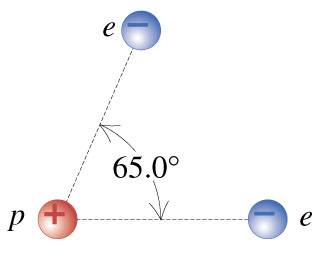
yg.17.41.jpg


B. Find the direction of the net electrical force electrons will exert on the proton.
Enter your answer as an angle measured relative to the line connecting the proton and the right electron with counterclockwise being positive.


Using the Law of Cosines, I was able to find the angles to be 57.46 and 57.54 degrees.
Csquared = Asquared + Bsquared - 2ABcos(65degrees)
C= 1.72*10^-10

Then I used C/sin(thetac) = A/sin(thetaa)
(1.72*10^-10)/sin(65degrees) = (1.6*10^-10)/sina
a = 57.46 degrees
b = 57.54 degrees

Then I did vector addition to find Fnet. The x-component = 1.54*10^-8 and the y-component = -4.84*10^-9

Therefore Fnet = 1.054*10^-8

? Am I on the right track??


Physics news on Phys.org
Doesn't look right to me. Are the electrons going to attract or repel the proton? What is the equation for the force exerted by one charge on another in terms of the charges and the distance?

Then the vector addition has nothing to do with the law of cosines. The force from the right electron on the proton will be straight horizontal (which way?), and the force from the other electron will be in line with that 65 degree line. You add the x and y components to get the net.
 
You do NOT need to calculate any angles. Everything you need is there.
Are you familiar with Coulomb's law and vector addition?
You should know that electrons will attract proton with forces along the lines that connect them - therefore you know the angles.
 
Here's a hint: You should be able to find the direction of the net force on the proton with no calculation whatsoever. Think symmetry. (Of course, you'll still need Coulomb's law to find the magnitude of that force.)
 

Similar threads

  • · Replies 5 ·
Replies
5
Views
2K
Replies
1
Views
3K
  • · Replies 9 ·
Replies
9
Views
8K
  • · Replies 7 ·
Replies
7
Views
3K
  • · Replies 15 ·
Replies
15
Views
6K
Replies
7
Views
2K
  • · Replies 11 ·
Replies
11
Views
16K
Replies
5
Views
3K
  • · Replies 21 ·
Replies
21
Views
10K
  • · Replies 5 ·
Replies
5
Views
2K