merlos
- 14
- 0
A. If two electrons are each 1.60×10⁻¹⁰ m from a proton, as shown in the figure, find the magnitude and of the net electrical force they will exert on the proton.
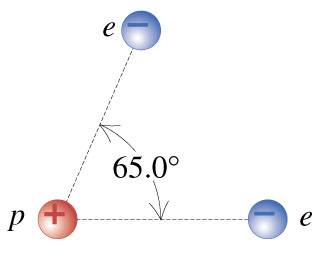
B. Find the direction of the net electrical force electrons will exert on the proton.
Enter your answer as an angle measured relative to the line connecting the proton and the right electron with counterclockwise being positive.
Using the Law of Cosines, I was able to find the angles to be 57.46 and 57.54 degrees.
Csquared = Asquared + Bsquared - 2ABcos(65degrees)
C= 1.72*10^-10
Then I used C/sin(thetac) = A/sin(thetaa)
(1.72*10^-10)/sin(65degrees) = (1.6*10^-10)/sina
a = 57.46 degrees
b = 57.54 degrees
Then I did vector addition to find Fnet. The x-component = 1.54*10^-8 and the y-component = -4.84*10^-9
Therefore Fnet = 1.054*10^-8
? Am I on the right track??
B. Find the direction of the net electrical force electrons will exert on the proton.
Enter your answer as an angle measured relative to the line connecting the proton and the right electron with counterclockwise being positive.
Using the Law of Cosines, I was able to find the angles to be 57.46 and 57.54 degrees.
Csquared = Asquared + Bsquared - 2ABcos(65degrees)
C= 1.72*10^-10
Then I used C/sin(thetac) = A/sin(thetaa)
(1.72*10^-10)/sin(65degrees) = (1.6*10^-10)/sina
a = 57.46 degrees
b = 57.54 degrees
Then I did vector addition to find Fnet. The x-component = 1.54*10^-8 and the y-component = -4.84*10^-9
Therefore Fnet = 1.054*10^-8
? Am I on the right track??