Find the dimensions of surface tension

Click For Summary

Homework Help Overview

The discussion revolves around finding the dimensions of surface tension, exploring the relationship between various physical quantities such as height, radius, density, and gravitational acceleration. Participants are examining how to interpret the concept of direct proportionality in this context.

Discussion Character

  • Conceptual clarification, Mathematical reasoning, Assumption checking

Approaches and Questions Raised

  • Participants are questioning how to handle the directly proportional sign in the context of surface tension and whether it can be treated as an equation with a dimensionless constant. There is discussion about isolating surface tension and deriving its dimensions from given variables.

Discussion Status

Some participants have provided insights into the nature of the constant involved in the proportionality and its implications for the dimensional analysis of surface tension. There is ongoing exploration of how to derive SI units while considering the constant.

Contextual Notes

There is a mention of a dimensionless constant in the discussion, which some participants suggest can be ignored in the context of dimensional analysis. The implications of this assumption are being examined.

lab-rat
Messages
44
Reaction score
0
I would really appreciate some help with this!
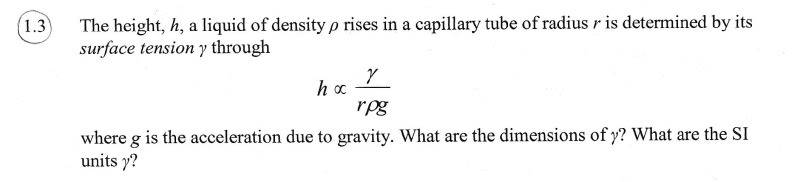
physics.jpg


h= (L)
r=(L)
p=(ML-3)
g=(LT-2)

I just don't know what to do with the directly proportional sign. Should I isolate the surface tension before or after adding the constant?
 
Physics news on Phys.org
From:

http://www.wikihow.com/Determine-Whether-Two-Variables-Are-Directly-Proportional

Which is from:

http://www.google.com/webhp?hl=en&t..._gc.r_pw.&fp=1fa7c254c97e187f&biw=800&bih=417


"Understand what the phrase directly proportional means. A very common misconception is that two variables are directly proportional if one increases as the other increases. Two variables are said to be directly proportional if, and only if, their ratio is a constant for all values of each variable. Thus when one variable is divided by the other, the answer is always a constant. "

So in the formula for surface tension I think that the proportional sign can be replaced with an equals sign when the formula is multiplied by a dimensionless constant?

See also:

http://en.wikipedia.org/wiki/Surface_tension#Two_definitions
 
lab-rat said:
I just don't know what to do with the directly proportional sign. Should I isolate the surface tension before or after adding the constant?

The directly proportional sign means a multiplicative constant K which is dimensionless. So

h=K \frac{\gamma}{r \rho g}

ehild
 
So from there I can isolate surface tension and find its dimensions?

surface tension = (L)(L)(ML-3)(LT-2) / k

=M/kT2

Now how do I find the SI units with a constant in there?
 
As ehild said, that constant is dimensionless so you can just ignore it.
 
Oh ok, so the SI units would be kg/s2 ?
 

Similar threads

  • · Replies 18 ·
Replies
18
Views
2K
  • · Replies 22 ·
Replies
22
Views
2K
Replies
2
Views
3K
  • · Replies 2 ·
Replies
2
Views
1K
  • · Replies 19 ·
Replies
19
Views
2K
  • · Replies 29 ·
Replies
29
Views
4K
  • · Replies 1 ·
Replies
1
Views
2K
Replies
2
Views
3K
  • · Replies 63 ·
3
Replies
63
Views
5K
Replies
5
Views
2K