Find the range of acceleration so that the drums won't fall

Click For Summary
SUMMARY

The discussion focuses on determining the range of acceleration for a system of drums to prevent them from falling. The user successfully calculated the upper bound of acceleration using Newton's second law but is uncertain about deriving the lower bound. The conversation highlights two critical scenarios: one where the top drum flies off due to excessive acceleration and another where insufficient normal forces fail to support the top drum. Understanding these conditions is essential for solving the problem accurately.

PREREQUISITES
  • Newton's Second Law of Motion
  • Understanding of normal forces in physics
  • Basic principles of static equilibrium
  • Problem-solving skills in mechanics
NEXT STEPS
  • Research methods for calculating normal forces in multi-body systems
  • Study the implications of static and dynamic friction on stability
  • Explore advanced applications of Newton's laws in real-world scenarios
  • Learn about the principles of equilibrium in mechanical systems
USEFUL FOR

Physics students, mechanical engineers, and anyone interested in dynamics and stability analysis of multi-body systems.

QuantumRose
Messages
11
Reaction score
1
Problem:
https://drive.google.com/open?id=19PDuyshgP6u4U9mXU3BfrF031J8wL12B
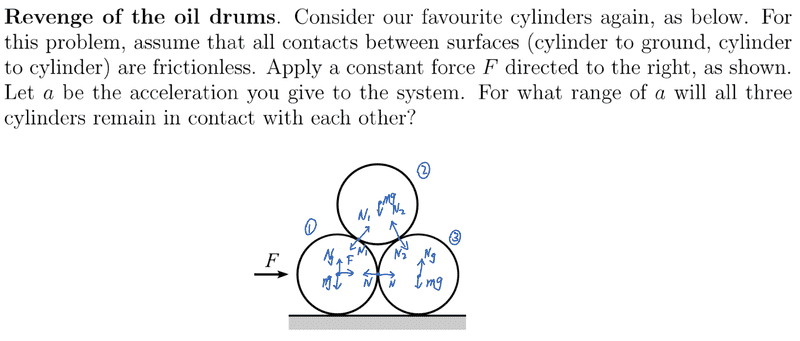
oil_drums.png

Attempt: I tried to solve the range by listing out the Newton's 2nd laws of each drum
1.png

https://drive.google.com/open?id=1Eslg2Wy3orG41eywwm_O6qN4OQ3QN-bA
and from the equations of the drum 2, I get
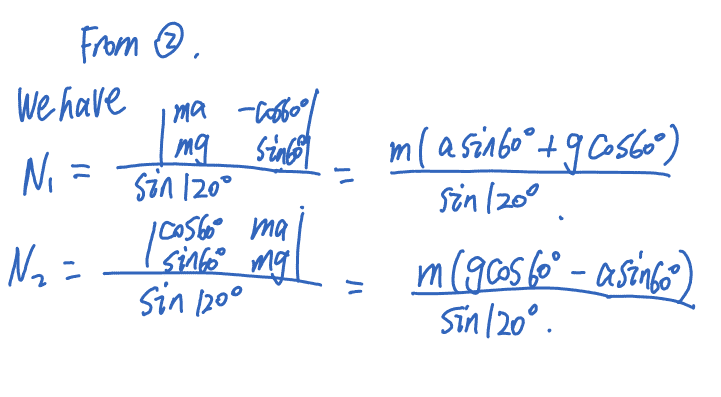
N1_N2.png

https://drive.google.com/open?id=19MFda8L_YuDBlsOg1_76O3-w1rJjHhfW
Since drum 2 must stay on the bottom drums, so it will not fly up, thus
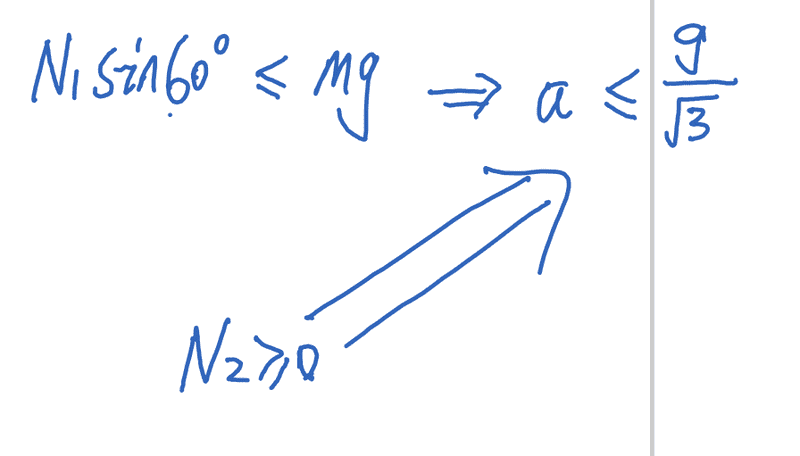
upper_bound.png

https://drive.google.com/open?id=1tpDM2zHyDQ84m73GC0EgcZsNz5Q4tq1z
I got the upper bound of the acceleration, but I don't know if it is correct.My question:
Although I got the seemingly correct upper bound of the acceleration, but I don't know how I can get the lower bound of the acceleration?
 

Attachments

  • oil_drums.png
    oil_drums.png
    23.7 KB · Views: 875
  • 1.png
    1.png
    16 KB · Views: 635
  • N1_N2.png
    N1_N2.png
    12.5 KB · Views: 577
  • upper_bound.png
    upper_bound.png
    9.4 KB · Views: 539
Last edited:
Physics news on Phys.org
None of your images show up
upload_2018-9-19_15-0-25.png
 

Attachments

  • upload_2018-9-19_15-0-25.png
    upload_2018-9-19_15-0-25.png
    2.2 KB · Views: 786
phinds said:
None of your images show up
View attachment 230886
I just fixed that, now it should be fine.
 
QuantumRose said:
got the seemingly correct upper bound of the acceleration, but I don't know how I can get the lower bound of the acceleration?
Each bound corresponds to the system falling apart. In which two ways can that happen? What can you say about the normal forces in those two cases?
 
haruspex said:
Each bound corresponds to the system falling apart. In which two ways can that happen? What can you say about the normal forces in those two cases?

Well, I think there are two cases, one is for the upper bound I solved(corresponds to the top drum flying up); the other case is for the lower bound(it corresponds to the situation when the top drum is falling down, i.e. N_1 and N_2 are not enough to support the top drum.)
 

Similar threads

  • · Replies 5 ·
Replies
5
Views
2K
  • · Replies 42 ·
2
Replies
42
Views
6K
Replies
6
Views
4K
  • · Replies 4 ·
Replies
4
Views
2K
  • · Replies 5 ·
Replies
5
Views
3K
  • · Replies 1 ·
Replies
1
Views
2K
Replies
1
Views
1K
  • · Replies 27 ·
Replies
27
Views
6K
  • · Replies 2 ·
Replies
2
Views
5K
  • · Replies 5 ·
Replies
5
Views
4K