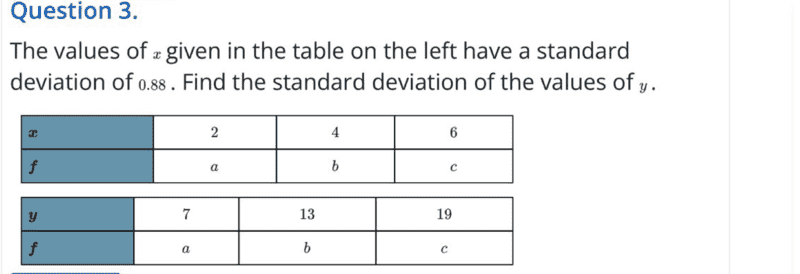
Find the standard deviation of the values of ##y##

Click For Summary

Homework Help Overview

The discussion revolves around finding the standard deviation of a set of values, specifically focusing on the relationship between two sequences represented by the variables x and y. The original poster presents a sequence of values for x and y and attempts to derive a formula connecting them.

Discussion Character

  • Exploratory, Conceptual clarification, Mathematical reasoning

Approaches and Questions Raised

  • Participants discuss the relationship between the sequences of x and y, with some questioning the interpretation of forming a sequence versus a function. There are attempts to apply properties of variance to derive the standard deviation of y based on the given standard deviation of x.

Discussion Status

The discussion is ongoing, with participants providing insights into the properties of variance and standard deviation. Some guidance has been offered regarding the calculations, but there is still uncertainty about the impact of constants on variance and standard deviation.

Contextual Notes

There is a mention of a provided solution and a potential typo in the formulas discussed. Participants are also navigating the implications of constants in variance calculations, indicating a need for clarity on these concepts.

chwala
Gold Member
Messages
2,828
Reaction score
425
Homework Statement
See attached- sent as received both question and solution.
Relevant Equations
stats
This is the question;

1676544903722.png
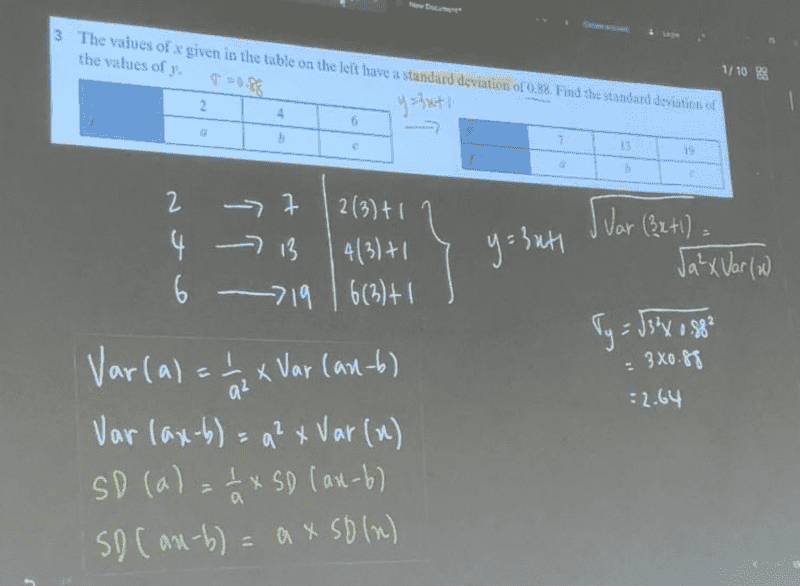
This is the solution as received;

1676544963497.png


I am not familiar with the approach used in the solution...my thinking was as follows

The frequencies are the same...the only thing changing are the discrete variables thus;

Let ##[x= 2,4,6]## and ##[y=7,13,19]## form a sequence...then the nth term is given by;

##x_n=2n## and ##y_n=(3⋅2n)+1=6n+1=3(x_n)+1##

##y_n=3(x_n)+1##

I will need to think on this...your input is welcome though as we already have the solution given...not unless it is wrong. Cheers.

I will look at this later...should be achievable! Since they've given us standard deviation for ##x## ... and both frequencies have same values then I would need to find the ratio of ##a:b:c## then use that to determine the standard deviation of ##y##.
 
Last edited:
Physics news on Phys.org
chwala said:
The frequencies are the same...the only thing changing are the discrete variables thus;
Let ##[x= 2,4,6]## and ##[y=7,13,19]## form a sequence...
The part about "form a sequence" doesn't make sense to me. Really, what you're talking about is a map (i.e., function) from the x values to the y values.
chwala said:
Let ##[x= 2,4,6]## and ##[y=7,13,19]## form a sequence...then the nth term is given by;
##x_n=2n## and ##y_n=(3⋅2n)+1=6n+1=3(x_n)+1##
##y_n=3(x_n)+1##
The last line gives the function. That is, Y = 3X + 1.

There are several properties of the variance (see https://en.wikipedia.org/wiki/Variance, in the section titled Addition and multiplication by a constant.
Among them are
  • Var(X + a) = Var(X)
  • Var(aX) = a2Var(X)
From these, you should be able to work out the value of Var(Y) = Var(3X + 1), and use the given value of ##\sigma_X## to find ##\sigma_Y## AKA SD(Y). Note that Var(X) = ##(\sigma_X)^2##.
 
Last edited:
  • Like
Likes   Reactions: chwala
Mark44 said:
The part about "form a sequence" doesn't make sense to me. Really, what you're talking about is a map (i.e., function) from the x values to the y values.

The last line gives the function. That is, Y = 3X + 1.

There are several properties of the variance (see https://en.wikipedia.org/wiki/Variance, in the section titled Addition and multiplication by a constant.
Among them are×
  • Var(X + a) = Var(X)
  • Var(aX) = a2Var(X)
From these, you should be able to work out the value of Var(Y) = Var(3X + 1), and use the given value of ##\sigma_X## to find ##\sigma_Y## AKA SD(Y). Note that Var(X) = ##(\sigma_X)^2##.

That is fine and clear ...but what happens to the ##1##? all values are scaled by a constant...and i think ##1## is also a part of that constant. Should we not have;

##Var (Y)=\sqrt {a^2×Var(3x)+1}=2.82## to two decimal places?
 
Last edited by a moderator:
Sorry, I made a typo (now corrected) in one of the formulas I wrote: It should be Var(X + a) = Var(X), not Var(a) as I originally wrote.

So if U = 3x, Var(U) = Var(3x), and so Var(U + 1) = Var(U).

chwala said:
Should we not have; ##Var (Y)=\sqrt {a^2×Var(3x)+1}=2.82## to two decimal places?
No, that's wrong on several counts.
##Var (Y) \ne \sqrt {a^2×Var(3x)+1}## -- you're mixing up variance and standard deviation.
Var(Y) = Var(3X) = 32 Var(X)
So SD(Y) = ##\sqrt{9 Var(X)} = 3 \sqrt{Var(X)}##

The answer given in the image you posted, 2.64, is correct. 2.82 is not.

chwala said:
but what happens to the 1?
It doesn't affect the calculation of the variance. A vertical translation in the data makes no difference. For example, the sets {1, 2, 3} and {3, 4, 5} have different means but the same variance, and hence the same standard deviations.
 
Last edited:
  • Informative
Likes   Reactions: chwala

Similar threads

Replies
13
Views
3K
  • · Replies 2 ·
Replies
2
Views
2K
Replies
4
Views
2K
  • · Replies 3 ·
Replies
3
Views
2K
Replies
8
Views
4K
  • · Replies 2 ·
Replies
2
Views
2K
  • · Replies 1 ·
Replies
1
Views
2K
  • · Replies 4 ·
Replies
4
Views
3K
  • · Replies 2 ·
Replies
2
Views
2K
  • · Replies 12 ·
Replies
12
Views
3K