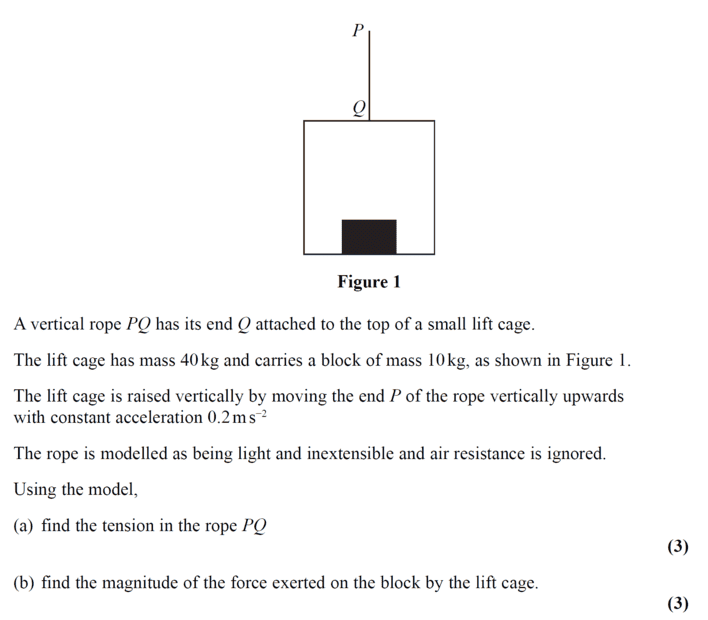
Find the tension in the rope PQ

Click For Summary
SUMMARY

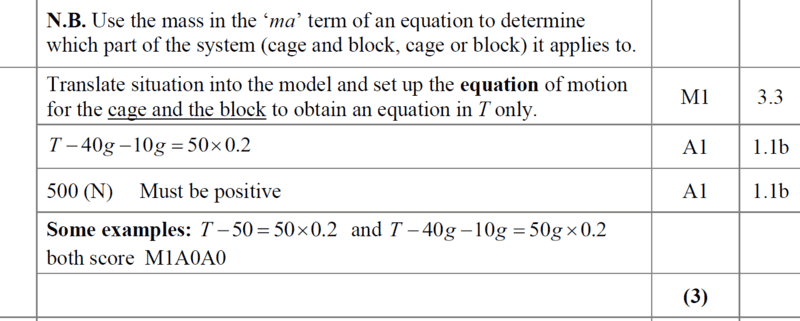
The discussion focuses on calculating the tension in a rope (PQ) in two scenarios involving a cage and a block. For part (a), the correct tension is derived using the equation T = M(g + a), resulting in T = 510 N when using g = 9.8 m/s². However, part (b) requires a different approach, as the tension cannot be equal to that of part (a) due to the differing accelerations of the cage and block. The correct calculations involve understanding the dynamics of both the cage and the block under acceleration.

PREREQUISITES
  • Newton's Second Law of Motion
  • Understanding of tension in ropes
  • Basic principles of acceleration and gravity
  • Familiarity with symbolic representation in physics
NEXT STEPS
  • Learn how to derive tension in systems with multiple masses
  • Study the effects of acceleration on tension in ropes
  • Explore symbolic representation of physics equations
  • Practice problems involving Newton's laws in dynamic systems
USEFUL FOR

Physics students, educators, and anyone interested in understanding the dynamics of tension in mechanical systems involving multiple objects.

chwala
Gold Member
Messages
2,828
Reaction score
423
Homework Statement
See attached.
Relevant Equations
Mechanics
My interest is on part (a), the steps are clear. I thought the final solution ought to be

##T- 500 =50 ×0.2##
##T=500+10 = 510N##


Unless I am missing something here, same query on part (b).
1711834485604.png


1711834533076.png


1711834919699.png
 
Physics news on Phys.org
Try g=9.8m/s2
 
  • Like
Likes   Reactions: chwala
Frabjous said:
Try g=9.8m/s2
Thanks @Frabjous
 
chwala said:
Unless I am missing something here, same query on part (b).
Does this mean that your answer for part (b) is also 510 N? If so, it is incorrect. You are missing that the rope accelerates both the cage and the block whilst the bottom of the cage accelerates only the block. That is why the two cannot be equal.
 
kuruman said:
Does this mean that your answer for part (b) is also 510 N? If so, it is incorrect. You are missing that the rope accelerates both the cage and the block whilst the bottom of the cage accelerates only the block. That is why the two cannot be equal.
I used ##g=10## instead of ##9.8## Check post ##3##.
Cheers.
 
That would not make it correct. How about shown your answer in symbolic form?
Use
##m_c = ~## mass of the cage
##m_b = ~## mass of the block
##a = ~## acceleration of cage and block
##g = ~## acceleration of gravity
##T = ~## the unknown tension in the rope
##F = ~## the magnitude of the force exerted on the block by the cage.

In symbolic form the answers should be independent of the value of ##g##. Once you have them, you can always substitute the numbers.
 
In case there is some confusion, note that using ##g=9.8m/s^2## gives the correct answer for part (a):

##M = m_c+m_b = 40+10 = 50kg##

##T - Mg = Ma## so ##T = M(g+a) = 50*(9.8+0.2) = 500N##
 
  • Like
Likes   Reactions: chwala
kuruman said:
Does this mean that your answer for part (b) is also 510 N? If so, it is incorrect. You are missing that the rope accelerates both the cage and the block whilst the bottom of the cage accelerates only the block. That is why the two cannot be equal.
for part (a) i had using Newtons second law of motion, ##F=ma##

##T-(40 +10)10 = (40+10)0.2##
##T-500=10##
##T=510N##

and in part (b) i had,
##R- 10(10)=10(0.2)##
##R=100+2=102N##

My mistake or error in using the wrong ##g## value should be clear boss. Using ##9.8## should have taken me in the right direction.
 

Similar threads

Replies
4
Views
1K
Replies
3
Views
2K
Replies
11
Views
3K
  • · Replies 39 ·
2
Replies
39
Views
7K
  • · Replies 8 ·
Replies
8
Views
9K
  • · Replies 7 ·
Replies
7
Views
9K
  • · Replies 18 ·
Replies
18
Views
2K
  • · Replies 2 ·
Replies
2
Views
3K
  • · Replies 2 ·
Replies
2
Views
2K
  • · Replies 2 ·
Replies
2
Views
2K
