Find the Time When Rocket Uses Up Its Fuel: Graph Analysis

Click For Summary

Homework Help Overview

The discussion revolves around a rocket's vertical launch and the analysis of a velocity graph to determine the time at which the rocket uses up its fuel. Participants are examining the relationship between the graph's features and the rocket's motion, particularly focusing on the timing of fuel depletion.

Discussion Character

  • Exploratory, Assumption checking, Conceptual clarification

Approaches and Questions Raised

  • Participants are analyzing the graph's axes and questioning the interpretation of velocity and time. There are discussions about the significance of the peak velocity and the implications of gravitational forces on the rocket's motion. Some participants express uncertainty about the original poster's answer and seek clarification on the timing of fuel depletion and maximum speed.

Discussion Status

The conversation is ongoing, with various interpretations being explored. Some participants have offered guidance on understanding the graph, while others are questioning the assumptions made about the timing of fuel depletion and the relationship between maximum speed and fuel usage.

Contextual Notes

There is mention of potential confusion regarding the graph's labeling and the implications of changing values within the context of the problem. Participants are also considering how changes to the graph might affect their conclusions about the timing of events.

nicholaschean
Messages
19
Reaction score
0
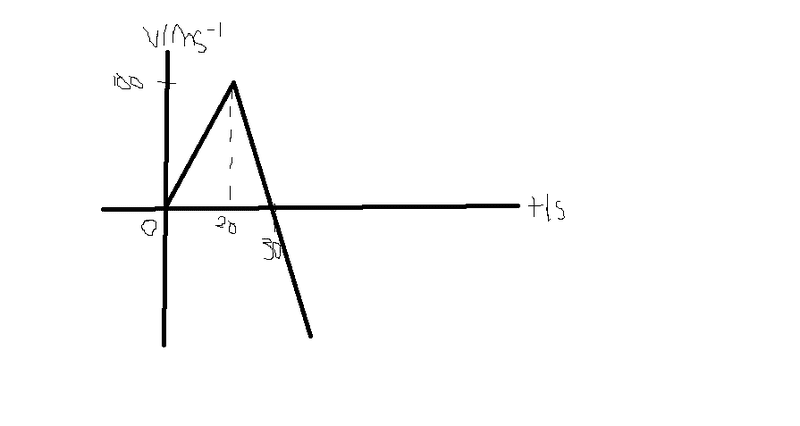
A rocket is launched vertically upwards until it uses up its fuel. It then falls back to Earth. Find the time when the rocket uses up its fuel from the graph.
Untitled.png


My answer was 20s. Is it correct?
 
Physics news on Phys.org
[EDIT]This information is wrong, I made a mistake.

It's rather difficult to make out what your axis are labeled as. and that is the crucial part of this problem.

It seems that your x-axis is labeled: t/s
which I would take to mean that axis is time in seconds.
and I think your y-axis is labeled: v/ms^(-1)
which I would take to mean that axis is velocity, with units of meters per second.
Be careful about that in the future because '/' means divide. Or maybe you were using '|' instead to divide the two?

Either way, if those assumptions are correct, then I think your answer is wrong.

You probably guessed 20s because that is where it appears to 'turn around' but if I am correct and that is a velocity graph, then it is a bit trickier than that. Because look at the peak again, it is still positive, not zero. So therefore your velocity is still positive meaning it is still going up.
 
Last edited:
Gear.0 said:
You probably guessed 20s because that is where it appears to 'turn around' but if I am correct and that is a velocity graph, then it is a bit trickier than that. Because look at the peak again, it is still positive, not zero. So therefore your velocity is still positive meaning it is still going up.

The direction of motion has nothing to do with the net force, which is directly related to the engine or the fuel.
Though that's not the tricky part, the problem is quite tricky: it may be easy to get the right answer, but it's not easy to get the right reason. The answer of the OP is correct, but I would like to hear an explanation from the OP :smile:
 
Oh yes, I apologize OP I was wrong. For some reason when I was responding I thought it was asking when the rocket turns around instead of when it runs out of fuel.

disregard my post, listen to hikaru1221.
 
I think the answer is correct. It is 20 second because the rocket will accelerate until it runs out of fuel at this point the rocket reaches his maximum speed and then the gravitational force plays its role in pulling the rocket which means decreasing the speed or decelerating from the maximum.
 
the_storm said:
I think the answer is correct. It is 20 second because the rocket will accelerate until it runs out of fuel at this point the rocket reaches his maximum speed and then the gravitational force plays its role in pulling the rocket which means decreasing the speed or decelerating from the maximum.

If I change the value 30 (s) to 40, is the answer still 20s?
 
No. and the maximum Velocity won't be 100 m/s.Correct?
 
I mean, just change the graph a bit by changing the value 30 to 40, the other things remains the same.
 
So you mean the maximum speed will be in 20 s ?
 
  • #10
Yes, the rocket reaches its max speed at t=20s.
 
  • #11
If the zero Velocity at 40s I don't thinks the maximum speed is at 20s
why ?
because at 20s after the fuel runs out, the force of the gravity takes 10s to decelerate the velocity from 100 to 0, so if the gravitational force is constant and the maximum speed is 100 why does the gravity take 20s to decelerate the velocity to 0 ? You get my point ?
 
  • #12
Now you get a bit of my point. Think about this. Is it true that the moment the rocket reaches maximum speed is the moment it uses up fuel? Is it the right reason?
 

Similar threads

  • · Replies 5 ·
Replies
5
Views
2K
  • · Replies 2 ·
Replies
2
Views
1K
  • · Replies 10 ·
Replies
10
Views
2K
  • · Replies 3 ·
Replies
3
Views
2K
  • · Replies 7 ·
Replies
7
Views
2K
  • · Replies 12 ·
Replies
12
Views
3K
  • · Replies 6 ·
Replies
6
Views
3K
Replies
1
Views
2K
  • · Replies 22 ·
Replies
22
Views
3K
  • · Replies 9 ·
Replies
9
Views
1K