Find the volume of th eresulting solid by and method

Click For Summary
SUMMARY

The discussion centers on calculating the volume of a solid formed by rotating the region bounded by the circle defined by the equation x² + (y - 1)² = 1 around the x-axis and y-axis. The user initially struggled with identifying the bounded region and correctly solving for x and y. It was clarified that the equation represents a circle with a radius of 1 centered at (0, 1), leading to the conclusion that the volume of the resulting solid is 4π/3, which corresponds to the volume of a unit sphere.

PREREQUISITES
  • Understanding of solid geometry and volume calculation
  • Familiarity with the equations of circles and their properties
  • Knowledge of rotation of solids about axes
  • Ability to manipulate and solve equations involving square roots
NEXT STEPS
  • Study the method of disks and washers for volume calculation
  • Learn about the properties of circles and their equations
  • Explore the concept of bounded regions in calculus
  • Review the derivation of volume formulas for common solids
USEFUL FOR

Students and educators in calculus, particularly those focusing on volume calculations of solids of revolution, as well as anyone seeking to strengthen their understanding of geometric properties and equations of curves.

tony873004
Science Advisor
Gold Member
Messages
1,753
Reaction score
143
The region bounded by the curves is rotated about the specified axis. Find the volume of th eresulting solid by and method.

x^2 + \left( {y - 1} \right)^2 = 1

First question want it rotated about the x-axis, the second question wants it rotated about the y-axis.

So I re-write it in terms of x. Seems easier than in terms of y since there's only 1 x term.
x = \sqrt { - y^2 + 2y} <br />


The problem is when I graph it,
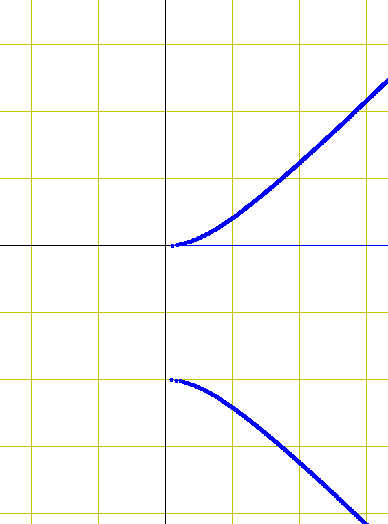
6_3_41b.GIF


So nothing is bounded. There is no solid to rotate. Should I have solved in terms of y instead? How would I do that?
 
Last edited:
Physics news on Phys.org
Don't you need to take both the positive and negative square roots?
 
cepheid said:
Don't you need to take both the positive and negative square roots?
Thanks for your reply.

It still seems like there is no bounded region. All the other problems in this section give a second curve, usually a line like y=2, just to bound the curve. What am I doing wrong? Did I properly solve for x?
6_3_41c.GIF
 
You have lost a "sign". x2+ (y-1)2= 1 is obviously a circle of radius 1 with center at (0, 1), not the hyperbola you show.

x= \pm \sqrt{1-(y-1)^2}= \pm \sqrt{2y- y^2}
and
y= 1\pm \sqrt{1- x^2}
 
lol... and I should have recognized that the answer in the back of the book, 4pi/3 is the volume of a unit sphere. Without the r^3 in the formula I didn't recognize it.

Thanks, Halls
 

Similar threads

Replies
3
Views
2K
  • · Replies 4 ·
Replies
4
Views
2K
  • · Replies 8 ·
Replies
8
Views
2K
Replies
1
Views
1K
  • · Replies 2 ·
Replies
2
Views
2K
  • · Replies 1 ·
Replies
1
Views
2K
  • · Replies 8 ·
Replies
8
Views
4K
Replies
2
Views
1K
Replies
2
Views
1K
  • · Replies 6 ·
Replies
6
Views
2K