Finding currents using Kirchhoff's laws

  • Thread starter Thread starter Bolter
  • Start date Start date
  • Tags Tags
    Currents Laws
Click For Summary
SUMMARY

This discussion focuses on solving electrical currents using Kirchhoff's laws, specifically addressing parts a), b), and c) of a problem set. Participants confirm that the methods used for parts a) and c) are correct, while part b) is acknowledged as potentially accurate but requires verification. The conversation emphasizes the importance of simultaneous equations in determining current values, highlighting the collaborative nature of problem-solving in physics.

PREREQUISITES
  • Understanding of Kirchhoff's laws
  • Proficiency in solving simultaneous equations
  • Basic knowledge of electrical circuits
  • Familiarity with current measurement techniques
NEXT STEPS
  • Study advanced applications of Kirchhoff's laws in circuit analysis
  • Practice solving complex simultaneous equations in electrical contexts
  • Explore current measurement tools and techniques
  • Review common mistakes in circuit analysis to enhance accuracy
USEFUL FOR

Students studying electrical engineering, physics enthusiasts, and anyone looking to improve their skills in circuit analysis using Kirchhoff's laws.

Bolter
Messages
262
Reaction score
31
Homework Statement
See below to see full question
Relevant Equations
V = IR
Q = It
Here is my question that I have been trying to do
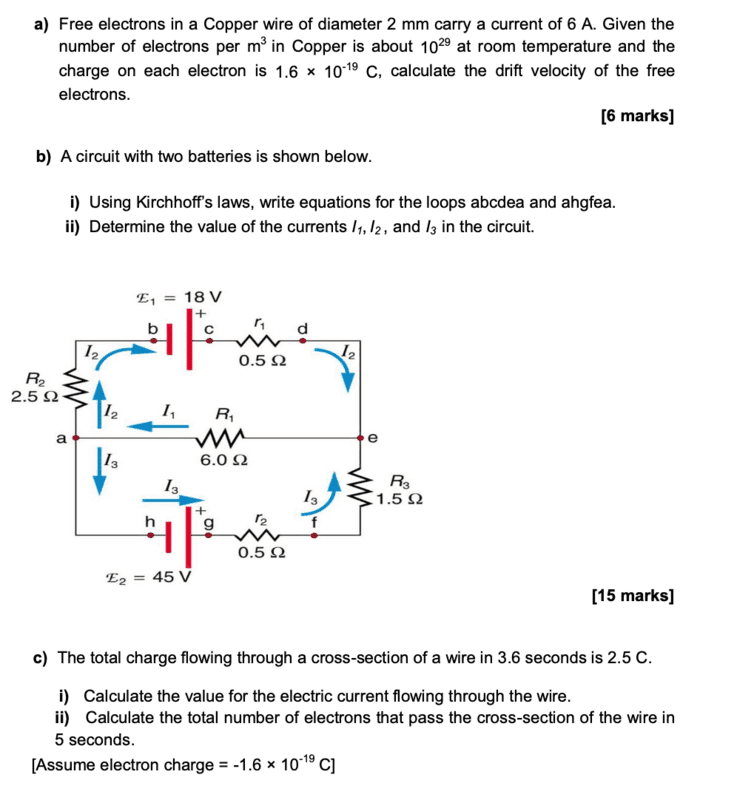
Screenshot 2020-05-20 at 15.44.19.png

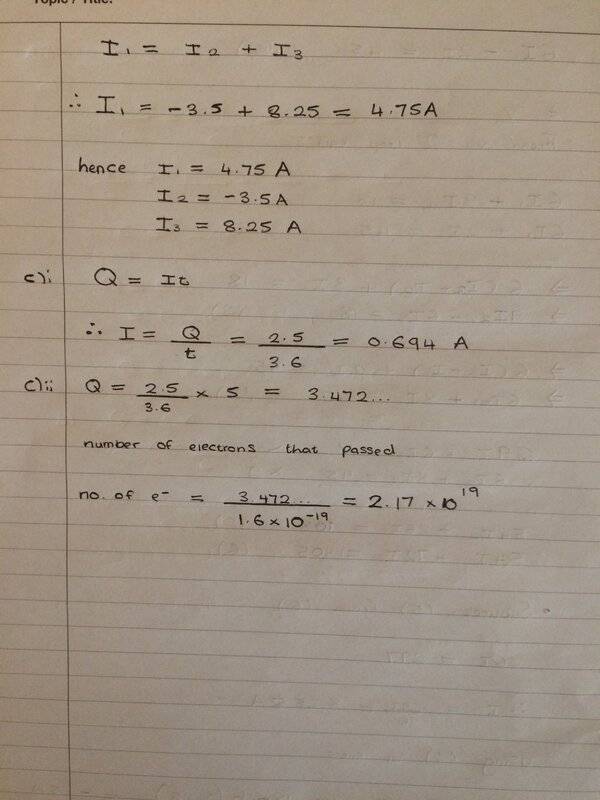
Had tried to attempt it and got there as my answers? Not particularly sure if I had done part b) right from the simultaneous equation I had to solve to get the current values
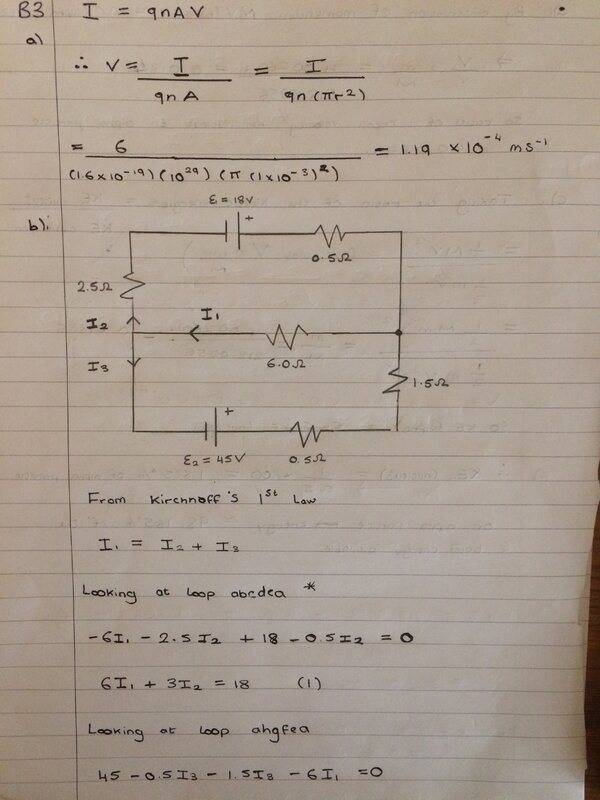
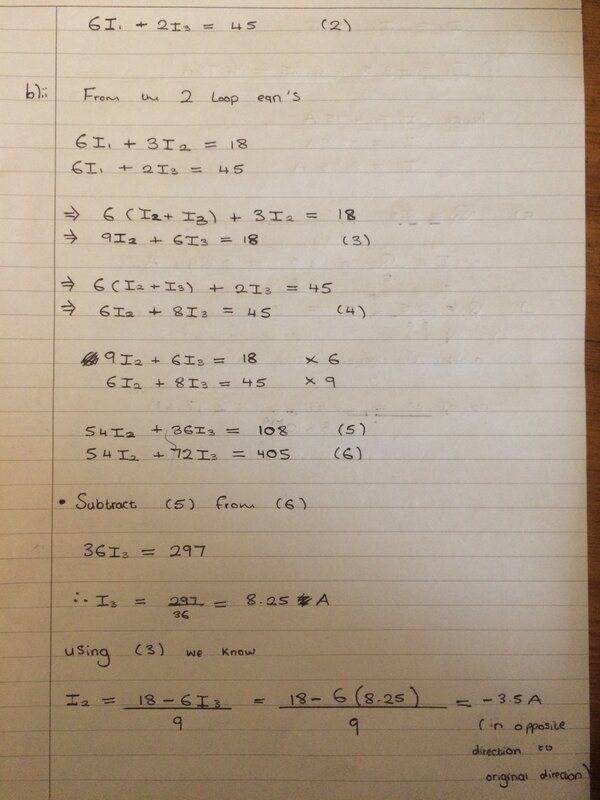
IMG_4931.JPG

IMG_4934.JPG

IMG_4933.JPG


Appreciate for any help! Thanks
 
  • Like
Likes Delta2
Physics news on Phys.org
Part b) looks fine, I haven't run the numbers for a) and c) but your methods look right.
 
  • Like
Likes Bolter and Adesh
Part a) and c) both are correct. (I wonder if they really give 6 marks for part a o0))
 
  • Like
Likes Bolter and etotheipi
Thank you both for taking a look at it! Appreciate the help
 
  • Like
Likes Adesh
The book claims the answer is that all the magnitudes are the same because "the gravitational force on the penguin is the same". I'm having trouble understanding this. I thought the buoyant force was equal to the weight of the fluid displaced. Weight depends on mass which depends on density. Therefore, due to the differing densities the buoyant force will be different in each case? Is this incorrect?

Similar threads

Replies
6
Views
2K
Replies
4
Views
1K
  • · Replies 2 ·
Replies
2
Views
825
  • · Replies 18 ·
Replies
18
Views
3K
  • · Replies 8 ·
Replies
8
Views
2K
  • · Replies 28 ·
Replies
28
Views
2K
  • · Replies 8 ·
Replies
8
Views
2K
  • · Replies 16 ·
Replies
16
Views
2K
  • · Replies 12 ·
Replies
12
Views
2K
  • · Replies 2 ·
Replies
2
Views
2K