Finding deflection and twisting using Castiglianos and Energy Methods

  • Thread starter Thread starter Payam30
  • Start date Start date
  • Tags Tags
    Deflection Energy
Join the discussion
Registration is free. Start your own thread to ask a follow-up.
13 replies · 5K views · last reply
Payam30
Messages
44
Reaction score
1
Hi,
This is not an homework. I'm doing a old exam question and have diffuclities. Since there is not a solution I want to get confirmed before I goes further with other similar question.
I have the figure belove.
The problem is here
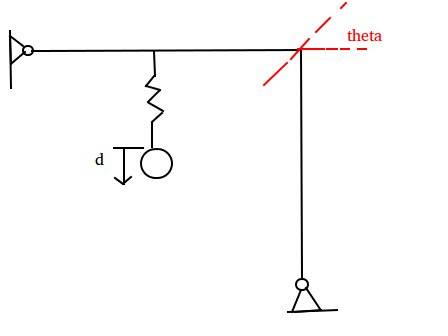
Free-body style sketch of a horizontal L-shaped frame: a pin support at the left end, a rigid horizontal member with a spring and mass hanging from its middle, and a vertical member pinned to a roller support at its base; a red dashed line marks angle theta at the right corner, and a downward arrow labelled d shows the spring deflection.


I do like this. Since I should have some bending moment I insert a fictive bending moment which is made by the force N. Then I do draw the forces in different part and solve the system. When I have N then I use the relation N = k.d where K is the stiffness coefficient of the spring. and then I solve for d. Forces R1 and R2 är equal since N is in the middle of the sctructure. But if I insert the fictive force They take other values right? or am I wrong?
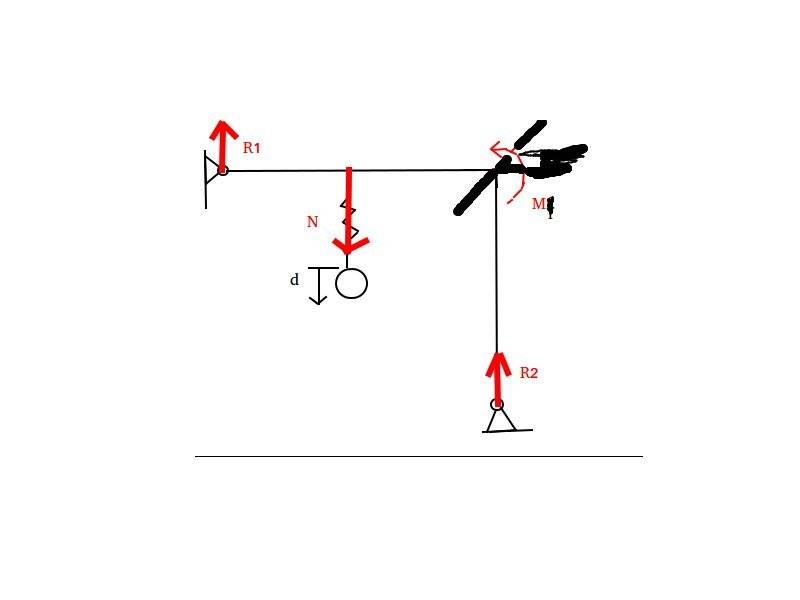
Free-body diagram of a horizontal beam pinned at the left end with reaction R1 upward and supported at the right by reaction R2 upward, with a downward force N on a spring of stiffness k at the middle, a moment M at the right end, and deflection d marked below the spring.


I wonder if this is the right wat to do these kind of problem. Please guide me! thanks :)
 
Physics news on Phys.org
Your solution is most likely wrong and too simplistic, I think.

Did you apply that prescribed theta and the applied moment or was the part of the initial problem?

I'm assuming that those were NOT part of the initial problem.

I also assume that you were given more information than you are showing: e.x. E, I, L

Pretty sure you can't solve this problem without knowing such things because the structure is statically indeterminate (there could certainly be horizontal reactions at those pins)

Most likely, you are expected to use Castigliano's theorem in the following way:
1) Recognize that your structure is statically indeterminate to degree 1.
2) Change one of the pins to a roller, and replace the missing force with your own force, call it "H."
3) Find all of the moments in the frame as functions of x and y due to "H" and the applied load N (this is possible now since you have made your structure statically determinate).
4) Apply Castigliano's Theorem, which will involve taking the derivative with respect to "H," integrating your moments, etc. (you should know how to do this if you have learned Castigliano's theorem)
5) The motion in direction "H" is actually zero, so you use that constraint to obtain one equation, with one unknown, "H."
6) Since you now know "H," you can use static equilibrium to solve for any other forces of interest..

E.x. 1 at THIS LINK is a statically indeterminate problem of degree 2, if you want to study the procedure.
 
Last edited:
afreiden said:
Your solution is most likely wrong and too simplistic, I think.

Did you apply that prescribed theta and the applied moment or was the part of the initial problem?

I'm assuming that those were NOT part of the initial problem.

I also assume that you were given more information than you are showing: e.x. E, I, L

Pretty sure you can't solve this problem without knowing such things because the structure is statically indeterminate (there could certainly be horizontal reactions at those pins)

Most likely, you are expected to use Castigliano's theorem in the following way:
1) Recognize that your structure is statically indeterminate to degree 1.
2) Change one of the pins to a roller, and replace the missing force with your own force, call it "H."
3) Find all of the moments in the frame as functions of x and y due to "H" and the applied load N (this is possible now since you have made your structure statically determinate).
4) Apply Castigliano's Theorem, which will involve taking the derivative with respect to "H," integrating your moments, etc. (you should know how to do this if you have learned Castigliano's theorem)
5) The motion in direction "H" is actually zero, so you use that constraint to obtain one equation, with one unknown, "H."
6) Since you now know "H," you can use static equilibrium to solve for any other forces of interest..

E.x. 1 at THIS LINK is a statically indeterminate problem of degree 2, if you want to study the procedure.

Hi Thank you for your help. Theta is given at the place I showed you. E and I and L are given.and mass of the thin = m and g =9.81 I didnt actully understand what you ment by the steps you represented. :(
 
When I do as you say. I get a vertical force too. and I will have N, V and H. is N =mg?
 
Payam30 said:
When I do as you say. I get a vertical force too. and I will have N, V and H. is N =mg?

Not sure what N,V,H you are referring to, but the "N" I was talking about was consistent with your "N" from your first post - N=k*d.

If you are expected to give a solution in terms of the given angle, then you should do so, in which case you still do my six steps, but instead of "H," you'll have "M." This is sort've what you drew in your original post. However, you ought to split up your structure into two parts: the beam, and the column. Apply the M equal and opposite onto each piece. Go through my steps. Your final solution would be in terms of the angle change.

If you think that my method is too complicated, can you ask a real life person who is familiar with your particular class?
 
I will post my solution here so you can see if I do something wrong. becouse the total energy is too complicated now! and the derivation will not give a good solution.
I paste my solutions here so you can tell me where do I do wrong. Yes but I already send an email but not response yet.

Handwritten engineering derivation on lined paper, rotated, with a structural diagram of a rod with a spring and a load N, labelled equilibrium equations and the unknowns H, V and M, and three numbered free-body sketches below.


Photo of a handwritten derivation on lined paper, rotated sideways, showing bending moment expressions M1 = HL, M2 = HL, M3 = HL + N/2 L - ML, M4 = N L/2 and an energy integral for the complete structure.


Handwritten derivation on lined paper of strain energy terms W1 = l/(6EI)(M·M) and W_tot = W1 + W2 + W3 + W4, with a combined result of (1/96)(20l^3H^2 + l^3N + 2l^3HN + l^3N^2 + 12N^2)/EI.


Im expected to determine deflektion theta in the spring and the rotation in theta..where I showed it from beginning
 
Doesn't look like you're using Castigliano's method like you said in the title..
or did you just skip the step where you write down the integrals?
Regardless of what method you are using, however (Castigliano's method, moment distribution method..), you should be able to solve for everything in terms of theta and the spring deflection without splitting the structure into so many different segments.. why don't you just split it into two segments -- the beam and the column?
 
I don't know how to do that Could you please write down what you mean? in mathematical terms
 
Look at the link in my first post. If you take the time to understand that problem, then you will be able to do your problem.
 
afreiden said:
Look at the link in my first post. If you take the time to understand that problem, then you will be able to do your problem.

Im running ubuntu and it has some problem with the link. Can we talk in private message?
 
Could you please just draw the figure you are thinking about?
 
H vill not give a moment in the x axis.. I don't know how you mean. and I saw the file... I will get problems