Finding Sliding Distance SS = 5.068 m

  • Thread starter Thread starter bj5110
  • Start date Start date
  • Tags Tags
    Sliding
Click For Summary

Homework Help Overview

The problem involves a block sliding down a ramp and then through a rough section, where the sliding distance is to be determined. It incorporates concepts from energy conservation, kinematics, and friction.

Discussion Character

  • Exploratory, Conceptual clarification, Mathematical reasoning

Approaches and Questions Raised

  • Participants discuss the use of conservation of mechanical energy to find the block's velocity at the bottom of the ramp. There are questions about the correct application of formulas and the dimensions of terms in the equations.

Discussion Status

Some participants have provided feedback on the original poster's calculations, suggesting corrections and clarifications. There is ongoing review of the revised calculations, with participants checking for accuracy and dimensional consistency.

Contextual Notes

There are indications of potential misunderstandings regarding the application of energy principles and the interpretation of terms in the equations. The discussion reflects a focus on ensuring correct mathematical representation and understanding of physical concepts.

bj5110
Messages
2
Reaction score
0
A 1.0 kg block is held in place against a spring with spring constant k = 100 N/m (see the figure, below) by a horizontal external force. The spring is compressed 20 cm. The external force is removed, and the block is projected with some (horizontal) velocity upon separation from the spring. The block descends a ramp with height h = 2.0 m. The track is frictionless between points A and B. The block enters a rough section at B, extending to E. The coefficient of kinetic friction over this section is 0.30. The block slides through this rough section a distance S, and comes to a stop at point D.
What is the sliding distance S?
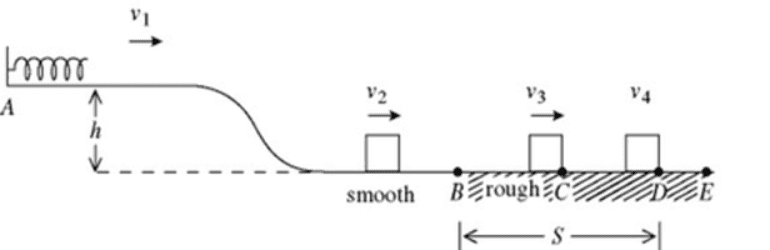
Lokk6AE.png


Can someone please tell me if my below attempt is the correct answer?

Find velocity after reaches bottom of hill (by conservation of mechanical energy)
( 1/2 * k * x2 ) + ( 1/2 * m * g ) = 1/2 * m * v2
(1/2 * 100 * .20) + (1/2 * 1 * 9.8) = 1/2 * 1 * v2
14.9 = 1/2 * v2
v ≈ 5.4589 m/s

Find the acceleration once it hits the rough spot
μmg = Fnet
0.30 * 1 * 9.8 = 2.94 N

2.94 N = m * a
2.94 N = 1 * a
a = -2.94 m/s2

Kinematics to find distance of S
vf2 = vi2 + 2ax
0 = 5.45892 + ( 2 * -2.94 * x)

x = 5.068 m
 
Physics news on Phys.org
KE bottom of hill -
check - gravitational potential energy, and shouldn't the 0.20m be squared?

Best practice:
- finish the algebra before subbing in the numbers.
i.e. ##-\mu m g = ma\implies a=-\mu g## ... then substitute.

- use the variable names from the problem in your equations.
i.e. the distance slid is S not x.
 
Awesome, thank you for the tips and catching my mistake.
Could you review my corrections and let me know if my answer now seems to be correct?

Find velocity after reaches bottom of hill (by conservation of mechanical energy)
( 1/2 * k * x2 ) + ( 1/2 * m * g ) = 1/2 * m * v2
(1/2 * 100 * .202) + (1/2 * 1 * 9.8) = 1/2 * 1 * v2
6.9 = 1/2 * v2
v ≈ 3.7148 m/s

Find the acceleration once it hits the rough spot
-μmg = ma
a = -μg
a = 0.30 * 9.8 = -2.94 m/s2

Kinematics to find distance of S
vf2 = vi2 + 2ax
0 = 3.71482 + ( 2 * -2.94 * S)

S ≈ 2.3469 m
 
... check this:
( 1/2 * k * x2 ) + ( 1/2 * m * g ) = 1/2 * m * v2
"1/2 * m * g" is "half the weight" - a force. All the other terms are energy.

You should get used to scanning your equations to see that the dimensions make sense.
Please note: I won't check your arithmetic.
 

Similar threads

  • · Replies 16 ·
Replies
16
Views
2K
  • · Replies 45 ·
2
Replies
45
Views
8K
  • · Replies 9 ·
Replies
9
Views
2K
  • · Replies 4 ·
Replies
4
Views
3K
  • · Replies 12 ·
Replies
12
Views
3K
  • · Replies 9 ·
Replies
9
Views
4K
Replies
4
Views
4K
  • · Replies 4 ·
Replies
4
Views
2K
  • · Replies 4 ·
Replies
4
Views
4K
Replies
49
Views
4K