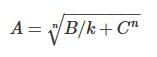
Finding the constants in an expression

  • Context: Undergrad 
  • Thread starter Thread starter ArnoldEdv
  • Start date Start date
  • Tags Tags
    Constants Expression
Click For Summary
SUMMARY

The discussion focuses on solving two equations derived from known value series A1, B1, C1 and A2, B2, C2, which involve two unknowns, n and k. The equations are expressed as A1 = √[n]{(B1/k) + C1^n} and A2 = √[n]{(B2/k) + C2^n}. The mentor notes that a function k = k(n) can be obtained from these equations, leading to the relationship A1^n - C1^n = γ(A2^n - C2^n), where γ = B1/B2. The consensus is that this equation can only be solved numerically, indicating a lack of analytical solutions.

PREREQUISITES
  • Understanding of algebraic equations and functions
  • Familiarity with numerical methods for solving equations
  • Knowledge of exponentiation and roots in mathematical expressions
  • Basic understanding of ratios and their applications in equations
NEXT STEPS
  • Research numerical methods for solving nonlinear equations
  • Explore the use of software tools like MATLAB or Python's SciPy for numerical analysis
  • Study the properties of exponential functions and their applications
  • Learn about the implications of parameter relationships in mathematical modeling
USEFUL FOR

Mathematicians, data analysts, and anyone involved in solving complex equations or modeling relationships between variables will benefit from this discussion.

ArnoldEdv
Messages
2
Reaction score
0
I have a problem with this formula:
upload_2018-8-31_16-41-40.png

I have two known value series: A1, B1, C1 and A2, B2, C2.
That gives me two equations with two unknowns n and k.
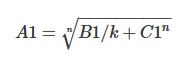
upload_2018-8-31_16-50-51.png
upload_2018-8-31_16-51-39.png

Mentor note:
More readable versions of the two equations:
$$A_1 = \sqrt[n]{\frac{B_1} k + C_1^n}$$
and
$$A_2 = \sqrt[n]{\frac{B_2} k + C_2^n}$$
Does anyone have a clue how to solve this?
 

Attachments

  • upload_2018-8-31_16-41-40.png
    upload_2018-8-31_16-41-40.png
    1.2 KB · Views: 804
  • upload_2018-8-31_16-50-51.png
    upload_2018-8-31_16-50-51.png
    1.2 KB · Views: 821
  • upload_2018-8-31_16-51-39.png
    upload_2018-8-31_16-51-39.png
    1.4 KB · Views: 841
Last edited by a moderator:
Physics news on Phys.org
ArnoldEdv said:
I have a problem with this formula:
View attachment 230078
I have two known value series: A1, B1, C1 and A2, B2, C2.
That gives me two equations with two unknowns n and k.
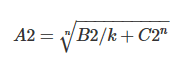
View attachment 230079 View attachment 230080
Does anyone have a clue how to solve this?
You get a function ##k=k(n)## from the equations and then ##A_1^n-C_1^n=\gamma (A_2^n-C_2^n)## which I assume can only be solved numerically.
 
  • Like
Likes   Reactions: jedishrfu
note: ##\gamma=\frac{B_1}{B_2}##.
 
Thank you for your answers.
I was hoping that there was some way of solving this equation that I didn't know of.
Probably there isn't.
 

Similar threads

Replies
4
Views
2K
Replies
6
Views
2K
  • · Replies 3 ·
Replies
3
Views
3K
  • · Replies 17 ·
Replies
17
Views
5K
  • · Replies 5 ·
Replies
5
Views
1K
  • · Replies 1 ·
Replies
1
Views
1K
  • · Replies 12 ·
Replies
12
Views
3K
Replies
1
Views
2K
Replies
8
Views
1K
  • · Replies 1 ·
Replies
1
Views
2K