Finding the Moment Generating Function

Join the discussion
Ask a follow-up here, or get your own question answered by working scientists, mathematicians and engineers — people, not an autocomplete.
Real named experts · corrections over time · the nuance an AI answer skips
4 replies · 2K views
joypav
Messages
149
Reaction score
0
I'm working this problem for my math stat class. Here is what I have for it.

First of all, is this the correct method for finding MGF? I thought it was but I don't understand the answers I am getting.

How do I determine my values for t? For both I have t not equal to 0 because t is in the denominator.

View attachment 7272
 

Attachments
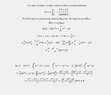
  • 2vkjbd2.jpg
    2vkjbd2.jpg
    31.9 KB · Views: 137
Physics news on Phys.org
joypav said:
I'm working this problem for my math stat class. Here is what I have for it.

First of all, is this the correct method for finding MGF? I thought it was but I don't understand the answers I am getting.

How do I determine my values for t? For both I have t not equal to 0 because t is in the denominator.

Hey joypav! ;)

More accurately, we have:
$$M_X(t) = E(e^{tX}) = \int_0^2 f(x)e^{tx}dx$$
It seems you have split up the 2 contributions, but we really need their sum.

I haven't checked your calculations, but we will indeed end up with a $t$ in the denominator.
And if we take the limit for $t\to 0$, we should find that $M_X(0)=\lim\limits_{t\to 0} M_X(t) = 1$.
 
I like Serena said:
Hey joypav! ;)

More accurately, we have:
$$M_X(t) = E(e^{tX}) = \int_0^2 f(x)e^{tx}dx$$
It seems you have split up the 2 contributions, but we really need their sum.

I haven't checked your calculations, but we will indeed end up with a $t$ in the denominator.
And if we take the limit for $t\to 0$, we should find that $M_X(0)=\lim\limits_{t\to 0} M_X(t) = 1$.

Okay, that's what I was missing was summing them. Thanks!
 
If we sum them we are just left with 2, correct? x+2-x?

Then when I integrate I get 2(e^2t-1)/t. But when I apply L'hospitals I get 4. I must be making an error.
 
joypav said:
If we sum them we are just left with 2, correct? x+2-x?

Then when I integrate I get 2(e^2t-1)/t. But when I apply L'hospitals I get 4. I must be making an error.

Without checking your calculations, I conclude that:
$$M_X(t) = \int_0^1 e^{tx}xdx + \int_1^2 e^{tx}(2-x)dx
= \left(\frac{e^t}{t} - \frac{e^{t}-1}{t^2}\right) + \left(-\frac{e^t}{t} + \frac{e^{2t}-e^{t}}{t^2}\right)
= \frac{e^{2t}-2e^t + 1}{t^2} = \left(\frac{e^t-1}{t}\right)^2
$$
And:
$$\lim_{t\to 0}\frac{e^t-1}{t} \overset{L'H\hat opital}{=} \lim_{t\to 0}\frac{e^t}{1} = 1
$$
(For the record, mister L'Hôpital was French, and I feel we owe him the respect to at least spell his name properly, although to be fair, when he actually lived, his name was spelled L'Hospital. ;))