Finding the settling time of an oscillatory response

  • Thread starter Thread starter paulmdrdo
  • Start date Start date
  • Tags Tags
    Response Time
Click For Summary
SUMMARY

The discussion centers on calculating the settling time of an oscillatory response in RLC circuits, specifically using the function v(t). The user initially approximated the settling time as Ts = 2.30 seconds by equating the upper envelope to 1% of the maximum voltage, which was determined to be approximately 71.8 V. Participants suggested using numerical methods, such as Newton's method, to find the root of the equation |v(t)| - 0.01 = 0 for more accurate results. Additionally, the discussion explored using Laplace transforms and second-order system approximations to refine the settling time calculation.

PREREQUISITES
  • Understanding of RLC circuit response and settling time definitions
  • Familiarity with numerical methods, specifically Newton's method
  • Knowledge of Laplace transforms and their applications in control systems
  • Basic concepts of second-order systems and damping ratios
NEXT STEPS
  • Learn about numerical root-finding techniques, focusing on Newton's method
  • Study Laplace transforms and their application in analyzing circuit responses
  • Explore second-order system dynamics and settling time calculations
  • Investigate the impact of overshoot on settling time definitions and calculations
USEFUL FOR

Electrical engineers, control system designers, and students studying circuit analysis who seek to understand and calculate settling times in oscillatory systems.

paulmdrdo
Messages
89
Reaction score
2
TL;DR
Finding the settling time of an oscillatory response
I was reading my book on circuit analysis on chapter about RLC response and became curious about how to get an approximate value for the settling time of the response. Particularly this response

243864


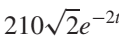
My first approach was to use the upper envelope of the response
243865
and equate to 1 percent of its maximum value and find the approximate settling time which turns out to be Ts = 2.30s.

Now my question is if there's other method that I can use to better approximate the settling time. My book speaks about a trial-and-error solution but did not show how it's done. Please tell me how to go about it. TIA!

243866
 
Engineering news on Phys.org
All moot until you define settling time. You do 1%, what does the book do ?
paulmdrdo said:
but did not show how it's done
end of story. Perhaps find another book ?
 
What is the max. value (for very large t) ?
 
BvU said:
All moot until you define settling time. You do 1%, what does the book do ?
end of story. Perhaps find another book ?
By settling time I mean he last time that the signal passes through some threshold
 
paulmdrdo said:
Now my question is if there's other method that I can use to better approximate the settling time. My book speaks about a trial-and-error solution but did not show how it's done.
I've never seen anything like that before. A book that gives a fairly complicated function for v(t) but doesn't define settling time and suggests a trial-and-error approach... What book is this?

This is the standard definition.
https://en.wikipedia.org/wiki/Settling_time#Definition
Finding the 1% settling time for the given v(t) is a pretty typical algebra problem. Try to plot it and you'll get a feel for what's happening. I didn't plot it out myself, but for your function v(0)=0 and v(inf)=0 so the max value will be a measure of the overshoot, not the settling time.

Edit: I spent a minute trying to solve this myself and I think I figured out what is going on and it may be language confusion. I am pretty sure what the book is saying is equations like this require one to use a numeric solver to find the root (and thus get the settling-time) and the book is recommending an iterative method like Newton to get the root. For the 1% settle time you could use f(t) = |v(t)|-0.01 and try to solve this for f(t)=0. This is actually a fun one because there is one final oscillation after 4 that is hard to catch. I used Mathematica which gave me the roots quickly and easily but I could see this tripping up less competent solvers.

In[*]:= FindMaximum[v[t], {t, 4.25}]
Out[*]= {0.00993382, {t -> 4.87809}}
 
Last edited:
Lat's take a look at the plots of the voltage vs time. First the "big picture" where we can see the whole response curve over 5 seconds:
243938

Using features of the plotting software (Mathcad in this case) I find that the maximum voltage is about 71.8 V.

Not much detail available for the time around the supposed settling time of t = 2.92 s. So let's do another plot to zoom in on the action. Note that the x-axis is expanded and the y-axis compressed for this view:
243939


Looks like the voltage at 2.92 s is about 1% (in magnitude) of the maximum voltage response of about 71.8 V of the peak around 0.453 s on the "big picture" plot. It doesn't appear that it can exceed this value in any subsequent oscillations.

So this is an "analog" approach to solving the problem using math software (Mathcad in this case).
 
  • Like
Likes BvU
I really like Dorf's book on Modern Control Systems, but the chapters I'm looking at is for a closed loop feedback system (Chapter 5 in the 13th edition)... I'm wondering if the method or idea would still work. I was thinking of modeling or massaging it to something like a 2nd order system

$$H(s) = \frac {w_n^2} {s^2 + 2 \zeta \omega_n s + w_n^2}$$

Then he's got a few equations he derived in the chapter... maybe we could use for them settling time? His approximation is 2% based on

$$e^{-\zeta \omega_n T_s} < 0.02$$ $$\zeta \omega_n T_s \approx 4$$ $$T_s = 4 \tau = \frac {4} {\zeta \omega_n}$$

Ts is the settling time, ζ is the damping factor, and ωn is the natural frequency. I don't think it would be far-fetched to replace that 0.02 with a 0.01 and to rearrange the equation for 1% settling time. I am curious to look back at this to see if it does work, and if there's a big difference between 1% and 2%. If it's not like a 2nd-order system, then maybe modeling it based on its dominant roots might be good enough too (described later in the same chapter).

Sorry for rambling, but I was curious to see if this may work without simulation or if it may help; also for my own reference should I revisit this thread (hopefully soon) to see for myself. I'm admittedly a bit rusty on these topics.
 
I'm sure double posting is highly frowned upon although I think following up on this may be of interest to the original poster or others.

I tried out the Laplace transform just like Dorf's book recommended for

$$e^{at}sin(bt)$$

I massaged the equation in and applied the formula and its results looked very similar to the second-order system without any need to worry about dominant poles... By hand or using the formula it was about 2 seconds for 2% steady-state error, and 2.302 seconds for 1% steady-state error.

My results are different than the interpretation from simulation results kindly provided by gneill (thank you), but I think this is because I'm defining it based on steady-state rather than using the maximum voltage. I'm not sure if referencing maximum voltage is appropriate because it looks to me like overshoot... wouldn't the maximum voltage approach only work if this was overly damped and had no overshoot? I don't know the answer.
 

Similar threads

  • · Replies 1 ·
Replies
1
Views
7K
  • · Replies 7 ·
Replies
7
Views
6K
Replies
9
Views
27K
Replies
2
Views
4K
  • · Replies 7 ·
Replies
7
Views
1K
Replies
15
Views
3K
Replies
1
Views
3K
  • · Replies 2 ·
Replies
2
Views
1K
  • · Replies 63 ·
3
Replies
63
Views
5K
  • · Replies 2 ·
Replies
2
Views
2K