Finding the The Power of CDC Computers

  • Context: Graduate 
  • Thread starter Thread starter Borek
  • Start date Start date
  • Tags Tags
    Computers Power
Click For Summary

Discussion Overview

The discussion revolves around the computational power of CDC computers, particularly the CDC 6600, in relation to modern processors like the Intel Core i7. Participants explore the performance capabilities of these systems through a specific programming example and compare their efficiencies in solving mathematical problems.

Discussion Character

  • Technical explanation
  • Debate/contested
  • Mathematical reasoning

Main Points Raised

  • One participant shares a code snippet that finds solutions to a mathematical problem, noting its execution speed on a modern Intel i7 processor.
  • Another participant suggests that the CDC computers likely took a long time to solve similar problems, implying a significant performance gap.
  • Some participants provide links to additional resources that discuss computational problems related to Euler's conjecture and other mathematical challenges.
  • A participant cites the CDC 6600's maximum performance of about 3 MFLOPS, contrasting it with modern processors that operate in GFLOPS and Tera FLOPS ranges.
  • There is a mention of magnetic core memory as a factor in the speed differences between past and present computing technologies.
  • One participant emphasizes that the discussed problem involves integer calculations, which may not directly correlate with FLOPS measurements typically used for floating-point operations.
  • Another reiterates that the performance comparison is rough and acknowledges variability in actual performance outcomes.

Areas of Agreement / Disagreement

Participants express differing views on the relevance of FLOPS in the context of integer-based problems, and there is no consensus on the exact performance comparison between the CDC 6600 and modern processors. The discussion remains unresolved regarding the implications of these performance metrics.

Contextual Notes

Participants note that the performance of the CDC 6600 is based on historical data, and modern performance metrics may vary significantly based on specific use cases and optimizations.

Borek
Mentor
Messages
29,203
Reaction score
4,626
http://www.ams.org/journals/bull/1966-72-06/S0002-9904-1966-11654-3/
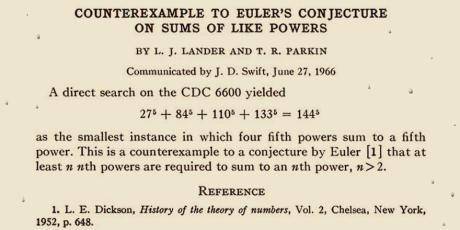
article.jpg


Funny thing, this:

Code:
#define p5(__i__) (__i__*__i__*__i__*__i__*__i__)

int main(int argc, _TCHAR* argv[])
{
    __int64 i, j, k, l, m;

    for (i = 1;i < 200;i++)
        for (j = 1;j < i;j++)
            for (k = 1;k < j;k++)
                for (l = 1;l < k;l++)
                    for (m = 1;m < k;m++)
                        if (p5(i) == p5(j) + p5(k) + p5(l) + p5(m))
                            printf("%I64d -> %I64d %I64d %I64d %I64d\n",i,j,k,l,m);

    return 0;
}

finds their solution in around 2 sec on my i7 (compiled to x64, no idea what code optimizations are done automatically and there are plenty of things that can be done) so it can be up to 8 times faster if split between threads. I wonder how long it took on CDC.
 
Last edited:
Mathematics news on Phys.org
Probably a long time. My cell phone is more powerful than the early Crays.
 
According to Wiki, the CDC 6600 maxed out at about 3 MFLOPS, with about 0.5 MFLOP sustained when running Fortran programs.

http://en.wikipedia.org/wiki/CDC_6600

Not bad for a 50-year old design with a clock speed of about 40 MHz.

By contrast, the Intel Core i7 family performs safely in GFLOP territory, with one model (the 6-core i7 980 XE) maxing out at 109 GFLOPS:

http://en.wikipedia.org/wiki/FLOPS

GPUs are now capable of operating in Tera FLOP territory, though.
 
  • Like
Likes   Reactions: Borek
SteamKing said:
According to Wiki, the CDC 6600 maxed out at about 3 MFLOPS

This problem doesn't call for flops, it is all integers (outside of the 32 bit territory though).
 
Borek said:
This problem doesn't call for flops, it is all integers (outside of the 32 bit territory though).

Just trying to provide a rough gauge of performance between two systems designed 50 years apart.

Like the disclaimers say, your performance may vary.
 
  • Like
Likes   Reactions: Borek

Similar threads

  • · Replies 2 ·
Replies
2
Views
13K
  • · Replies 8 ·
Replies
8
Views
2K
  • · Replies 2 ·
Replies
2
Views
2K
  • · Replies 8 ·
Replies
8
Views
2K
  • · Replies 169 ·
6
Replies
169
Views
16K
  • · Replies 5 ·
Replies
5
Views
3K
  • · Replies 1 ·
Replies
1
Views
2K
  • · Replies 4 ·
Replies
4
Views
2K
  • · Replies 1 ·
Replies
1
Views
3K
  • · Replies 2 ·
Replies
2
Views
2K