First ever recorded planetary engulfment

  • Context: High School 
  • Thread starter Thread starter Tom.G
  • Start date Start date
Join the discussion
Ask a follow-up here, or get your own question answered by working scientists, mathematicians and engineers — people, not an autocomplete.
Real named experts · corrections over time · the nuance an AI answer skips
3 replies · 4K views
Science Advisor
Gold Member
Messages
5,661
Reaction score
4,508
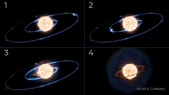
"NASA’s James Webb Space Telescope’s observations of what is thought to be the first ever recorded planetary engulfment event revealed a hot accretion disk surrounding the star, with an expanding cloud of cooler dust enveloping the scene. Webb also revealed that the star did not swell to swallow the planet, but the planet’s orbit actually slowly decayed over time."

https://webbtelescope.org/contents/media/images/2025/117/01JR8HQ5MZTSG07EBWNBPYJADH

1744519752098.png
1744519752098.png

Cheers,
Tom
 
Reply
  • Like
  • Wow
Likes   Reactions: Greg Bernhardt, phinds, ohwilleke and 5 others
Astronomy news on Phys.org
Can you talk us through in a bit more detail what is going on in #3 and #4?
 
More detail here. The planet was roughly Jupiter sized and heavily disrupted by repeated grazing impacts with the stellar atmosphere, which is what's supposed to be depicted in (3). The final impact flung ejecta into space, some of which settled into a ring (4).

Note that the images are artists' impressions, not Webb photos.

Original journal article (which I haven't read yet) here: https://iopscience.iop.org/article/10.3847/1538-4357/adb429
 
Reply
  • Like
Likes   Reactions: Tom.G and ohwilleke
The journal article says the star was in the Sun's mass range and the planet was probably less than ten times Jupiter's mass. The star appears to be cooler and dimmer than the Sun, so unlikely to have engulfed the planet as part of an expansion into a red giant. Hence it was probably orbital decay.

The rest of the paper seems to be a lot of modelling talk. There seem to be a good few assumptions feeding into the model, so I suspect the details are rather more model-dependent than the NASA article would suggest. Figure 9 (in section 4) is a less arty version of what their best fit says things look like pre- and post- event.
 
Reply
  • Informative
  • Like
Likes   Reactions: berkeman and ohwilleke