For WW2 buffs!
- Topic: History
- Thread starter Drakkith
- Start date
-
- Tags
- History
Join the discussion
Registration is free. Ask a follow-up in this thread, or start your own.
135 replies · 34K views
Physics news on Phys.org
Swamp Thing
- 1,076
- 848
From vid description:
In 1938 Ernst Shafer and his team set off to Tibet in the name of the German Reich. In the popular imagination they were chasing a mythical land for Heinrich Himmler. But what was the reality? Were Shafer and his team chasing another Ahnenerbe fiasco or was it a legitimate expedition with real goals? Was it a success? What did they find in Tibet? The entire history of that strange expedition in 38/39 will be revealed in this video.
sbrothy
Gold Member
- 1,984
- 1,565
Drakkith said:Four years ago, the youtube channel The Great War started producing weekly videos detailing the events of World War 1, as they happened, week by week, one-hundred years ago. Since then they've released hundreds of videos, including many about the weapons, equipment, tactics, and important persons in addition to the weekly release. I've watched nearly all of their videos and I enjoyed them greatly. There is so much about the war that I either misunderstood or had never heard of at all, and I highly recommend that anyone who thinks they might want to learn about one of the most terrible conflicts in human history give this series a look. The video below is the first episode of the series. Enjoy!
In addition, now that their main series on The Great War is coming to a close the folks over at that channel have recently started another series along the same vein for World War 2. It may not be the centennial anniversary of that conflict, but I think we can forgive them for not waiting another twenty years to start. If this new series is anything like the first (which it appears that it is) you'll likely learn a lot about the war. One of the main differences between this channel and most of the other media sources is the perspective of going through the war week by week, as if you're living through the war in real time. For example, in most places you'll read or hear, "On September 1st, 1939 the German Army invaded Poland, kicking off World War Two." But in this series it starts as, "On September 1st, 1939 the German Army invaded Poland, and the Polish-German War of 1939 had begun."
Perspective matters.
First episode of the series:

Wasn't it one of Himmler's twisted ideas searching for the biological roots of the Nazi "ubermench"? I seem to have read or seen something to that effect, but as you yourself mentioned there's a plethora of documentation regarding WWII. It's weird how criminal regimes like to document their atrocities only to try to burn it all last minute. With electronic storage I guess that's gonna be more difficult in the future.
I'll try to dig up a reference....
Last edited by a moderator:
Swamp Thing
- 1,076
- 848
BTW, wasn't there a thread called something like "For WW2 buffs"? Has it been retitled to this thread?
difalcojr
- 459
- 352
I am not a WWII history buff al all, but I do have a question on such matter that someone here might know the answer to.
I had heard that U.S. General Patton was looking for the SS training base when his army marched through Germany. Does the town of Wildflecken show up in any histories or biographies of Patton that anyone knows of?
https://www.bing.com/maps?q=Wildflecken&satid=id.sid:773875c8-4b81-4e4b-9b6b-3b6c6b357b95&FORM=KC2MAP&cp=50.352223~9.895428&lvl=11.9
I had heard that U.S. General Patton was looking for the SS training base when his army marched through Germany. Does the town of Wildflecken show up in any histories or biographies of Patton that anyone knows of?
https://www.bing.com/maps?q=Wildflecken&satid=id.sid:773875c8-4b81-4e4b-9b6b-3b6c6b357b95&FORM=KC2MAP&cp=50.352223~9.895428&lvl=11.9
Last edited:
Mentor
- 23,212
- 7,701
I haven't read any biographies of Patton, so I can't say anything about them, but I also haven't heard of such a thing in anything else I've seen or read of Patton either.difalcojr said:I had heard that U.S. General Patton was looking for the SS training base when his army marched through Germany. Does the town of Wildflecken show up in any histories or biographies of Patton that anyone knows of?
difalcojr
- 459
- 352
That anecdote was told to me when I was stationed there in the U.S. Army. Don't remember who told me, long time ago. Never thought of it again until now, seeing this thread on WWII.
It was the location of their SS officer training center.
I do have access to a couple of Patton biographies, though, so I'll take a quick look soon, to see if there is any mention of it. Nothing about it in the movie.
It was the location of their SS officer training center.
I do have access to a couple of Patton biographies, though, so I'll take a quick look soon, to see if there is any mention of it. Nothing about it in the movie.
difalcojr
- 459
- 352
Yes, what I heard was correct. Wildflecken Training Area was looked for but not found. Some web quotes:
"Due to the densely wooded vegetation and effective camouflage, WTA was never discovered by allied aerial reconnaisance throughout the War. German military training terminated before 6 April 1945, when elements of the Third U.S. Army occupied the area. After a short fight against the retreating germans, units of the 14th Armor Division and the 3rd Infantry Division gained control of the vast insallation."
"To make the camp as invisible as possible, all buildings were placed inside the already existing woods. Every tree to be cut down needed a special permision. This natural camoflage saved Camp Wildflecken from bombing up to the war's end."
March 22, 1945: Patton's 3rd Army, 5th Division, crossed the Rhine at Oppenheim at night.
April 6: 3rd Army occupies Wildflecken and Camp Wildflecken. 174km (108 miles) distant.
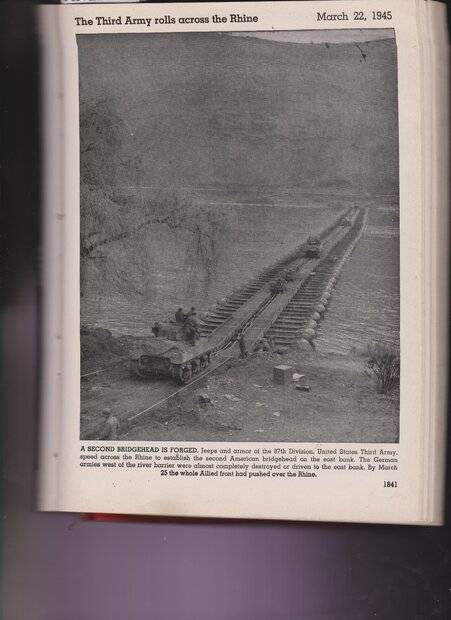
In a very short time, the 3rd Army found and occupied the huge training camp (18,000 acres).
However, the aerial reconnaissance never identified it from the air. And Patton and the Allies were surely seeking it. A major Wehrmacht and Waffen SS infantry, artillery, and armor training camp.
It is in a dense, tall tree, forested area, a rough, beautiful place of 'Wild Spots', in translation. Inclement weather and cold winters. Entire camp still completely intact, though, thankfully, and still in use today as a training camp for military exercises. Very well built in 1937. In northern Bavaria on the border with Hesse. Beautiful area of Germany.
http://www.campwildflecken.heinzleitsch.de/us-army/wta_history.htm
http://www.campwildflecken.heinzleitsch.de/truppenlager/en-beginn.htm
https://www.abebooks.com/servlet/SearchResults?kn=wise: pictorial history of the second world war&sts=t&cm_sp=SearchF-_-topnav-_-Results Volume IV.
"Due to the densely wooded vegetation and effective camouflage, WTA was never discovered by allied aerial reconnaisance throughout the War. German military training terminated before 6 April 1945, when elements of the Third U.S. Army occupied the area. After a short fight against the retreating germans, units of the 14th Armor Division and the 3rd Infantry Division gained control of the vast insallation."
"To make the camp as invisible as possible, all buildings were placed inside the already existing woods. Every tree to be cut down needed a special permision. This natural camoflage saved Camp Wildflecken from bombing up to the war's end."
March 22, 1945: Patton's 3rd Army, 5th Division, crossed the Rhine at Oppenheim at night.
April 6: 3rd Army occupies Wildflecken and Camp Wildflecken. 174km (108 miles) distant.
In a very short time, the 3rd Army found and occupied the huge training camp (18,000 acres).
However, the aerial reconnaissance never identified it from the air. And Patton and the Allies were surely seeking it. A major Wehrmacht and Waffen SS infantry, artillery, and armor training camp.
It is in a dense, tall tree, forested area, a rough, beautiful place of 'Wild Spots', in translation. Inclement weather and cold winters. Entire camp still completely intact, though, thankfully, and still in use today as a training camp for military exercises. Very well built in 1937. In northern Bavaria on the border with Hesse. Beautiful area of Germany.
http://www.campwildflecken.heinzleitsch.de/us-army/wta_history.htm
http://www.campwildflecken.heinzleitsch.de/truppenlager/en-beginn.htm
https://www.abebooks.com/servlet/SearchResults?kn=wise: pictorial history of the second world war&sts=t&cm_sp=SearchF-_-topnav-_-Results Volume IV.
Last edited:
difalcojr
- 459
- 352
Here's some B/W photos from Wise's "Pictorial History of the Second World War" which I just discovered. On the early rockets. From Vols. 3 & 4. Wartime photos, large scale, one or two per page, original books are strongly bound with quality paper. Not sure of more recent paperback copies. Still available online. 90%+ photos, chronological, amazing, realistic views of the operations and horrors of war.Drakkith said:The Allies were at least roughly equal to Germany technologically in almost every category except rocketry.
There's really no clear area where Germany leads throughout the war except rocketry. If anyone has one they think Germany leads in, please let me know.
Thank you @Borg for the almanac recommendation too.
Science Advisor
2025 Award
- 17,271
- 10,735
There is physics in the defence.
I quote a first-hand account, extracted from The Secret War, 1978, BBC.
"Wing Commander Roland Beamont flew Hawker Tempests, the fastest piston-engined RAF fighter of the day, against the V1:
‘For the first few days it was rather interesting because none of us knew exactly what was going to happen; they were bombs, after all, and they were expected to blow up. We first of all started opening fire on them from about 400 yards, for safety, from astern; they were a tiny target and we used to miss them rather consistently, and so we halved the range to about 200 yards. When you fired at that range and the thing exploded in front of you, you were travelling at 400 mph or more and you’d have no time to avoid the explosion, and as soon as you saw it you were in it and you’d go through the centre of the fire ball and come out the other side and always come out upside down. It was some time before we could figure this one out but you were in fact going through a partial vacuum as you went through the centre of the explosion. In a partial vacuum the torque of this enormous propeller had the effect of twisting the aeroplane over. It was rather extraordinary. The only adverse effects were fire damage to the outside of the aeroplane – the rudder and the elevator of the Tempest were fabric-covered and quite often this used to burn, and the other problem was that the pilots used to come back with a burn blister on their left arm. In the cockpit of the Tempest you had two air ventilators, one on either side, and the left-hand one was immediately over your left arm and in hot summer weather we were all flying in shirt-sleeves and the flame was coming through the ventilator and burning our arms, so we shut the ventilator,’"
I quote a first-hand account, extracted from The Secret War, 1978, BBC.
"Wing Commander Roland Beamont flew Hawker Tempests, the fastest piston-engined RAF fighter of the day, against the V1:
‘For the first few days it was rather interesting because none of us knew exactly what was going to happen; they were bombs, after all, and they were expected to blow up. We first of all started opening fire on them from about 400 yards, for safety, from astern; they were a tiny target and we used to miss them rather consistently, and so we halved the range to about 200 yards. When you fired at that range and the thing exploded in front of you, you were travelling at 400 mph or more and you’d have no time to avoid the explosion, and as soon as you saw it you were in it and you’d go through the centre of the fire ball and come out the other side and always come out upside down. It was some time before we could figure this one out but you were in fact going through a partial vacuum as you went through the centre of the explosion. In a partial vacuum the torque of this enormous propeller had the effect of twisting the aeroplane over. It was rather extraordinary. The only adverse effects were fire damage to the outside of the aeroplane – the rudder and the elevator of the Tempest were fabric-covered and quite often this used to burn, and the other problem was that the pilots used to come back with a burn blister on their left arm. In the cockpit of the Tempest you had two air ventilators, one on either side, and the left-hand one was immediately over your left arm and in hot summer weather we were all flying in shirt-sleeves and the flame was coming through the ventilator and burning our arms, so we shut the ventilator,’"
difalcojr
- 459
- 352
(Found this that Patton wrote to his Third Army day after the war in Europe ended. I'll copy it here. Can't get a good scan.)
HEADQUARTERS
THIRD UNITED STATES ARMY
APO 403
............................................................................................................................................................................9 May 1945
GENERAL ORDERS - NUMBER 98
Soldiers of the Third Army, Past, and Present
During the 281 days of incessant and victorious combat, your penetrations have advanced farther in less time than any other army in history. You have fought your way across 24 major rivers and innumerable lesser streams. You have liberated or conquered more than 82,000 square miles of territory, including 1,500 cities and towns, and some 12,000 inhabited places. Prior to the termination of active hostilities, you had captured in battle 956,000 enemy soldiers and killed wounded at least 500,000 others. France, Belgium, Luxembourg, Germany, Austria, and Czechoslovakia bear witness to your exploits.
All men and women of the six corps and thirty-nine divisions that have at different times been members of this Army have done their duty. Each deserves credit. The enduring valor of the combat troops has been paralleled and made possible by the often unpublicized activities of the supply, administrative, and medical services of this army and of the Communications Zone troops supporting it. Nor should we forget our comrades of the other armies and of the air force, particularly of the XIX Tactical Air Command, by whose side or under whose wings we have had the honor to fight.
In proudly contemplating our achievements, let us never forget our heroic dead whose graves mark the course of our victorious advances, nor our wounded whose sacrifices aided so much to our success.
I should be both ungrateful and wanting in candor if I failed to acknowledge the debt we owe to our Chiefs of Staff, Gererals Gaffey and Gay, and to the officers and men of the General and Special Staff Sections of army headquarters. Without their loyalty, intelligence, and unremitting labors, success would have been impossible.
The termination of fighting in Europe does not remove the opportunities for other outstanding and equally difficult achievements in the days which are to come. In some ways the immediate future will demand of you more fortitude than has the past because, without the inspiration of combat, you must maintain-by your dress, deportment, and efficiency-not only the prestige of the Third Army but also the honor of the United States. I have complete confidence that you will not fail.
During the course of this war I have received promotions and decorations far above and beyond my individual merit. You won them; I as your representative wear them. The one honor which is mine and mine alone is that of having commanded such an incomparable group of Americans, the record of whose fortitude, audacity, and valor will endure as long as history lasts.
........................................................................................................................................................G. S. Patton, Jr.,
....................................................................................................................................................................General
HEADQUARTERS
THIRD UNITED STATES ARMY
APO 403
............................................................................................................................................................................9 May 1945
GENERAL ORDERS - NUMBER 98
Soldiers of the Third Army, Past, and Present
During the 281 days of incessant and victorious combat, your penetrations have advanced farther in less time than any other army in history. You have fought your way across 24 major rivers and innumerable lesser streams. You have liberated or conquered more than 82,000 square miles of territory, including 1,500 cities and towns, and some 12,000 inhabited places. Prior to the termination of active hostilities, you had captured in battle 956,000 enemy soldiers and killed wounded at least 500,000 others. France, Belgium, Luxembourg, Germany, Austria, and Czechoslovakia bear witness to your exploits.
All men and women of the six corps and thirty-nine divisions that have at different times been members of this Army have done their duty. Each deserves credit. The enduring valor of the combat troops has been paralleled and made possible by the often unpublicized activities of the supply, administrative, and medical services of this army and of the Communications Zone troops supporting it. Nor should we forget our comrades of the other armies and of the air force, particularly of the XIX Tactical Air Command, by whose side or under whose wings we have had the honor to fight.
In proudly contemplating our achievements, let us never forget our heroic dead whose graves mark the course of our victorious advances, nor our wounded whose sacrifices aided so much to our success.
I should be both ungrateful and wanting in candor if I failed to acknowledge the debt we owe to our Chiefs of Staff, Gererals Gaffey and Gay, and to the officers and men of the General and Special Staff Sections of army headquarters. Without their loyalty, intelligence, and unremitting labors, success would have been impossible.
The termination of fighting in Europe does not remove the opportunities for other outstanding and equally difficult achievements in the days which are to come. In some ways the immediate future will demand of you more fortitude than has the past because, without the inspiration of combat, you must maintain-by your dress, deportment, and efficiency-not only the prestige of the Third Army but also the honor of the United States. I have complete confidence that you will not fail.
During the course of this war I have received promotions and decorations far above and beyond my individual merit. You won them; I as your representative wear them. The one honor which is mine and mine alone is that of having commanded such an incomparable group of Americans, the record of whose fortitude, audacity, and valor will endure as long as history lasts.
........................................................................................................................................................G. S. Patton, Jr.,
....................................................................................................................................................................General
difalcojr
- 459
- 352
Found a 'popular audience' diagram of the V1. Looks like the wings were used as the fuel tank?!Baluncore said:"Wing Commander Roland Beamont flew Hawker Tempests, the fastest piston-engine RAF fighter of the day, against the V1:
‘For the first few days it was rather interesting because none of us knew exactly what was going to happen; they were bombs, after all, and they were expected to blow up. We first of all started opening fire on them from about 400 yards, for safety, from astern; they were a tiny target and we used to miss them rather consistently, and so we halved the range to about 200 yards. When you fired at that range and the thing exploded in front of you, you were travelling at 400 mph or more and you’d have no time to avoid the explosion, and as soon as you saw it you were in it and you’d go through the centre of the fire ball and come out the other side and always come out upside down. It was some time before we could figure this one out but you were in fact going through a partial vacuum as you went through the centre of the explosion. In a partial vacuum the torque of this enormous propeller had the effect of twisting the aeroplane over. It was rather extraordinary.
And a 'popular audience' diagram of the V2:
Other rocket developments in WWII:
And why I hate war. Peace, not war, for freedom.
difalcojr
- 459
- 352
I learn something new every day in PF, even fundamental stuff. Thanks. 'Gas station' bombs, no wonder the explosions were so violent. I wonder if the Japanese suicide bombers in the Pacific loaded up their aircraft with extra petrol for more explosive power too? i don't think I ever heard of that. What a world!
Mentor
- 23,212
- 7,701
You bet they did. They commonly loaded their planes with bombs and extra gasoline tanks to maximize the destruction. Though the gasoline is less explosive and more "coat everything within 20 yards of the impact with burning fuel".difalcojr said:. I wonder if the Japanese suicide bombers in the Pacific loaded up their aircraft with extra petrol for more explosive power too?
Science Advisor
2025 Award
- 17,271
- 10,735
That is the case because it is the lift from the wing that must support the fuel tanks in flight. By placing the tanks in the wings, the total fuel load can be increased without having to increase the spar structure in the wing roots.Drakkith said:Indeed. It was and is quite common for the hollow spaces of the wings to be used as fuel tanks in aircraft of all sorts.
The undercarriage can then be mounted from the wing structure, so the heavy wing tanks are supported prior to and during takeoff.
Takeoff is fuelled from centre tanks in the fuselage, that will not unbalance the mass distribution at a critical time during the initial climb.
Multi-engine aircraft benefit from having fuel available close to the engines in the wings. That reduces the cross-flow of fuel through the aircraft.
Science Advisor
2025 Award
- 17,271
- 10,735
The petrol bomb has become the 'Fuel Air Explosive'. The initial impact and explosion is designed to disperse and mix the fuel with air, without ignition of the fuel. A second charge is then ignited to initiate combustion of the approximately stoichiometric air-fuel mix that may have been drawn into cavities and ventilation systems. Following the AFE pressure wave, there is a partial vacuum that adds to the destruction, hence the parallel term 'vacuum bomb'. That is the mechanism used in today's thermobaric weapons.
https://en.wikipedia.org/wiki/Thermobaric_weapon
https://en.wikipedia.org/wiki/Thermobaric_weapon
difalcojr
- 459
- 352
Memorial Day today in U.S. A photo from WWII in Europe, returning those to ship.

DennisN
Gold Member
- 2,199
- 10,339
Regarding World War 1 I recently heard about a weird, crazy tank design that never made it to the frontline. I hereby give you: the Tsar Tank.Drakkith said:Four years ago, the youtube channel The Great War started producing weekly videos detailing the events of World War 1,
Looking like a plough with wheels measuring 9 meters in diameter, it may not have been effective in combat, but maybe it would have stunned the enemy into utter confusion.

Swamp Thing
- 1,076
- 848
Patrolling the Ether in WW2...
sbrothy
Gold Member
- 1,984
- 1,565
I can recommend the Sleepwalkers as well. It provides a great perspective of the events leading up to the actual war.mathwonk said:I know little of the actual brutal events of WW1, but I felt greatly enlightened by, and enjoyed, the fine book The Sleepwalkers, by Christopher Clark, explaining in great detail the many deviously plotted, some accidental, and tragically foolish sequences of events, i.e. treachery, deception, arrogance, intransigent nationalism and stupidity, that led up to that war.
Swamp Thing
- 1,076
- 848
Why were Polish pilots so bad@ss in the Battle of Britain?
Swamp Thing
- 1,076
- 848
The Glücksberg Heist, Part 1
Last edited:
Staff Emeritus
Science Advisor
Gold Member
2025 Award
- 22,720
- 7,820
Apparently, the Polish Air Force was small compared to those of other nations like Germany, France and England, and the Polish Air Force selected the best pilots for further training; one group became known in France as the Polish Fighter Squadron of Warsaw. Plus, they were highly motivated following the invasion of Poland and escape from Europe via France to England, where they formed the 303 fighter group at Northolt. I do not know how many separate groups there were in France, or how many formed the 303.Swamp Thing said:Why were Polish pilots so bad@ss in the Battle of Britain?
https://en.wikipedia.org/wiki/RAF_Northolt
https://en.wikipedia.org/wiki/No._303_Squadron_RAF
Disclaimer: I have not independently verified the contents of the articles or video.
Hornbein
Gold Member
- 4,286
- 3,425
Astronuc said:Apparently, the Polish Air Force was small compared to those of other nations like Germany, France and England, and the Polish Air Force selected the best pilots for further training; one group became known in France as the Polish Fighter Squadron of Warsaw. Plus, they were highly motivated following the invasion of Poland and escape from Europe via France to England, where they formed the 303 fighter group at Northolt. I do not know how many separate groups there were in France, or how many formed the 303.
https://en.wikipedia.org/wiki/RAF_Northolt
https://en.wikipedia.org/wiki/No._303_Squadron_RAF
Disclaimer: I have not independently verified the contents of the articles or video.
They taught the UK that a fighter plane is an attack dog. You've got to close with the enemy. Snipeing won't do.
Swamp Thing
- 1,076
- 848
Similar threads
- Dissident Dan
- · Replies 3 ·
- General Discussion
- Replies
- 3
- SOS2008
- · Replies 65 ·
- General Discussion
- Replies
- 65