Formation of Substitution Product from 1-Bromo-2,6-Dimethylcyclohexane

Click For Summary
SUMMARY

The discussion centers on the formation of a substitution product from 1-bromo-2,6-dimethylcyclohexane when treated with sodium methoxide, confirming that only an SN2 reaction occurs. Sodium methoxide acts as a strong nucleophile but is not a strong base, which explains the absence of elimination products. The secondary structure of the compound and the stability of sodium methoxide in polar solvents further support the preference for substitution over elimination. The stereochemical implications of the SN2 mechanism are also highlighted as crucial to understanding the product formation.

PREREQUISITES
  • Understanding of SN2 reaction mechanisms
  • Knowledge of nucleophiles and bases in organic chemistry
  • Familiarity with the concept of chair conformers
  • Basic principles of stereochemistry
NEXT STEPS
  • Study the mechanism of SN2 reactions in detail
  • Research the properties of sodium methoxide as a nucleophile
  • Learn about chair conformers and their stability in cyclohexane derivatives
  • Explore the relationship between pKa values and nucleophilicity
USEFUL FOR

Chemistry students, organic chemists, and educators focusing on reaction mechanisms and stereochemistry in substitution reactions.

chiyakotiten
Messages
3
Reaction score
0
Only a substitution product is obtained when the compound below is treated with sodium methoxide. Draw the substitution product and explain why an elimination product is not obtained
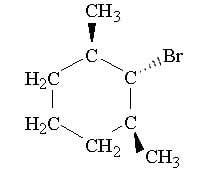
1zlvg9h.jpg


(If the image doesn't show up, the compound is 1-bromo-2,6-dimethylcyclohexane)

Homework Equations


- The compound is a secondary structure
- It is going to be an SN2 reaction(?)
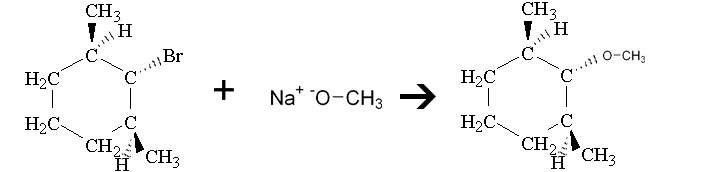
The Attempt at a Solution


2qlvdj6.jpg


Is it because sodium methoxide is a weak base, but a good nucleophile which favors SN2 reactions?
 
Physics news on Phys.org
Sodium methoxide is a strong base which favours SN2.
Your product for SN2 is wrong. The nucleophile attacks from the rear end of the leaving group.
Regarding elimination -
Hint: What is the requirement for elimination? Is the hydrogen easily available for abstraction? Does it require high energy transition state?
 
Edit: Sodium methoxide is not a strong base...just stable.
 
Sodium Methoxide is stable because its a salt, as soon as you have a polar solvent involved you get sodium cation plus a methoxide anion. Alkoxides are fairly strong bases. pKa of alcohols are ~15.5-16.

To the OP. For a hint at why elimination won't happen, draw the most stable chair conformer of the reactant and you will see the answer.

And as far as the products of your substitution reaction go, remember what happens to stereochemistry as you go through SN1 or SN2 mechanisms.
 

Similar threads

Replies
5
Views
4K
  • · Replies 2 ·
Replies
2
Views
3K
  • · Replies 2 ·
Replies
2
Views
4K
  • · Replies 28 ·
Replies
28
Views
5K
Replies
1
Views
3K
  • · Replies 2 ·
Replies
2
Views
10K
  • · Replies 1 ·
Replies
1
Views
2K
  • · Replies 2 ·
Replies
2
Views
6K
  • · Replies 3 ·
Replies
3
Views
21K
  • · Replies 4 ·
Replies
4
Views
5K