Formula for Evaporative Cooloer (Swamp cooler)

  • Context: Undergrad 
  • Thread starter Thread starter Rose Gardener
  • Start date Start date
  • Tags Tags
    Cooler Formula
Click For Summary
SUMMARY

The discussion focuses on using evaporative coolers, specifically in the context of growing cool weather vegetables like lettuce in hot, dry climates. The user seeks a formula to calculate the temperature drop achieved by swamp coolers, referencing data from Weather Underground and TMY3 data from NREL. The concept of wet bulb temperature is highlighted as crucial for understanding the efficiency of evaporative coolers, which typically operate at about 75% effectiveness, meaning they can reduce air temperature significantly but not perfectly match the wet bulb temperature.

PREREQUISITES
  • Understanding of wet bulb temperature and its significance in thermodynamics
  • Familiarity with evaporative cooler mechanics and efficiency ratings
  • Proficiency in data analysis using spreadsheets
  • Knowledge of TMY3 data and its application in climate analysis
NEXT STEPS
  • Research the calculation methods for wet bulb temperature and its application in HVAC systems
  • Explore the effectiveness ratings of various evaporative cooler models
  • Learn how to analyze TMY3 data for specific climate conditions
  • Investigate best practices for using spreadsheets to analyze meteorological data
USEFUL FOR

Gardeners, agricultural engineers, HVAC professionals, and anyone interested in optimizing temperature control in dry climates using evaporative cooling technology.

Rose Gardener
Messages
8
Reaction score
1
I am trying to figure out if I could grow cool weather vegetable (say lettuce) in hot but dry climate by using swamp cooler to lower the temp of shade house. I have downloaded daily temp and humidity from www.weatherunderground.com and a chart on the potential temp drop:
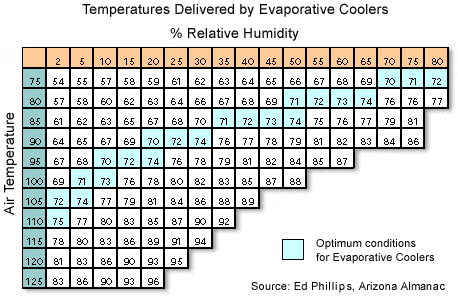
evap_chart3.gif

The thing is that I have 3 years of data from weatherunderground on a spreadsheet, doing manual matching of data is laborious.

Does anyone know the formula behind the above chart? I think that chart assumed the airflow is perfectly matched to the room size.

Thanks for helping.
 
Science news on Phys.org
So, what data does Weather Underground give you...and by the way, where exactly did you get it, because I've only seen month-to-month spreadsheets on their website?

I use TMY3 data from NREL:
http://rredc.nrel.gov/solar/old_data/nsrdb/1991-2005/tmy3/by_state_and_city.html

TMY stands for "typical meteorological year" - it's really what you want; what is typical, not just what the last 3 years were like.

Now, as it turns out, the calculation you are asking about is pretty involved and I haven't even found a good calculation for it, even though I would use it every day if I had one (I use a chart). But there are other ways to do this...

First, why are you trying to analyze 3 years' worth of data. Don't you really want a worst-case?

Evaporative coolers work by exchanging energy between sensible (what a thermometer reads) and latent (energy from evaporating water) heat. There is a measure that combines the two to find the total energy of the air. It's called "wet bulb" temperature and as you might expect, it is very similar to what an evaporative cooler does: it puts a wet "sock" on the bulb of a thermometer and finds the resulting temperature due to evaporation.

A good, professional weather site lists the wet bulb temperature. TMY3 data includes it -- not sure if weatherunderground does. But all you need to do - with either - is put the data into a spreadsheet and sort by wet bulb temperature. The highest wet bulb temperature you see is, thermodynamically, the hottest day of the year.

Now, an evaporative cooler is probably rated to come close to providing air at the wet bulb temperature, but not exactly, since it isn't perfectly efficient/effective. It looks to me like they assume 75% effectiveness, which means you get 75% of the way from the dry bulb to the wet bulb temperature. Meaning, if the dry bulb is 90 and the wet bulb is 50, you'd get 60F off your evaporative cooler (3/4 of the 40F difference).

I think the chart assumed the airflow is perfectly matched to the room size.
No, all it says is what the temperature of the air out of the evaporative cooler is: it doesn't say what that can do for a room.
 

Similar threads

  • · Replies 32 ·
2
Replies
32
Views
4K
  • · Replies 4 ·
Replies
4
Views
2K