Formula of Average Magnetic B Field Strength of Large Conductor

Click For Summary
SUMMARY

The discussion focuses on calculating the magnetic B field strength at a distance from a large conductor, specifically using Ampere's Law. Participants emphasize the complexity of determining the magnetic field strength for arbitrarily shaped magnets and suggest methods such as summing magnetic dipoles. The conversation also highlights the need for a formula that accommodates various types of permanent magnets, including N35 and N52 grades, and considers the effects of motion and rotation on the magnetic field strength.

PREREQUISITES
  • Ampere's Law
  • Magnetic dipole theory
  • Understanding of permanent magnet grades (N35, N52)
  • Basic electromagnetism concepts
NEXT STEPS
  • Research the application of Ampere's Law in calculating magnetic fields
  • Explore methods for summing magnetic dipoles in complex geometries
  • Learn about the effects of motion on magnetic field strength
  • Investigate the properties and applications of different grades of permanent magnets
USEFUL FOR

Engineers, physicists, and students involved in electromagnetism, particularly those interested in calculating magnetic fields from large conductors and permanent magnets.

benofer90
Messages
64
Reaction score
1
Any one knows how to calculate the magnetic B field strength at a distance from a Large Conductor ? Do we go by average ?

thanks
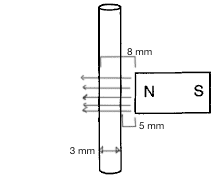
Image006.png
 
Physics news on Phys.org
benofer90 said:
Any one knows how to calculate the magnetic B field strength at a distance from a Large Conductor ? Do we go by average ?

thanks

Image006.png

Use Ampere's Law:

http://wikipremed.com/01physicscards600/371a.gif
371a.gif
 
Oh, and d is the distance from the center of the wire.
 
berkeman said:
Oh, and d is the distance from the center of the wire.

I do believe he means the magnetic field strength due to the perm. magnet.

In general, for an arbitrarily shaped magnet, this is difficult. One method would be to add up the magnetic dipoles over the volume, although I don't believe the value is given in a materials data sheet.
 
  • Like
Likes   Reactions: benofer90
stedwards said:
I do believe he means the magnetic field strength due to the perm. magnet.

In general, for an arbitrarily shaped magnet, this is difficult. One method would be to add up the magnetic dipoles over the volume, although I don't believe the value is given in a materials data sheet.

Yes tou are right . I am going to calculate the EMF(v) later as the magnet will be in motion at the same distance as the above drawing .
He magnet will be N35 or N52 but it can be of any force the formula should be able to handle any type,of magnet and it T strength . The magnet will be a ring and it will rotate on its axis at some kind of rpm . But still this things shouldn't effect the formula . Any per idea ?
 
Last edited by a moderator:
benofer90 said:
Yes you are right . I am going to calculate the EMF(v) later as the magnet in motion at the some distance as the above drawing .

The magnet will be N35 or N52 but it can be of any force. The formula I am seeking should be able to handle any type of magnet and its T strength.

The magnet will be a ring and it will rotate on its axis at some kind of RPM . But still these things should not effect the formula .

any thoughts of how to calculate?
 

Similar threads

  • · Replies 7 ·
Replies
7
Views
1K
  • · Replies 7 ·
Replies
7
Views
4K
  • · Replies 41 ·
2
Replies
41
Views
6K
  • · Replies 1 ·
Replies
1
Views
2K
  • · Replies 3 ·
Replies
3
Views
981
  • · Replies 5 ·
Replies
5
Views
657
  • · Replies 1 ·
Replies
1
Views
1K
  • · Replies 198 ·
7
Replies
198
Views
15K
  • · Replies 14 ·
Replies
14
Views
2K
  • · Replies 7 ·
Replies
7
Views
2K