Free Groups - Dmmit & Fooote - Section 6.3

  • Context: Undergrad 
  • Thread starter Thread starter Math Amateur
  • Start date Start date
  • Tags Tags
    Groups Section
Click For Summary

Discussion Overview

The discussion centers on the nature and properties of free groups as presented in Section 6.3 of Dummit and Foote's Abstract Algebra. Participants explore the implications of the definition of free groups, particularly regarding the absence of relations among the generators and the construction of free groups.

Discussion Character

  • Exploratory
  • Technical explanation
  • Debate/contested

Main Points Raised

  • Peter questions the lack of a rigorous proof regarding the absence of relations satisfied by the elements of the generating set S in free groups.
  • Some participants assert that the absence of relations is a given and cannot be proven, exemplified by the inability to simplify certain words like abc-1b-1a.
  • Another participant suggests that elements of S are treated as abstract symbols without intrinsic meaning, emphasizing that simplifications are only made under specific conditions.
  • A participant explains that in any group, products of elements may represent the same element, which defines relations, and that a free group is characterized by having a trivial subgroup of relations.
  • One participant highlights the "mapping property" of free groups, stating that every function from S to any group G extends to a group homomorphism from F(S) to G, implying no non-trivial relations among elements of S.
  • Another participant critiques the imprecision of Dummit and Foote's statement about "no relations," arguing that while there are relations imposed by group axioms, there are no non-trivial relations in the context of free groups.
  • A participant mentions the challenge of proving associativity in the context of free groups and suggests that other texts may present the material more clearly.

Areas of Agreement / Disagreement

The discussion reveals multiple competing views regarding the nature of relations in free groups and the clarity of Dummit and Foote's presentation. There is no consensus on the interpretation of the absence of relations or the adequacy of the proofs provided in the text.

Contextual Notes

Participants express varying levels of understanding and interpretation of the definitions and properties of free groups, indicating potential limitations in the clarity of the original text and the assumptions made about the nature of relations.

Math Amateur
Gold Member
MHB
Messages
3,920
Reaction score
48
I am reading Dummit and Foote's book: Abstract Algebra ... ... and am currently focused on Section 6.3 A Word on Free Groups ...

I have a basic question regarding the nature and character of free groups ...

Dummit and Foote's introduction to free groups reads as follows:
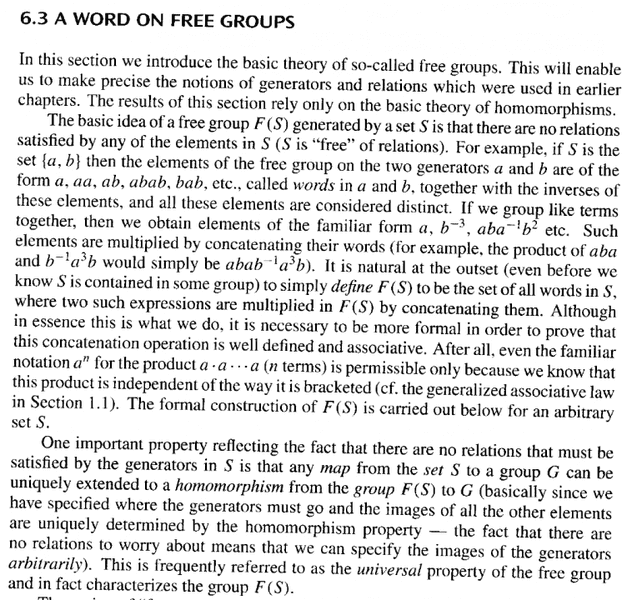
?temp_hash=15af753795a4bb3d9a7cc79e8ab52d08.png

In the above text, Dummit and Foote write the following:

" ... ... The basic idea of a free group ##F(S)## generated by a set ##S## is that there are no satisfied by any of the elements in ##S## (##S## is "free"of relations.) ... ... "Dummit and Foote then show how to construct ##F(S)## as the set of all words (together with inverses) ... but they do not seem to prove that given that ##F(S)## contains all words in ##S## there are no relations satisfied by any of the elements in ##S## ... ...

Is the lack of a rigorous proof because the lack of any such relations is obvious ... ?

Can someone please help clarify this situation ...?

Peter
 

Attachments

  • D&F - Introduction to Free Groups.PNG
    D&F - Introduction to Free Groups.PNG
    78.8 KB · Views: 719
Physics news on Phys.org
That there is no relation satisfied by the elements of S is a given, it can't be proved.
It means that a word like abc-1b-1a can't be simplified (assuming a, b, c stand for different elements of S).
 
  • Like
Likes   Reactions: Math Amateur
Samy_A said:
That there is no relation satisfied by the elements of S is a given, it can't be proved.
It means that a word like abc-1b-1a can't be simplified (assuming a, b, c stand for different elements of S).
Thanks for the help Samy ...

I must say that I am a little surprised the D&F assert something (which does not have the status of an axiom) as true ... but it cannot be proven ...

Peter
 
You seem to be overthinking this. :oldsmile:

They simply mean that the elements of S are to be treated as abstract symbols, without any intrinsic meaning. That's why a word like ##abc^{-1}b^{-1}## is just that.
The only simplification (or reduction) you have to make to get a well defined free group is reducing a word like ##acc^{-1}b^{-1}## as follows: ##acc^{-1}b^{-1}=ab^{-1}##.
 
Last edited:
  • Like
Likes   Reactions: Math Amateur
Given any group, any product ##g^{k_{1}}_{1}...g^{k_{n}}_{n}## of its elements determines some other element of the group. .

In an arbitrary group, not all such products represent different elements. For instance in an abelian group ##a^{n}b^{m}## is the same as ##b^{m}a^{n}##. When two different products or "words" represent the same element of the group, this is called a relation. A relation can always be expressed as a product word that equals the identity. For instance for the abelian group ##b^{m}a^{n}b^{-m}a^{-n}## is a relation.

As Sammy_A pointed out one excludes from the definition of relation trivial expressions that are true for all groups.

So abtractly one can think of a group as the group of all finite length words ##g^{k_{1}}_{1}...g^{k_{n}}_{n}## modulo the normal subgroup of its relations.

If the subgroup of relations is trivial, then the group is just all finite length words with multiplication given by concatenation of words. This is called a free group.
 
Last edited:
  • Like
Likes   Reactions: Math Amateur
the essential property of a free group F(S) on the set S, is its "mapping property", the fact that every function from S to any group G extends to a group homomorphism from F(S) to G. If you prove that, it is equivalent to saying there are no non trivial relations among the elements of S. I presume they do prove that.

actually the statement you reference above from DF about "no relations" is a bit imprecise. indeed as pointed out here there are relations, but they are the ones imposed by the group axioms. a relation is simply given by two different words that are equal. by definition such pairs are given by "reducing" one word to another. so a more correct statement would be that there are no "non trivial" relations, in the sense that no two reduced words are equal. but this is true by definition of F(S) since DF define F(S) to be the set of all reduced words.

so the hard part of their approach is proving associativity, since by definition, the product of two reduced words is the reduction of their concatenation. and if you have three words, there are two orders in which to concatenate them, i.e. you must show that Red(Red(AB).C) = Red(A.Red(BC)).

I think Mike Artin makes it much clearer in his book Algebra, by simply proving that each word has a unique reduced form, no matter what order you reduce it in. Then since concatenation of words is obviously associative, you get associativity of reduced words as well. I think others have said essentially the same thing above. The treatment in DF is so hard to read my eyes just blur looking at it.
 
Last edited:
  • Like
Likes   Reactions: Math Amateur
Samy, Lavinia, mathwonk ... ...

Thanks so much for your help ...

I now have a much better understanding of what is happening regarding free groups ...

Am still reflecting on what you have written ...

Peter
 
They're giving away free groups! :).
 
  • Like
Likes   Reactions: Math Amateur and Samy_A
WWGD said:
They're giving away free groups! :).
Yeah but you can't commute there to get them.
 
  • Like
Likes   Reactions: Math Amateur, jim mcnamara, WWGD and 1 other person

Similar threads

  • · Replies 2 ·
Replies
2
Views
2K
  • · Replies 4 ·
Replies
4
Views
2K
Replies
1
Views
1K
Replies
2
Views
2K
  • · Replies 4 ·
Replies
4
Views
2K
Replies
2
Views
2K
  • · Replies 2 ·
Replies
2
Views
2K
  • · Replies 1 ·
Replies
1
Views
2K
  • · Replies 1 ·
Replies
1
Views
1K
  • · Replies 2 ·
Replies
2
Views
2K