Fuchs-Sondheimer Resistivity model for Nanowires

Click For Summary

Discussion Overview

The discussion revolves around the Fuchs-Sondheimer resistivity model as applied to nanowires, specifically examining the relationship between resistivity and wire width. Participants explore calculations, interpretations of the original paper, and potential discrepancies in results.

Discussion Character

  • Technical explanation
  • Debate/contested
  • Mathematical reasoning

Main Points Raised

  • One participant calculated the Fuchs-Sondheimer model using Mathcad and found that resistivity increases with decreasing width, which they believe contradicts the model's predictions.
  • Another participant points out that the original paper explicitly states that resistivity increases as wire width decreases, suggesting that the first participant may have misunderstood the results.
  • A later reply clarifies that the participant's calculation actually indicates resistivity decreases with decreasing width, which is contrary to the model's prediction.
  • Some participants discuss the integration challenges faced in their calculations and the potential for errors in their results.
  • Questions arise regarding the interpretation of plots and the parameters used in calculations, with one participant seeking clarification on the meaning of certain ratios in their graphs.
  • There is a discussion about the choice of parameters in the calculations, particularly the value of p used to recreate plots from the original paper.
  • Concerns are raised about the appropriateness of certain assumptions made during calculations, particularly regarding the integration over azimuthal angles.

Areas of Agreement / Disagreement

Participants do not reach consensus; there are multiple competing views regarding the relationship between resistivity and wire width, with some asserting that resistivity increases while others suggest it decreases. The discussion remains unresolved with ongoing questions and calculations.

Contextual Notes

Some calculations are based on assumptions that may not be universally accepted, and there are unresolved mathematical steps that could affect the outcomes. The discussion also highlights the complexity of integrating over specific angles in the context of the model.

Avocado
Messages
6
Reaction score
0
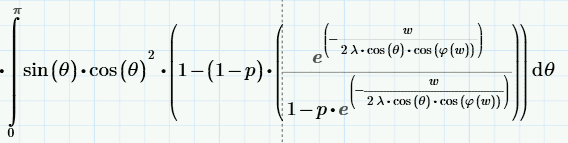
I calculated FS Model using Mathcad and I got that this part
upload_2019-1-11_19-41-34.png


increases with decreasing width $\w$.
This make the resistivity increases with decreasing width $\w$.
This contradict the result of this model.

Has anyone ever come across with this before?

the original paper: https://journals.aps.org/prb/abstract/10.1103/PhysRevB.61.14215
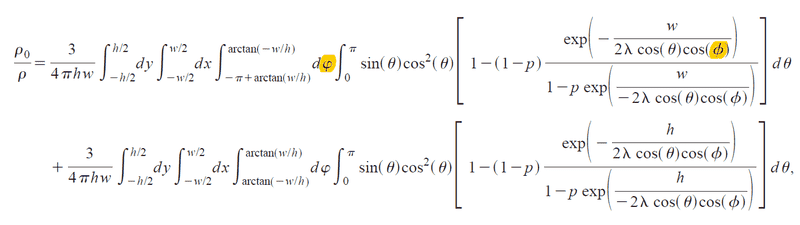
complete equation:
vat07.png
 

Attachments

  • upload_2019-1-11_19-41-34.png
    upload_2019-1-11_19-41-34.png
    5.1 KB · Views: 1,185
  • vat07.png
    vat07.png
    17.5 KB · Views: 1,072
Physics news on Phys.org
I don’t understand. The resistivity does increase with decreasing width. The paper you link to says this explicitly in the abstract:
The abstract said:
We find that the resistivity increases as wire width decreases in a manner which is dependent on the mean grain size and cannot be explained adequately by either model alone.
 
TeethWhitener said:
I don’t understand. The resistivity does increase with decreasing width. The paper you link to says this explicitly in the abstract:

yes, the paper does say so.

When I calculate it, the result is the opposite.

This term below,
upload_2019-1-11_19-41-34-png.png

increases with dicreasing width. This make the resistivity increases with decreasing width.

I calculated it with Mathcad.
The integration is difficult, so I cannot check it by hand calculation.
What I mean is, if there are some mistakes, the mistakes might be from that term.
 

Attachments

  • upload_2019-1-11_19-41-34-png.png
    upload_2019-1-11_19-41-34-png.png
    5.1 KB · Views: 780
I still don’t understand. You, the paper, and Mathcad all say the same thing: that resistivity increases with decreasing width. Where is the problem?
 
Apologize, what I meant is resistivity decreases with decreasing width.
This is the opposite of the model prediction.

This term below,
upload_2019-1-11_19-41-34-png-png.png

increases with dicreasing width. This make the resistivity decreases with decreasing width.I finish calculating it with MATLAB to double check.
It shows the same with the Mathcad calculation.
Small width has smaller resistivity.

upload_2019-1-12_16-27-3.png
 

Attachments

  • upload_2019-1-12_16-27-3.png
    upload_2019-1-12_16-27-3.png
    25.4 KB · Views: 778
  • upload_2019-1-11_19-41-34-png-png.png
    upload_2019-1-11_19-41-34-png-png.png
    5.1 KB · Views: 736
It's a bit dry to me. In your last screenshot, are the plots the ratio of ##\frac{\rho _0}{\rho}##? What is ##\rho _0##? I'm guessing it's the resistivity at a particular width. If that ratio goes to ##0## as ##w## goes to ##0## as you seem to show in your plots, then it would mean that the resistivity increases when ##w## decreases, which is inline with the paper. So there would be no problem.
 
fluidistic said:
It's a bit dry to me. In your last screenshot, are the plots the ratio of ##\frac{\rho _0}{\rho}##? What is ##\rho _0##? I'm guessing it's the resistivity at a particular width. If that ratio goes to ##0## as ##w## goes to ##0## as you seem to show in your plots, then it would mean that the resistivity increases when ##w## decreases, which is inline with the paper. So there would be no problem.

The plot is ##\rho(w)## vs. ##\w##.
##\rho _0## is the bulk resistivity, considered a constant.
 
Avocado said:
The plot is ##\rho(w)## vs. ##\w##.
##\rho _0## is the bulk resistivity, considered a constant.
I see, this is puzzling. Which value of p did you choose (1/2?).
 
fluidistic said:
I see, this is puzzling. Which value of p did you choose (1/2?).

Yes, I chose p=0.5 in order to recreate the plot on the paper.
 
  • #10
I am a bit puzzled and this is not a topic I am very knowledgeable about, but why are you allowed to set [itex]\phi=arctan\frac{w}{h}[/itex]?
Is this not supposed to be an integration over the whole azimuthal angle?
 
  • #11
Cthugha said:
I am a bit puzzled and this is not a topic I am very knowledgeable about, but why are you allowed to set [itex]\phi=arctan\frac{w}{h}[/itex]?
Is this not supposed to be an integration over the whole azimuthal angle?

Yes, you are right.
I am trying other formula now.
The calculation take long time though. Still not sure about the result.

medium?v=1.png
 

Attachments

  • medium?v=1.png
    medium?v=1.png
    23 KB · Views: 674

Similar threads

Replies
3
Views
4K
  • · Replies 5 ·
Replies
5
Views
561
  • · Replies 0 ·
Replies
0
Views
3K