SUMMARY
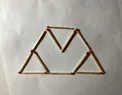
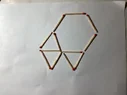
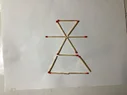
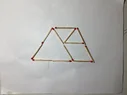
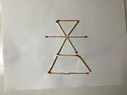
The discussion centers on a geometric puzzle from Pierre Berloquin's 1976 book "100 Geometric Games," involving rearranging exactly four matches out of twelve to form exactly three equilateral triangles without removing any matches. Participants debate the interpretation of key terms such as "exactly three equilateral triangles," "do not remove," and whether flipping or rotating matches counts as changing position. One proposed solution involves translating matches BC, DE, AF in specific directions and rotating EF by 180 degrees, adhering to the puzzle's conditions. The conversation highlights the importance of assumptions and clarity in puzzle wording, emphasizing that the puzzle is well-stated but open to subjective interpretation based on context and problem-solving sophistication.
PREREQUISITES
- Understanding of geometric constructions involving equilateral triangles
- Familiarity with matchstick puzzles and spatial reasoning
- Knowledge of geometric transformations: translation and rotation
- Ability to interpret puzzle constraints and logical problem-solving
NEXT STEPS
- Study Pierre Berloquin's "100 Geometric Games" for similar matchstick puzzles
- Explore geometric transformations in plane geometry, focusing on translation and rotation
- Analyze puzzle wording and assumptions in logic and problem-solving contexts
- Investigate other classic matchstick puzzles involving equilateral triangles and minimal moves
USEFUL FOR
Enthusiasts of geometric puzzles, educators designing spatial reasoning challenges, puzzle designers, and anyone interested in the nuances of problem interpretation and logical reasoning within matchstick and geometric games.