Gap in Joints of Large Steel Constructions

Join the discussion
Registration is free. Start your own thread to ask a follow-up.
2 replies · 2K views
JJ91
Messages
40
Reaction score
0
Hello,

I'm a very curious EPE student (electrical power engineer) who is trying to figure out why there are variable gaps between joints of large steel structures. Because of this gap the stress seems to be distributed with peak force at the intersection of the bottom plate, why is this beneficial?
- To add space for vibrations?
- Heat expansion effect?
- Easier to check-up for condition?
- To let the dirt flow-off?
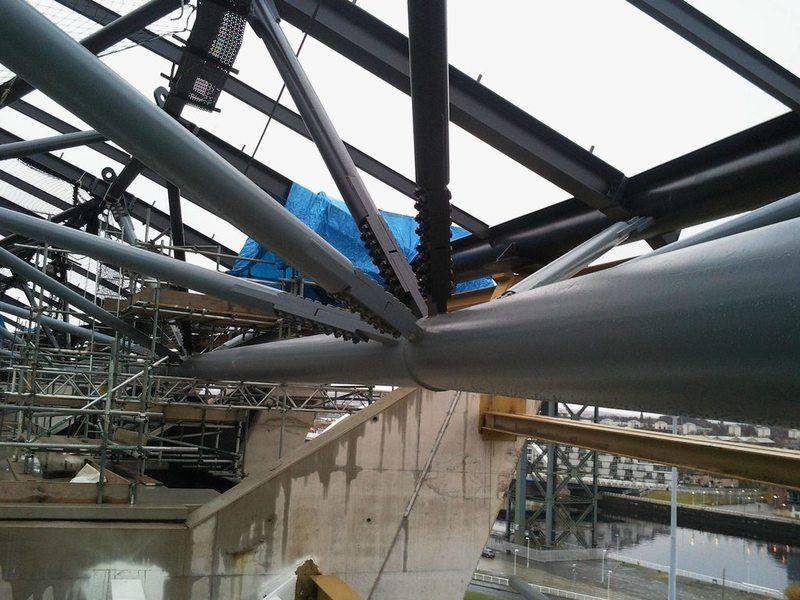
s6FakZHh.jpg


Thanks,
JJ
 
Physics news on Phys.org
I'm not educated in the field, but I can say that here in Canada things like bridges are build with large gaps to accommodate the thermal expansion that you mentioned. Most places any significant distance from the equator probably do the same thing. Alternating from 40° to -45° (yes, that happens here) over the course of a few months makes for some serious reconfiguration.
 
Yes there is that.

The way certain parts are assembled would necessarily dictate a tolerance gap so that the bolt holes can be lined up between mating parts. I seriously doubt that this structure, for instance, has a design tolerance of 0.001 inch which you might find in machined steel parts.

As for the load, if the design is such that the bolts and plates are adequate to transfer the the load from one member to the next, and are selected as such so that a direct abutment of members is not required, your design will not fail when you think there was an abutement when in reality there was not.

Even so, the way the design is set up, the round members could be in tension rather than compression, so abutement would serve no purpose.
 
Last edited: