Gearbox with single input, double output (at different RPM)

  • Thread starter Thread starter kunalv
  • Start date Start date
  • Tags Tags
    Gears
Click For Summary

Discussion Overview

The discussion revolves around the design of a gearbox that takes input from a DC gearmotor and provides two outputs at different RPMs. Participants explore various configurations and gear types to achieve the desired output speeds of 32 RPM and 460 RPM, while addressing challenges related to size, torque, and motor mounting.

Discussion Character

  • Exploratory
  • Technical explanation
  • Debate/contested
  • Mathematical reasoning

Main Points Raised

  • One participant suggests redesigning the gearbox to use smaller gears to reduce size and weight, while questioning the feasibility of mounting the input gearmotor at the top.
  • Another participant proposes replacing the existing input gear with a bevel gear to drive the vertical output shaft directly, raising concerns about acceptable speed ranges.
  • There is a discussion about the torque reduction when using a 46T bevel gear driving a 15T bevel gear, with some participants noting that while torque decreases, RPM increases, keeping power constant.
  • One participant questions the practicality of a horizontally mounted 450 RPM gearmotor transmitting power vertically while also providing a lower RPM output, suggesting the use of a two-stage reduction or worm gear as alternatives.
  • Concerns are raised about the increased height of the gearbox if the motor is mounted vertically, with a participant emphasizing the need for the input motor to be mounted horizontally.
  • Another participant challenges the complexity of the gearbox design, suggesting that simplifying the design could reduce height and complexity, and questions the necessity of having multiple gears versus using two separate gear motors.

Areas of Agreement / Disagreement

Participants express differing opinions on the design approach, with no consensus on the optimal configuration or the necessity of certain design constraints. Multiple competing views remain regarding gear types, motor placement, and overall design complexity.

Contextual Notes

Participants express uncertainty about the implications of gear ratios on torque and RPM, as well as the impact of motor orientation on gearbox height. There are unresolved questions about the feasibility of certain design choices and the overall efficiency of the proposed solutions.

Who May Find This Useful

Engineers and designers working on gearbox systems, hobbyists involved in mechanical design projects, and those interested in gear mechanics and motor configurations may find this discussion relevant.

kunalv
Messages
29
Reaction score
1
TL;DR
Designed & machined a gearbox with single input and double outputs at 90 degree to each other. Help needed with reducing the size
Hello,
For a trial project (can't give details on what the project is at the moment sorry!), I have designed a gearbox that takes input from a DC gearmotor at 150RPM, and provides 2 outputs as per the following:
1. 32rpm in the same axis as the input. This drives the pulleys and the belt
2. 460rpm at right angle (vertically down). This drives an impeller in the water
Please see the layout as per this
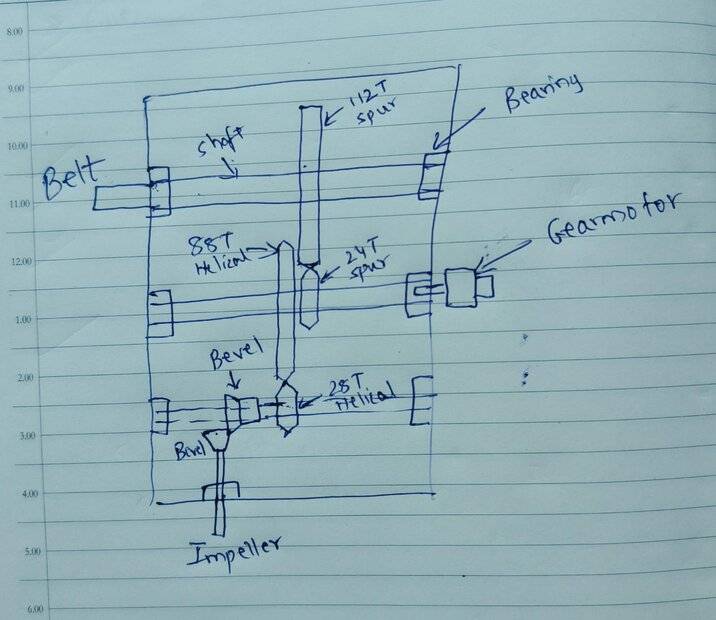
WhatsApp Image 2024-07-13 at 13.38.22.jpeg


The gearbox looks like this -

I have the following issues:
1. I have used 0.75 module gears, although I feel I can reduce the module and go for smaller gears. This will reduce the size of the gearbox & weight of the machine. Pls comment
2. Now the input gearmotor is connected to the 24Teeth Spur Gear in the middle of the gearbox. Can I re-design it to have the input gearmotor mounted near the top? See image below..
WhatsApp Image 2024-07-13 at 13.44.21.jpeg

The input gearmotor will be the 50RPM one at the top driving the 75 Teeth Spur gear in this layout. I am going to use PWM to vary the speed of both outputs.

Comments/Suggestions/Corrections are welcome please. Thank you!
 
  • Like
Likes   Reactions: DeBangis21
Engineering news on Phys.org
Are speeds important here?
What ranges are acceptable?

Replace the 150 RPM, 75T helical cut spur gear on the input shaft, with a 46T bevel gear. That 46T bevel, drives a 15 tooth bevel gear on the vertical output shaft, at 460 RPM.

Faster DC gear-motors are smaller and cheaper.
Mount a 460 RPM gear-motor at the top, driving the vertical output shaft directly. Reduce the main shaft through a bevel bear to drive the 32 RPM belt output.
 
  • Like
Likes   Reactions: DeBangis21 and Nik_2213
Sorry for the delay in my response, been busy with a lot of things and had to take some trials with the existing gearbox.

Speeds are important. Ranges acceptable are 40-60RPM and 400-500RPM.

Baluncore said:
Replace the 150 RPM, 75T helical cut spur gear on the input shaft, with a 46T bevel gear. That 46T bevel, drives a 15 tooth bevel gear on the vertical output shaft, at 460 RPM.
In my illustration, the input gearmotor of 50RPM is actually connected to the top gear i.e 75T helical which drives the 25T helical gear @150RPM. Another 75T Helical is mounted on this shaft which then drives another 25T helical @450RPM. Here the Bevel gears of 1:1 ratio are proposed to take the 450RPM drive to the Impeller on the vertical shaft.

Won't a 46T bevel driving a 15T bevel reduce the torque at the 15T bevel shaft?
Baluncore said:
Mount a 460 RPM gear-motor at the top, driving the vertical output shaft directly. Reduce the main shaft through a bevel bear to drive the 32 RPM belt output.
Not sure I understood this. Please help me out!
 
kunalv said:
Won't a 46T bevel driving a 15T bevel reduce the torque at the 15T bevel shaft?
Yes, it will reduce torque, but it will increase RPM, so power is the same.
I try to avoid situations where a gear train increases RPM, (and lube problems).

A higher RPM motor is a better investment.
Why gear down, then gear up again, when a direct drive, multi-pole AC motor, near 450 RPM, is available?
 
  • Like
Likes   Reactions: Lnewqban and russ_watters
Baluncore said:
Yes, it will reduce torque, but it will increase RPM, so power is the same.
I try to avoid situations where a gear train increases RPM, (and lube problems).

A higher RPM motor is a better investment.
Why gear down, then gear up again, when a direct drive, multi-pole AC motor, near 450 RPM, is available?
Yes but how will a horizontally mounted 450RPM gearmotor be able to transmit that 450 RPM vertically downwards (at right angle using bevel) AND give me 50 RPM in the same axis as the gearmotor? I thought about this but I am unable to think of a geartrain that will enable this.
For eg. I will connect a 1:1 bevel gear set to transmit the 450RPM at 90 degrees. But how will I get the 50RPM drive ?
I could connect a 1:9 spur/helical set to get the output, but I am afraid the driven gear here will be too large.
 
kunalv said:
Yes but how will a horizontally mounted 450RPM gearmotor be able to transmit that 450 RPM vertically downwards
The motor would be mounted, with axis vertical, where the top of the gearbox is in your original design. A vertical shaft directly drives the impeller below.

A bevel gear on that shaft drives the 50 RPM output shaft to the belt. That is a 9:1 ratio, so is probably best done with a two stage reduction.
An alternative would be a worm gear, but that would be difficult at 9:1.

A vertical axis 900 RPM motor, could drive an 18:1 worm and wheel, that drives the 90° belt output shaft, without the use of bevel gears. The impeller would then need a 2:1 speed reduction.
 
Baluncore said:
The motor would be mounted, with axis vertical, where the top of the gearbox is in your original design. A vertical shaft directly drives the impeller below.

A bevel gear on that shaft drives the 50 RPM output shaft to the belt. That is a 9:1 ratio, so is probably best done with a two stage reduction.
An alternative would be a worm gear, but that would be difficult at 9:1.

A vertical axis 900 RPM motor, could drive an 18:1 worm and wheel, that drives the 90° belt output shaft, without the use of bevel gears. The impeller would then need a 2:1 speed reduction.
Smallest issue with this.. if I mount the motor vertically (shaft pointing downwards), this will increase the total height of my gearbox (and machine). the input motor has to be mounted horizontally :headbang:
What i meant by 'top' is actually where the topmost shaft is located. there are 3 shaft, currently in the video you can see the gearmotor in the 2nd shaft (the one in the middle). I was wondering if the gearmotor can be connected to the topmost shaft. Sorry if I was unable to make myself clear
 
Last 30 minutes, I have been trying to use ChatGPT to help me with the geartrain and I guess this isn't as easy as I had thought initially as even the damn AI is struggling haha
 
You want a different solution, but you are trapped in a local minimum. You have to escape the trap, which is why I make silly suggestions.

ChatGPT will not help you design or optimise a gearbox. Experience, in dismantling broken gearboxes, is an essential prerequisite. Learn from others mistakes.

Unfortunately, a worm has a high reduction ratio, but it does have 90° shafts.

How many of these gearboxes do you intend to manufacture?
 
  • #10
kunalv said:
Smallest issue with this.. if I mount the motor vertically (shaft pointing downwards), this will increase the total height of my gearbox (and machine). the input motor has to be mounted horizontally :headbang:
Gear box pulley.jpg
 
  • #11
kunalv said:
the input motor has to be mounted horizontally
That is an irrational constraint on the solution.

Your gearbox is quite tall, and houses much expensive complexity. If you throw out most of that complexity, the gearbox height will collapse, and there will be more than sufficient space for the motor, in the place of the old gearbox.

Why must you have so many gears? Why not just use two gear motors?
Is there some reason why the impeller must be mechanically locked to the belt speed?

I ask again. How many of these gearboxes do you intend to manufacture?
 
  • Like
Likes   Reactions: Lnewqban and berkeman

Similar threads

  • · Replies 15 ·
Replies
15
Views
5K
  • · Replies 11 ·
Replies
11
Views
4K
  • · Replies 3 ·
Replies
3
Views
35K
Replies
1
Views
2K
Replies
2
Views
3K
  • · Replies 2 ·
Replies
2
Views
3K
  • · Replies 2 ·
Replies
2
Views
4K
  • · Replies 1 ·
Replies
1
Views
2K
  • · Replies 2 ·
Replies
2
Views
3K
Replies
6
Views
15K