General natural boundary condition?

Click For Summary
SUMMARY

The discussion focuses on the general natural (Neumann) boundary condition for partial differential equations (PDEs) and its application in finite element analysis and finite difference methods. Participants clarify that the normal vector's y-component is zero at the boundary of a square plate, and the sign of the boundary condition can be a source of confusion, with a noted typo in the original formulation. The conversation also addresses the implementation of boundary conditions on irregular boundaries, emphasizing the need to calculate the normal vector components accurately for finite difference methods.

PREREQUISITES
  • Understanding of partial differential equations (PDEs)
  • Familiarity with Neumann boundary conditions
  • Knowledge of finite element analysis (FEA)
  • Basic principles of finite difference methods
NEXT STEPS
  • Study the derivation and application of Neumann boundary conditions in PDEs
  • Learn how to implement boundary conditions in finite element analysis
  • Explore the Generalized Finite Difference Method for irregular boundaries
  • Investigate the calculation of normal vectors for curved boundaries in numerical methods
USEFUL FOR

Researchers, engineers, and students involved in computational fluid dynamics, structural analysis, and numerical methods for PDEs will benefit from this discussion.

maistral
Messages
235
Reaction score
17
TL;DR
A little clarification with regard to the natural boundary condition.
Hi, I'd like to be clarified regarding the general natural/Neumann boundary condition for a PDE.

1. The natural boundary condition is generally defined as:
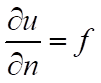
242655
(1)
and can be expressed as, according to this resource:
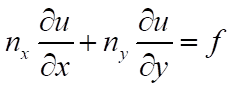
242656
(2)

But apparently, according to https://www.researchgate.net/post/How_to_impose_natural_boundary_conditions_with_Generalized_Finite_Difference_Method_or_meshfree_collocation_method resource (posted by Dr. Fan):
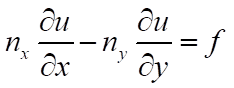
242657
(3)

Which is which? Is it supposed to be positive, or negative? When should it be positive or negative?

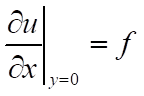
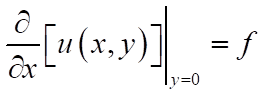
2. If I apply the derivative boundary condition, on say, the bottom of a square plate, I can state:
242658
(4)
or for simplicity,
242659
(5)

Obviously, comparing it with (2), ny is equal to 0. Why is this so? Why is ny = 0?

Thanks!
 
Physics news on Phys.org
1. The minus sign is an obvious typo.
2. ##\vec n## is the normal vector. The normal vector's y-component on a coordinate surface of ##y## is zero.
 
  • Like
Likes   Reactions: maistral
Hi! Thanks for replying. Thank you very much, it did clarify a lot of things. I still have two remaining problems, however.

1. Where is the vector n exactly pointed to? Is it going towards the region, or is it going away from the region?

2. I am assuming that the complete form of the Neumann condition is used for irregular boundaries (ie. curved ones, so on and forth). As stated by the first resource, nx = cos θ, and ny = sin θ.

If I use finite element analysis, I can just take the normal vector perpendicular to the edge of the element which is definitely a no-brainer as it's a straight line.

My problem begins to appear if I begin using finite differences. How do I exactly implement this kind of boundary condition on nodes? I'm confused - nodes are, well, nodes; just a point. I'm under the impression that I can get the angle required for calculating nx and ny by taking the tangent of the irregular boundary curve at the node, then I draw the perpendicular line needed to calculate the angle. Is this even correct?
 

Similar threads

  • · Replies 4 ·
Replies
4
Views
2K
  • · Replies 4 ·
Replies
4
Views
4K
  • · Replies 4 ·
Replies
4
Views
3K
  • · Replies 1 ·
Replies
1
Views
2K
  • · Replies 2 ·
Replies
2
Views
2K
  • · Replies 6 ·
Replies
6
Views
3K
  • · Replies 2 ·
Replies
2
Views
3K
  • · Replies 8 ·
Replies
8
Views
4K
  • · Replies 2 ·
Replies
2
Views
2K