Deriving the derivative boundary conditions from natural formulation

Click For Summary

Discussion Overview

The discussion revolves around deriving derivative boundary conditions from a natural formulation, specifically focusing on the application of general derivative boundary conditions in the context of heat flux and temperature distribution. The scope includes theoretical exploration and mathematical reasoning.

Discussion Character

  • Exploratory, Technical explanation, Debate/contested

Main Points Raised

  • One participant expresses uncertainty about transitioning from a general natural boundary condition formulation to a specific derivative boundary condition, seeking assistance to identify potential errors in their reasoning.
  • Several participants affirm that the initial formulation appears correct but do not provide further clarification on the identified problem.
  • Another participant introduces the concept of heat flux in the x direction, stating that it is defined by the equation $$q_x=-k\frac{dT}{dx}$$, emphasizing that the sign of the flux can vary depending on the direction.
  • The same participant provides equations for temperature at fictitious points at both the left and right boundaries, suggesting a method to relate temperature and heat flux at these boundaries.
  • One participant acknowledges the explanation provided about heat flux as a satisfactory response.

Areas of Agreement / Disagreement

Participants generally agree that the initial formulation seems correct, but there is no consensus on the specific problem identified by the original poster. The discussion includes differing perspectives on the implications of heat flux and boundary conditions.

Contextual Notes

There are unresolved aspects regarding the assumptions behind the general natural boundary condition formulation and how it relates to the derivative boundary conditions. The discussion does not clarify the specific errors or discrepancies noted by the original poster.

maistral
Messages
235
Reaction score
17
TL;DR
How to derive the finite difference derivative formulation from the natural boundary formulation?
PS: This is not an assignment, this is more of a brain exercise.

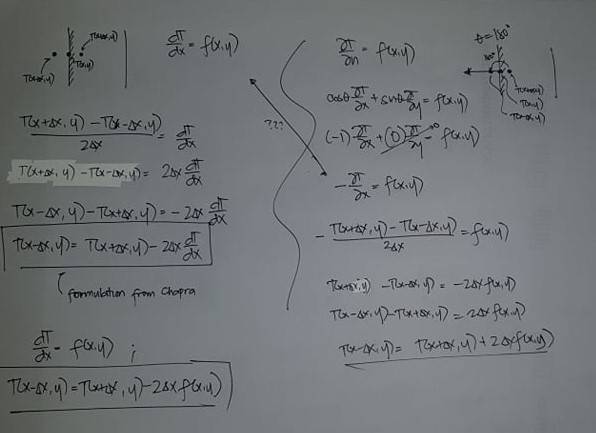
I intend to apply a general derivative boundary condition f(x,y). While I know that the boxed formulation is correct, I have no idea how to acquire the same formulation if I come from the general natural boundary condition formulation. I honestly do not know what am I doing wrong. Can someone check where am I incorrect?
67846231_357745925149080_6309915412955922432_n.jpg
 
  • Like
Likes   Reactions: exln
Physics news on Phys.org
Looks OK. So what is the problem?
 
Chestermiller said:
Looks OK. So what is the problem?

The left side and the right side have different results.
 
If ##q_x## is the heat flux in the x direction, then ##q_x## is always given by $$q_x=-k\frac{dT}{dx}$$irrespective of whether it is the left- or the right boundary. Of course, the sign of the flux in the x direction can be negative. So, at the fictitious point at the left boundary, you have:
$$T(-\Delta x)=T(+\Delta x)+q_x(0)\Delta x$$and, at the fictitious point at the right boundary, you have:
$$T(L+\Delta x)=T(L-\Delta x)-q_x(L)\Delta x$$
 
that is a good answer
 

Similar threads

  • · Replies 4 ·
Replies
4
Views
3K
  • · Replies 2 ·
Replies
2
Views
2K
  • · Replies 4 ·
Replies
4
Views
4K
  • · Replies 9 ·
Replies
9
Views
3K
Replies
3
Views
3K
  • · Replies 1 ·
Replies
1
Views
2K
  • · Replies 8 ·
Replies
8
Views
3K
  • · Replies 1 ·
Replies
1
Views
2K
  • · Replies 8 ·
Replies
8
Views
4K
  • · Replies 6 ·
Replies
6
Views
3K