maistral
- 235
- 17
- TL;DR
- A little clarification with regard to the natural boundary condition.
Hi, I'd like to be clarified regarding the general natural/Neumann boundary condition for a PDE.
1. The natural boundary condition is generally defined as:
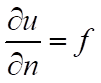 (1)
(1)
and can be expressed as, according to this resource:
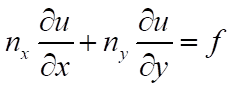 (2)
(2)
But apparently, according to https://www.researchgate.net/post/How_to_impose_natural_boundary_conditions_with_Generalized_Finite_Difference_Method_or_meshfree_collocation_method resource (posted by Dr. Fan):
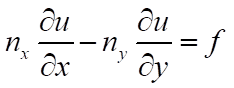 (3)
(3)
Which is which? Is it supposed to be positive, or negative? When should it be positive or negative?
2. If I apply the derivative boundary condition, on say, the bottom of a square plate, I can state:
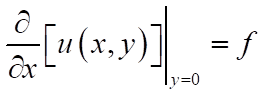 (4)
(4)
or for simplicity,
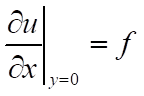 (5)
(5)
Obviously, comparing it with (2), ny is equal to 0. Why is this so? Why is ny = 0?
Thanks!
1. The natural boundary condition is generally defined as:
and can be expressed as, according to this resource:
But apparently, according to https://www.researchgate.net/post/How_to_impose_natural_boundary_conditions_with_Generalized_Finite_Difference_Method_or_meshfree_collocation_method resource (posted by Dr. Fan):
Which is which? Is it supposed to be positive, or negative? When should it be positive or negative?
2. If I apply the derivative boundary condition, on say, the bottom of a square plate, I can state:
or for simplicity,
Obviously, comparing it with (2), ny is equal to 0. Why is this so? Why is ny = 0?
Thanks!