Geometric Algebra formulation of Quantum Mechanics

Click For Summary
SUMMARY

The discussion centers on the application of Geometric Algebra (GA) to Quantum Mechanics (QM), specifically referencing the book "Geometric Algebra for Physicists" by Chris Doran and Anthony Lasenby. Participants explore the mapping between normalized spinors and rotors, emphasizing the importance of establishing a one-to-one mapping as outlined in equation 8.20. The conversation highlights the utility of GA calculations in deriving results that typically require specialized Pauli operators, suggesting that GA provides deeper geometric insights into the relationship between complex numbers and spin.

PREREQUISITES
  • Understanding of Geometric Algebra (GA)
  • Familiarity with Quantum Mechanics (QM) principles
  • Knowledge of Pauli matrices and their properties
  • Basic mathematical definitions related to mappings and algebraic structures
NEXT STEPS
  • Study the concept of mappings in mathematical contexts, particularly in algebra
  • Explore the relationship between Clifford algebras and quantum mechanics
  • Investigate the derivation of spinor wavefunctions as rotors in Geometric Algebra
  • Review the implications of equation 8.20 in "Geometric Algebra for Physicists"
USEFUL FOR

Physicists, mathematicians, and students interested in the intersection of Geometric Algebra and Quantum Mechanics, particularly those seeking to deepen their understanding of spin and its geometric interpretations.

Milsomonk
Messages
100
Reaction score
17
Hi all,
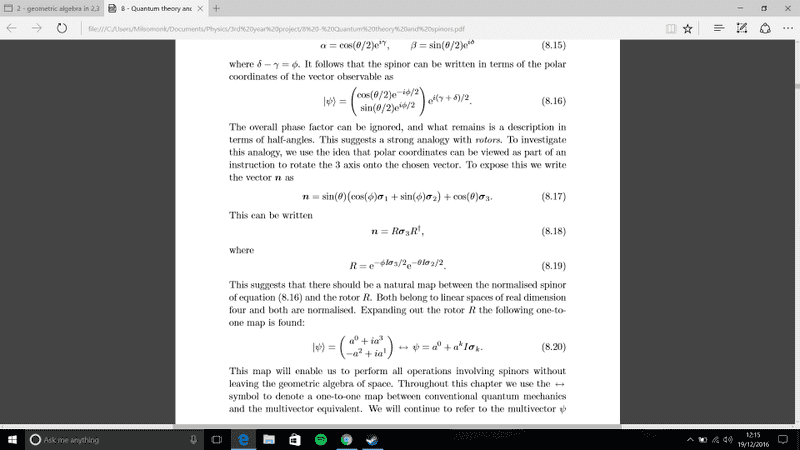
I'm reading a paragraph from "Geometric Algebra for Physicists" - Chris Doran, Anthony Lasenby. I'm quite interested in applying GA to QM but I've got to a stage where I am not following part of the chapter and am wondering if someone can shed a little light for me.
upload_2016-12-19_12-15-53.png

The part I'm not quite sure about is the bit at the bottom where a "map" is found between the normalised spinor and the rotor. I guess I'm just not sure how I might derive this myself, which I would like to do, as I have done for the rest so far. Any guidance would be much appreciated, and wishing all a happy festive season :)
 
Physics news on Phys.org
The only thing to prove is that there is a mapping that is 1-1. The right side of 8.20 expands to
a0 + a1Iσ1+ a2Iσ2+ a3Iσ3
Since the match-ups of the ai on the left and right side are obvious, the 1-1 mapping follows.
The motivation of why he would want to match the two sides up that way, (with sign changes, etc.), is that the calculations of the right side are very methodically defined in geometric algebra and can be used in many situations. The GA calculations and definitions are not specific to this application, whereas the left side Pauli operators have to be specifically defined for that application.
 
Hi, Thanks very much for your reply, it deffinately helps :) I guess I'm not really sure what map means in this context, I sort of have a vague idea but am lacking a more mathematical definition. I'm not really sure what a represents and it's superscript numbers.
 
Milsomonk said:
Hi, Thanks very much for your reply, it deffinately helps :) I guess I'm not really sure what map means in this context, I sort of have a vague idea but am lacking a more mathematical definition. I'm not really sure what a represents and it's superscript numbers.
The mapping means very little on its own. The book should show that one can do routine GA calculations and get back to the same results that required specialized Pauli operators. Once that is accomplished, you should see if GA offers some routine, methodical, insight into the physical results that were less obvious without GA.
 
Yeah basically what I'm trying to do is show that you can use the fact that the pauli matrices form a clifford algebra of space, to write the spinor wavefunction as a rotor, thus lending a little more geometric insight into the link between complex numbers and spin. This map appears to be an important component but I simply don't understand what "a" represents.
 
Milsomonk said:
Yeah basically what I'm trying to do is show that you can use the fact that the pauli matrices form a clifford algebra of space, to write the spinor wavefunction as a rotor, thus lending a little more geometric insight into the link between complex numbers and spin. This map appears to be an important component but I simply don't understand what "a" represents.
It looks to me like the ais come from the real and imaginary parts of equation 8.16. Beyond that, I can't help you because I don't really know anything about that physics subject.
 
Hmm, yeah I wondered that. Thanks for your help :)
 

Similar threads

  • · Replies 14 ·
Replies
14
Views
4K
  • · Replies 11 ·
Replies
11
Views
4K
  • · Replies 3 ·
Replies
3
Views
3K
  • · Replies 10 ·
Replies
10
Views
16K
  • · Replies 4 ·
Replies
4
Views
3K
  • · Replies 7 ·
Replies
7
Views
5K
  • · Replies 116 ·
4
Replies
116
Views
6K
  • · Replies 26 ·
Replies
26
Views
5K
  • · Replies 2 ·
Replies
2
Views
1K
  • · Replies 2 ·
Replies
2
Views
14K