Discussion Overview
The discussion revolves around a geometry proof related to the midpoint theorem, specifically within the context of triangle properties and congruence. Participants explore various approaches to proving relationships between segments and triangles in a given geometric configuration.
Discussion Character
- Exploratory
- Technical explanation
- Mathematical reasoning
- Debate/contested
Main Points Raised
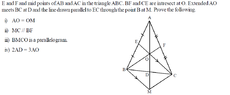
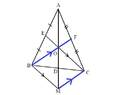
- One participant suggests that in triangle ABM, with E as the midpoint of AB and EO parallel to OM, AO should equal OM, seeking assistance in proving this.
- Another participant asserts that triangles ODC and MDB are congruent by SAA, implying this is a key fact for the proof.
- Some participants express uncertainty about the necessity of certain steps, indicating that they believe the problem can be approached differently without those details.
- A participant references a standard theorem stating that a line through the midpoint of one side of a triangle, parallel to another side, will intersect the midpoint of the third side, suggesting this is relevant to their reasoning.
- Another participant discusses the implications of the midpoint theorem, stating that the line through the midpoint of one side and parallel to another bisects the third side, leading to the conclusion that AO equals OM.
- One participant proposes using congruence of triangles BOC and BMC, as well as CMO and BMO, to show that BMCO is a parallelogram, which would support their argument.
- Another participant outlines a method to prove that 2AD equals 3AO, based on established relationships and properties of the parallelogram.
Areas of Agreement / Disagreement
Participants express differing views on the necessity and approach to proving certain relationships, indicating that multiple competing methods and interpretations exist. The discussion remains unresolved regarding the best approach to the proof.
Contextual Notes
Some participants mention the midpoint theorem and its converse, but there are unresolved assumptions and steps in the mathematical reasoning that could affect the conclusions drawn.