SUMMARY
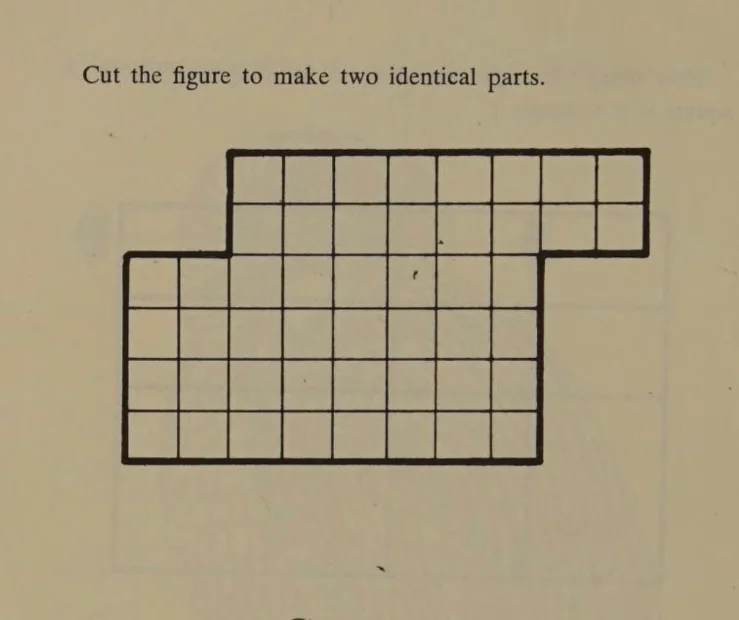
The discussion centers on a geometry puzzle from Pierre Berloquin’s book "100 Geometric Games," which requires cutting a figure into two identical parts by a single continuous cut line. "Identical" is defined strictly as two shapes that can be superimposed by rotation without flipping. Multiple solutions exist, including one by user @kuruman and the official book solution, both described using coordinate notation on a 5x3 grid. Physical paper models and coordinate-based cut descriptions were used to verify solutions, with the puzzle emphasizing persistence and spatial reasoning.
PREREQUISITES
- Understanding of geometric transformations: rotation and reflection
- Familiarity with coordinate geometry for describing cuts
- Ability to visualize and manipulate 2D shapes physically or mentally
- Basic knowledge of puzzle-solving strategies in geometry
NEXT STEPS
- Explore coordinate-based cut descriptions for complex geometric figures
- Study Pierre Berloquin’s "100 Geometric Games" for similar puzzles
- Practice constructing physical models to test geometric hypotheses
- Learn advanced shape congruence criteria beyond simple rotation
USEFUL FOR
Geometry enthusiasts, educators designing spatial reasoning exercises, puzzle solvers interested in geometric dissections, and anyone studying shape congruence and transformations in plane geometry.