Geometry Puzzle: Cut The Figure to Make Two Identical Parts

  • Context: High School 
  • Thread starter Thread starter bob012345
  • Start date Start date
bob012345
Gold Member
Messages
2,370
Reaction score
1,089
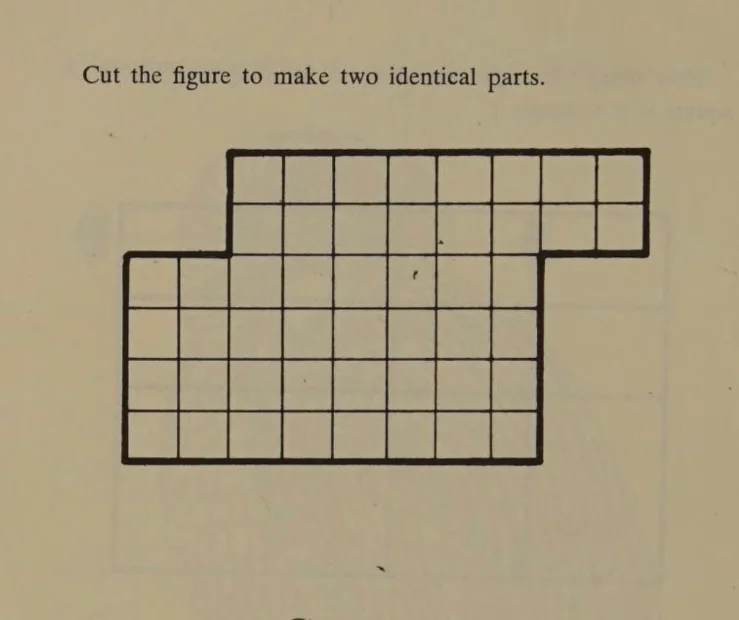
Here is a little puzzle from Pierre Berloquin’s book 100 Geometric Games. The goal is to cut the figure once to make two identical parts. Have fun!
IMG_5751.webp
 
  • Like
Likes   Reactions: OmCheeto
Mathematics news on Phys.org
Does "identical" mean that after the object is cut into two, one can superimpose the two pieces into one with no more than a simple rotation in the plane of the screen?
 
  • Like
Likes   Reactions: FactChecker
kuruman said:
Does "identical" mean that after the object is cut into two, one can superimpose the two pieces into one with no more than a simple rotation in the plane of the screen?
Identical here means they have the same shape. Think of it like two pieces of physical paper. Only the shapes matter.
 
bob012345 said:
Identical here means they have the same shape. Think of it like two pieces of physical paper. Only the shapes matter.
Cut.webp
This doesn't help. A cut along the red line produces two pieces that have the same shape, namely rectangles. Is this a valid solution? If not, why not?
 
bob012345 said:
Identical here means they have the same shape. Think of it like two pieces of physical paper. Only the shapes matter.
Can you flip one, so that a clockwise outer perimeter becomes a counter-clockwise perimeter?

ADDED: Sorry. The one I thought of with a "flip" does not solve it and the real solution does not require a flip.
 
Last edited:
FactChecker said:
Can you flip one, so that a clockwise outer perimeter becomes a counter-clockwise perimeter?
Yes.
 
kuruman said:
View attachment 372339This doesn't help. A cut along the red line produces two pieces that have the same shape, namely rectangles. Is this a valid solution? If not, why not?
Same shape in this context means that they overlap, they are the same size and thus are identical so that is not a valid solution as I understand the problem.
 
Last edited:
  • Like
Likes   Reactions: weirdoguy
Here is one solution. There is at least one more.
IMG_5756.webp


[\SPOILER]
 
Last edited:
  • Like
Likes   Reactions: FactChecker
bob012345 said:
Here is a little puzzle from Pierre Berloquin’s book 100 Geometric Games. The goal is to cut the figure once to make two identical parts. Have fun!

View attachment 372336
The original text does not say "once". You added that in your instruction. But what does cutting once mean? It suggests a single straight cut, but that appears impossible. Do you mean one continuous line, but not necessarily straight? I can do that, but it seems too easy.
 
  • #10
haruspex said:
The original text does not say "once". You added that in your instruction. But what does cutting once mean? It suggests a single straight cut, but that appears impossible. Do you mean one continuous line, but not necessarily straight? I can do that, but it seems too easy.
Yes.
 
  • #11
bob012345 said:
Yes.
OK, then if turns are allowed, it is easy as @haruspex noted. Referring to the figure in post #4, separate in half each of the rectangles with vertical cuts to the red line and then connect the vertical cuts with a horizontal cut.
 
  • Like
Likes   Reactions: bob012345
  • #12
kuruman said:
OK, then if turns are allowed, it is easy as @haruspex noted. Referring to the figure in post #4, separate in half each of the rectangles with vertical cuts to the red line and then connect the vertical cuts with a horizontal cut.
That gives what I showed in post #8. But there is at least one other solution. Who can find it and possibly more?
 
  • #13
BTW, if we label the bottom left corner of the original figure as (0,0) and the upper right corner as (5,3), we can describe the cut above as $$(3,3)->(3,2)->(2,2)->(2,0)$$ and we can use that method to describe other cuts.
 
  • #14
Well, it’s been 2 days and no one has offered up a different solution than the one above by @kuruman which I believe is the simplest solution. There exist two other solutions. Interestingly, the solution given so far is not the ‘book’ solution! I’ll give the book solution now so perhaps that will stimulate finding the third solution. Setting two small squares as one unit, the lower left corner is ##(0,0)## and the upper right corner is ##(5,3)## make the cut $$(2,3)->(2,1)->(3,1)->(3,0)$$

IMG_5753.webp

Then flip one of the two parts.

IMG_5782.webp
 

Similar threads

  • · Replies 10 ·
Replies
10
Views
6K
  • · Replies 31 ·
2
Replies
31
Views
6K
  • · Replies 10 ·
Replies
10
Views
3K
  • · Replies 2 ·
Replies
2
Views
3K
  • · Replies 10 ·
Replies
10
Views
3K
  • · Replies 8 ·
Replies
8
Views
3K
  • · Replies 12 ·
Replies
12
Views
3K
  • · Replies 2 ·
Replies
2
Views
2K
  • · Replies 4 ·
Replies
4
Views
2K
Replies
1
Views
2K