Get Physics Lab Help: Find Theoretical Distance X

Click For Summary

Homework Help Overview

The discussion revolves around a physics lab problem involving a solid spherical ball released from a height and exiting a track as a projectile. Participants are tasked with finding the theoretical horizontal distance (X) the ball travels after exiting the setup, given specific parameters such as the ball's radius and mass.

Discussion Character

  • Exploratory, Conceptual clarification, Mathematical reasoning, Problem interpretation

Approaches and Questions Raised

  • The original poster attempts to apply conservation of energy to find the exit velocity of the ball and expresses uncertainty about their calculations. Other participants suggest decomposing the velocity into components and using kinematic equations to determine the projectile's motion. Questions arise regarding how to handle multiple unknowns when given a specific x value.

Discussion Status

Participants are actively engaging with the problem, offering hints and clarifications. Some guidance has been provided regarding the use of energy conservation and kinematic equations, but there is no explicit consensus on the correctness of the calculations presented.

Contextual Notes

There is mention of potential energy loss due to air resistance, and participants are encouraged to consider the dimensions of the setup in their calculations. The original poster expresses concern about discrepancies between their calculated value and the expected result from the lab.

ji707
Messages
8
Reaction score
0
1.hi, I am new to this forum and i have a question regarding my final physics lab:
A solid spherical ball, R= 1.4 cm and m=95 grams, is released from point A(1m above the). After traveling through the loop, the ball exits the set up as a projectile and land at point B with the horizontal distance of X= 37 cm.

the picture of the setup is here:
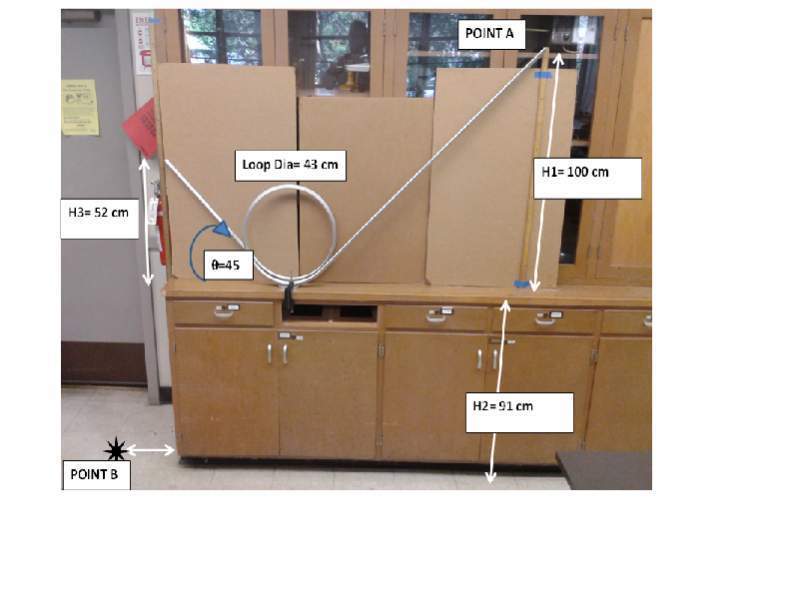
lab#13.jpg

2. i have to find the theoretical distance x, but I am not sure how to do this...

The Attempt at a Solution


I tried finding the velocity at the end of the track by saying mgh = K.E.r+K.E+mgh(loop)+mgh(end of track) and i get the velocity once the ball leaves the track to be .843m/s. i think this seems to easy though, is it?

Im stuck on how to even start this and this is our final lab so we have to use all of our physics we've learned so far.
Can someone give me a hint on how to start?
 
Last edited:
Physics news on Phys.org
welcome to pf!

hi ji707! welcome to pf! :smile:
ji707 said:
I tried finding the velocity at the end of the track by saying mgh = K.E.r+K.E+mgh(loop)+mgh(end of track) and i get the velocity once the ball leaves the track to be .843m/s.

yes, that's right :smile:

(except that the loop makes no difference)

now resolve the velocity into x and y components, and use the standard constant acceleration equations :wink:
 
ahh, thank you i was stuck on this for a while but knowing the loop cancels out helps a lot, thanks : D
 
How would i go about finding the exit velocity given an x value?
ive tried plugging into the kinematic equations but i can't solve for both v and t...
 
I don't understand your question. Use the conservation of energy to solve for the exit velocity, decompose the vector, then use the kinematic equations to solve for what you want. You know the Vi, Vf and a for the x component and Vi, a and displacement for the y component.
 
Last edited:
Ill try to clarify, after all of this, they gave us an x value and told us to use that given value to find a new exit velocity corresponding to the new x value of the projectile,
so when i tried to plug in the x displacement value they gave us i figured that since the exit velocity had changed so would the time, now i have two unknown variables, V and t and I don't know how to go about finding them. hope that clears up my question.
 
hi ji707! :smile:
ji707 said:
… after all of this, they gave us an x value and told us to use that given value to find a new exit velocity corresponding to the new x value of the projectile …
now i have two unknown variables, V and t …

yes, it means, ignore everything except the angle at the exit, and find v as a function of x

two equations with two unknowns should be enough …

use one to find t, then put that value of t into the other to find v :wink:
 
thank you tiny-tim.
so i did the problem and found my x to be 1.43m does that seem right, i feel like I am way off...
 
ji707 said:
so i did the problem and found my x to be 1.43m does that seem right, i feel like I am way off...

(which question is this now?)

if you want us to check your answer, you need to show us your calculations :wink:
 
  • #10
ok, I am finding the theoretical x value so i did


Mgh(point A)=1/2 Mv^2+1/5 Mv^2+Mgh(end of track)

.913J= .0475v^2+ .019vt^2+ .484J

v_exit=2.539 m/s

Then i found the Y component

2.539*sin(3pi/4) = 1.79 m/s

then into kinematic for a free falling object

0 = 1.43+1.795t-4.9t^2

t = .8

then again into the kinematics

x = -1.79*.8

x = 1.43m

I think I messed up somewhere, because the actual value when we did the lab was .37m...
 
  • #11
looks ok :confused:

(but would have been a lot easier if you'd left M out of the equation completely :wink:)

perhaps you lost a lot of energy from air resistance in the tube …

how much was the diameter of the tube compared with the diameter of the ball?
 

Similar threads

Replies
2
Views
2K
  • · Replies 1 ·
Replies
1
Views
4K
  • · Replies 14 ·
Replies
14
Views
2K
Replies
8
Views
4K
  • · Replies 2 ·
Replies
2
Views
2K
Replies
1
Views
2K
  • · Replies 3 ·
Replies
3
Views
4K
  • · Replies 3 ·
Replies
3
Views
4K
Replies
1
Views
2K
Replies
1
Views
3K