Graphing Eigenvectors and Sine Curves: Understanding the Relationship

Click For Summary

Discussion Overview

The discussion revolves around understanding the relationship between eigenvectors of a second difference matrix and their graphical representation in relation to sine curves. Participants explore the implications of graphing these eigenvectors, the nature of the second difference matrix, and the mathematical concepts involved, including potential connections to harmonic functions and Fourier transforms.

Discussion Character

  • Exploratory
  • Technical explanation
  • Conceptual clarification
  • Debate/contested

Main Points Raised

  • One participant questions the meaning of graphing eigenvectors from a second difference matrix and seeks clarification on how the graph is produced.
  • Another participant suggests that the second difference matrix may relate to a discretization of the Laplacian and proposes that the eigenvectors could represent coordinate vectors in a basis of harmonics.
  • Some participants express confusion about how to graph three-dimensional vectors in a two-dimensional space, raising questions about the graphical representation of eigenvectors.
  • There is a suggestion that the eigenvectors might correspond to linear combinations of basis functions, which could be graphed as functions.
  • A later reply indicates that the second difference matrix may be relevant to finite differences in differential equations, and there is uncertainty about the order of topics covered in the curriculum.
  • One participant provides a mathematical transformation of a matrix and relates it to specific points on sine curves, suggesting a method for interpreting the graphical representation.

Areas of Agreement / Disagreement

Participants express varying levels of understanding regarding the second difference matrix and its graphical implications. There is no consensus on how to graph the eigenvectors or the exact nature of their relationship to sine curves, indicating multiple competing views and unresolved questions.

Contextual Notes

Some participants note limitations in the course materials, such as a lack of explanation regarding the graphing of eigenvectors and the curriculum's non-linear progression, which may contribute to confusion.

kostoglotov
Messages
231
Reaction score
6
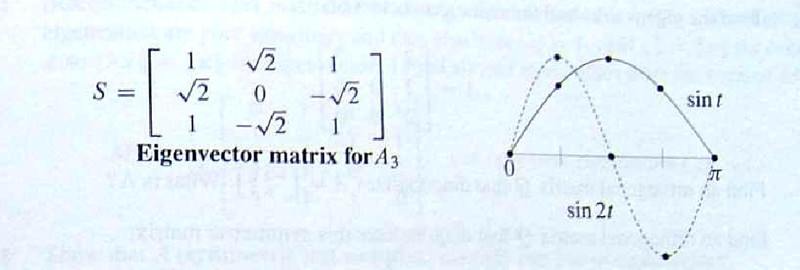
In my text, it tells me to find the eigenvectors of a 2nd difference matrix and graph the eigenvectors to see how they fall onto sine curves.
oxbkTn6.jpg


imgur link: http://i.imgur.com/oxbkTn6.jpg

My question is simple but general. What does this even mean? How did they produce this graph from the first two eigenvectors in the matrix on the left?

I tried in MATLAB to create an outer product of each vector with a time vector, but that plots straight lines.
 
Physics news on Phys.org
I'm not sure what a "2nd difference matrix is". Is it related to (a discretision of) the Laplacian?

The only thing that I can imagine at this moment is that the matrix ##A## is a representation of some operator acting on a vector space spanned by a basis of three harmonics. The eigenvectors of ##A## will then be coordinate vectors with respect to that basis. You can then "graph" an eigenvector by actually first computing the linear combination of basis harmonics to which it corresponds, and then graphing that linear combination (= a function).
 
Krylov said:
I'm not sure what a "2nd difference matrix is". Is it related to (a discretision of) the Laplacian?

The only thing that I can imagine at this moment is that the matrix ##A## is a representation of some operator acting on a vector space spanned by a basis of three harmonics. The eigenvectors of ##A## will then be coordinate vectors with respect to that basis. You can then "graph" an eigenvector by actually first computing the linear combination of basis harmonics to which it corresponds, and then graphing that linear combination (= a function).

Yeah the text gives no explication as to what it means to graph these vectors, and it's not mentioned in the video lectures. It's actually a really good course but Gilbert Strang is definitely an academic not a teacher. Still, I can't complain, it's an entire linear algebra course for free. :) And having an informal, messy text has hidden benefits, it forces you to get answers elsewhere, which is a better way of learning really.
 
Draw a short "arrow" showing the direction and length of the vector at that point on the graph.
 
HallsofIvy said:
Draw a short "arrow" showing the direction and length of the vector at that point on the graph.

But the vectors have three elements, and are being graphs in 2 dimensions.
 
  • Like
Likes   Reactions: S.G. Janssens
kostoglotov said:
But the vectors have three elements, and are being graphs in 2 dimensions.
You've never heard of two-dimensional vectors?
 
HallsofIvy said:
You've never heard of two-dimensional vectors?

Wow, ok, one last shot...how would I graph [itex][1,\sqrt{2},1][/itex] on a 2 dimensional plane? I've not seen how to do that before, but ok.
 
@kostoglotov : Are you sue these vectors aren't coordinate vectors with respect to some basis consisting of three functions? That is namely what the function graphs suggested to me.
 
Krylov said:
@kostoglotov : Are you sue these vectors aren't coordinate vectors with respect to some basis consisting of three functions? That is namely what the function graphs suggested to me.

Very possibly, the second difference matrix seems to be a matrix for the second finite difference, in a diff eqs section.

Thing is, it's possible I've followed the curriculum in the wrong order, because I haven't seen anything like this up until now. Maybe I should have done the later section on Fourier Transforms before getting to where I am now, since the syllabus skips around a bit.

Here is the entire problem:

EGO4q9D.jpg


imgur link: http://i.imgur.com/EGO4q9D.jpg

and a bit more of the solution:

zBOhs0n.jpg


imgur link: http://i.imgur.com/zBOhs0n.jpg
 
  • #10
I think this is what they're doing in the solution. If you divide S by ##\sqrt 2##, you get
$$S/\sqrt{2} = \begin{bmatrix} 1/\sqrt{2} & 1 & 1/\sqrt{2} \\ 1 & 0 & -1 \\ 1/\sqrt{2} & -1 & 1/\sqrt{2} \end{bmatrix}.$$ The points marked on ##\sin t## correspond to the first row of this matrix. That is, evaluate ##\sin t## at ##t = \pi/4, \pi/2, 3\pi/4## and you get the values in the first row. Similarly, the points marked on ##\sin 2t## correspond to the second row.
 
  • Like
Likes   Reactions: kostoglotov

Similar threads

  • · Replies 3 ·
Replies
3
Views
2K
  • · Replies 5 ·
Replies
5
Views
3K
  • · Replies 2 ·
Replies
2
Views
6K
  • · Replies 4 ·
Replies
4
Views
2K
Replies
22
Views
5K
Replies
8
Views
6K
Replies
1
Views
6K
Replies
2
Views
2K
Replies
2
Views
1K
  • · Replies 2 ·
Replies
2
Views
2K