Science Advisor
- 1,615
- 612
- TL;DR
- An estimate for 3d potential wells of different depths and shapes is calculated with quantum diffusion monte carlo.
In some other thread someone mentioned that a 3D cubic potential well always has a ground state that is a bound state, but a spherical well doesn't necessarily have if it's too shallow.
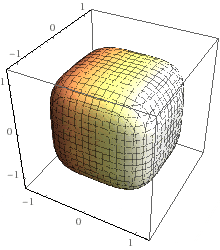
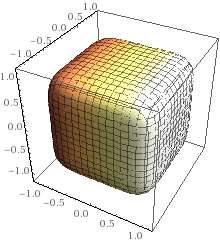
I calculated some results for 3d cubes, spheres and surfaces of form ##x^{2n}+y^{2n}+z^{2n}=r^{2n}##, which look like
4th order (n=2):
6th order (n=3):
10th order (n=5):
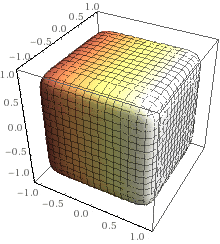
and are the more cube-like the larger the exponent ##2n## is. The ground state energy was obtained with an old diffusion monte carlo code from
https://github.com/m0baxter/DMC
with the potential energy ##V(x,y,z)## set to some constant value ##V## outside the well and to ##0## inside it. I'll post the graphs of the results here in case someone finds them interesting.
For well depth ##V=1500##, similar to a hard-walled box, the results for spheres, cubes and things between them were like in this image:
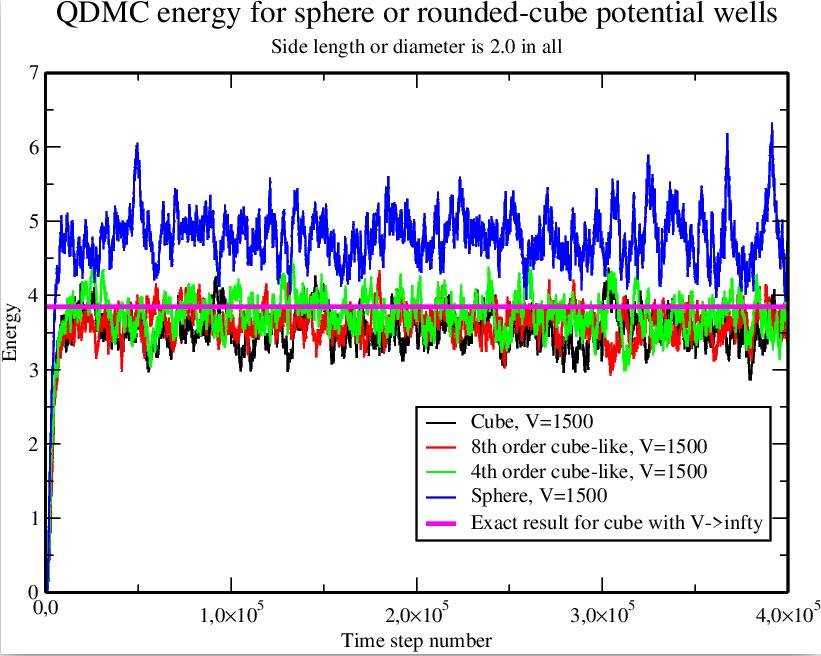 The energy converges to much the same value with a cubic box and the ##x^n + y^n + z^n = r^n## as long as the ##n>4##. With ##n=4## there's a small but clear difference to the cube if you calculate the average of the energy values after convergence (##t>10^5##). The ground state for these was near the exact result, ##E=3.85##, of a box with that side length and hard walls (##V\rightarrow\infty##). I think the energies are a bit less than that because ##V## is only large but finite.
If the graph for the spherical well is compared to the exact result for a sphere with hard walls, then it looks like this:
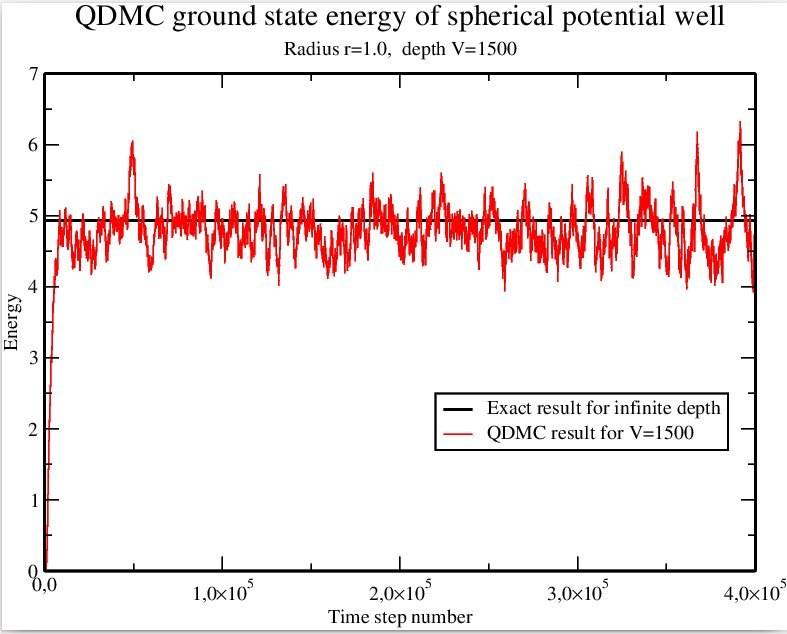
So there's a good agreement there as well.
The same result calculated for potential wells of same radius and a potential step of only ##V=1## looks like
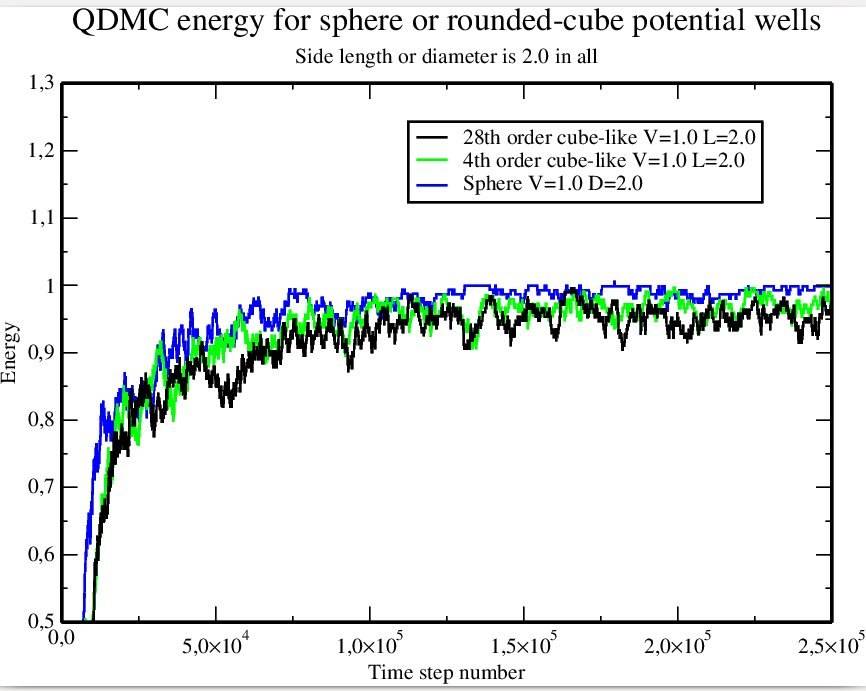
So there's a less clear difference between a cube and a sphere potential well when the potential well is shallow. The 28th order surface can for any computational physicist's interests be seen as exactly the same as a cube.
The QDMC calculation takes a lot more time for less deep potential wells. Actually, it doesn't seem to be convenient to try to test whether the ground state looks like a bound state for a really low well depth like ##V=10^{-3}##. This was the result I was interested in. Maybe I could calculate ground state energies for different well depths and extrapolate to zero depth to see what happens. To do that, it's probably necessary to include surfaces like ##|x|^q + |y|^q +|z|^q = r^q## with ##q## a rational number between ##2## and ##4## because for integer values only there are not enough data points. The similarity of the results in the first image makes me somehow expect that almost all properties of ##x^n + y^n + z^n = r^n## potential wells, including the existence of a bound state, are the same as for a cube when ##n>4##.
So, this was an Insight-like example of a ground state energy calculation with QDMC. In some book containing a physics lecture by E. Fermi there actually was a cube-rounded-from-corners potential well used in an atomic nucleus model, but I couldn't find any other examples of applications.
CORRECTION: The ground state energy of an infinite cube-shaped well with side length 2.0 should be ##E_0 = \frac{3\pi^2}{8} \approx 3.7##, not the 3.85 in the first picture. That's why the DMC graphs seemed to converge to a smaller value than they should. The particle mass in all simulations was ##m=1##, and the Planck constant was also ##\hbar =1## as in atomic-like units.
I calculated some results for 3d cubes, spheres and surfaces of form ##x^{2n}+y^{2n}+z^{2n}=r^{2n}##, which look like
4th order (n=2):
6th order (n=3):
10th order (n=5):
and are the more cube-like the larger the exponent ##2n## is. The ground state energy was obtained with an old diffusion monte carlo code from
https://github.com/m0baxter/DMC
with the potential energy ##V(x,y,z)## set to some constant value ##V## outside the well and to ##0## inside it. I'll post the graphs of the results here in case someone finds them interesting.
For well depth ##V=1500##, similar to a hard-walled box, the results for spheres, cubes and things between them were like in this image:
If the graph for the spherical well is compared to the exact result for a sphere with hard walls, then it looks like this:
So there's a good agreement there as well.
The same result calculated for potential wells of same radius and a potential step of only ##V=1## looks like
So there's a less clear difference between a cube and a sphere potential well when the potential well is shallow. The 28th order surface can for any computational physicist's interests be seen as exactly the same as a cube.
The QDMC calculation takes a lot more time for less deep potential wells. Actually, it doesn't seem to be convenient to try to test whether the ground state looks like a bound state for a really low well depth like ##V=10^{-3}##. This was the result I was interested in. Maybe I could calculate ground state energies for different well depths and extrapolate to zero depth to see what happens. To do that, it's probably necessary to include surfaces like ##|x|^q + |y|^q +|z|^q = r^q## with ##q## a rational number between ##2## and ##4## because for integer values only there are not enough data points. The similarity of the results in the first image makes me somehow expect that almost all properties of ##x^n + y^n + z^n = r^n## potential wells, including the existence of a bound state, are the same as for a cube when ##n>4##.
So, this was an Insight-like example of a ground state energy calculation with QDMC. In some book containing a physics lecture by E. Fermi there actually was a cube-rounded-from-corners potential well used in an atomic nucleus model, but I couldn't find any other examples of applications.
CORRECTION: The ground state energy of an infinite cube-shaped well with side length 2.0 should be ##E_0 = \frac{3\pi^2}{8} \approx 3.7##, not the 3.85 in the first picture. That's why the DMC graphs seemed to converge to a smaller value than they should. The particle mass in all simulations was ##m=1##, and the Planck constant was also ##\hbar =1## as in atomic-like units.
Last edited:
