cwill53
- 220
- 40
- Homework Statement
- Determine the force transmitted by the gusset late mnpqr to the member MN of the joint shown in the figure if the forces acting along the straight lines OA, OB, OC are $$P_{1}=P_{3}=141 lbs$$ and $$P_{2}= 100 lbs$$. The directions of these forces are shown in the figure.
- Relevant Equations
- $$F_{x}= \left \| \vec{F} \right \|cos\phi$$
$$F_{y}= \left \| \vec{F} \right \|sin\phi$$
Here is the image of the problem.
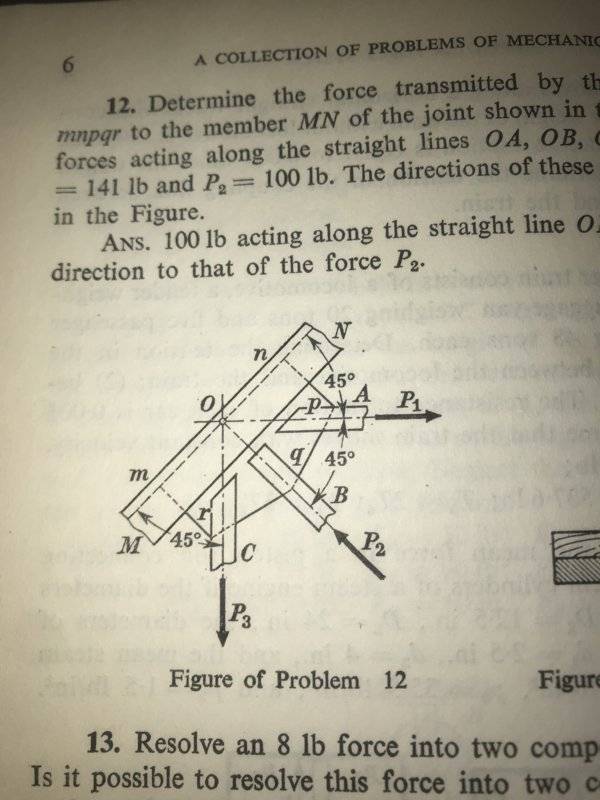
I arrived at the solution that the force on MN is in fact 100lbs due to P2 because the components P1 and P3 acting along MN are equal in magnitude but opposite in direction. What I don't understand is why the force is acting in the direction OPPOSITE to $$\vec{P_{2}}$$. That doesn't make sense to me.
I arrived at the solution that the force on MN is in fact 100lbs due to P2 because the components P1 and P3 acting along MN are equal in magnitude but opposite in direction. What I don't understand is why the force is acting in the direction OPPOSITE to $$\vec{P_{2}}$$. That doesn't make sense to me.