Gym exercise equipment analysis

Click For Summary
SUMMARY

The discussion focuses on analyzing the forces exerted on a leg extension machine's workarm, specifically under a maximum load of 300 pounds. The user calculates torque on the cam, yielding a maximum torque of 2435.4 lb*in, and evaluates the rotating bearing's torque at 1912.5 lb*in using the formula T = F*d. Additionally, the user applies the cantilever beam equation to determine the lever's torque at 3750 lb*in. The analysis aims to clarify the forces acting on the system, including reaction forces and the upward force exerted by the user's leg.

PREREQUISITES
  • Understanding of torque calculations in mechanical systems
  • Familiarity with cantilever beam equations
  • Knowledge of reaction forces in static equilibrium
  • Basic principles of biomechanics related to weight training equipment
NEXT STEPS
  • Research advanced torque analysis techniques for complex mechanical systems
  • Study the principles of static equilibrium in mechanical structures
  • Learn about the biomechanics of leg extension exercises and their impact on force distribution
  • Explore software tools for simulating mechanical systems and analyzing forces
USEFUL FOR

Mechanical engineers, fitness equipment designers, and biomechanics researchers interested in the structural analysis and force dynamics of gym exercise machines.

JasmineRM
Messages
3
Reaction score
0
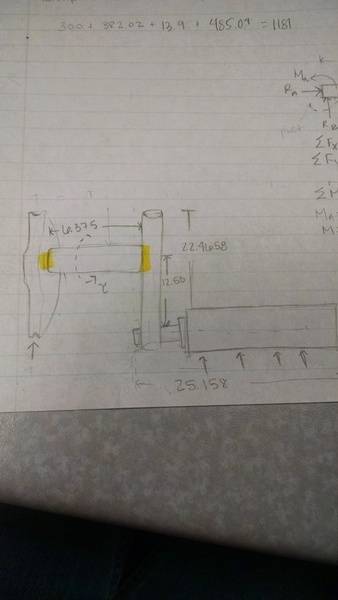
I need some help on the direction to go with this problem. This is a workarm on a leg extension machine and there's 300 pounds (max) coming from the weight stack attached via a cable on the cam. I need to find the total force exterted on this system to double check my results on an analysis.

To explain the diagram a littler more, there's a cam that exerts a torque onto the shaft connected to it. Then there's a perpendicular lever connected to that where the leg extension pad is connected perpendicular to that. I know there's a force exerted on to the work arm from a person seated using the machine.

I know for sure I can calculate the torque on the cam using distances from the cable as different degrees to the pivot point and multiplying that by the 300 lbs. I am lost on how to approach the rest. Should I analyze part by part or as a whole system? Any input would be great because I've racked my head on this for quite some time and I am stuck. Thank you
IMG_20150724_093216564_zps63fys364.jpg
 
Engineering news on Phys.org
Are you trying to find the Force by the user's leg (as a function of angle), or the reaction Forces applied to the shaft by the bearings?
that is, are you analyzing the biology/kinesiology, or the mechanical machine structure?
 
lightgrav said:
Are you trying to find the Force by the user's leg (as a function of angle), or the reaction Forces applied to the shaft by the bearings?
that is, are you analyzing the biology/kinesiology, or the mechanical machine structure?
The mechanical machine structure
 
Would this be the correct thinking...
I analyzed each part separately. For the cam, I took the distance from the cable to the center and found the max torque to be 2435.4 lb*in. Then for the rotating bearing, I used T = F*d, with the force being 300 lb and distance as the length of the bearing, getting 1912.5 lb*in. For the lever, I used the cantilever beam equation and 3750 lb*in. As for the final beam which is where the leg has a force going up on ...I was unsure of how to go about the forces on this one. I have two reaction forces, one in the x and one in the y which equals 300lb, weight going down, another weight of a person going down because there's a potential someone could sit in the end of this beam (although hopefully unlikely) that is at max 300 lb(weight stack weight), and the questionable force going up that I am trying to find.

Is this correct?


IMG_20150728_090711031_zpsukf0emck.jpg
 

Similar threads

  • · Replies 5 ·
Replies
5
Views
3K
  • · Replies 8 ·
Replies
8
Views
2K
Replies
9
Views
5K
  • · Replies 1 ·
Replies
1
Views
5K
  • · Replies 87 ·
3
Replies
87
Views
8K
  • · Replies 3 ·
Replies
3
Views
16K
  • · Replies 20 ·
Replies
20
Views
5K
  • · Replies 1 ·
Replies
1
Views
4K