Math Amateur
Gold Member
MHB
- 3,920
- 48
I am reading "Multidimensional Real Analysis I: Differentiation" by J. J. Duistermaat and J. A. C. Kolk ...
I am focused on Chapter 2: Differentiation ... ...
I need help with another aspect of the proof of Lemma 2.2.7 (Hadamard...) ... ...
Duistermaat and Kolk's Lemma 2.2.7 and its proof read as follows:
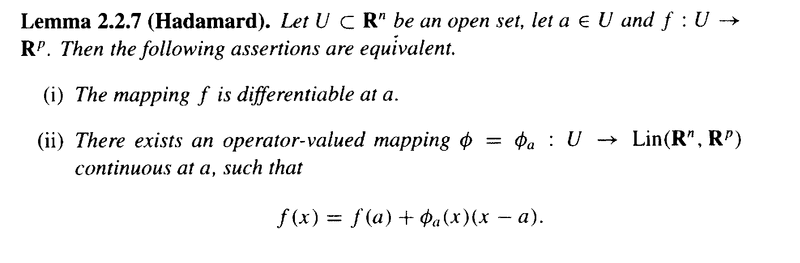
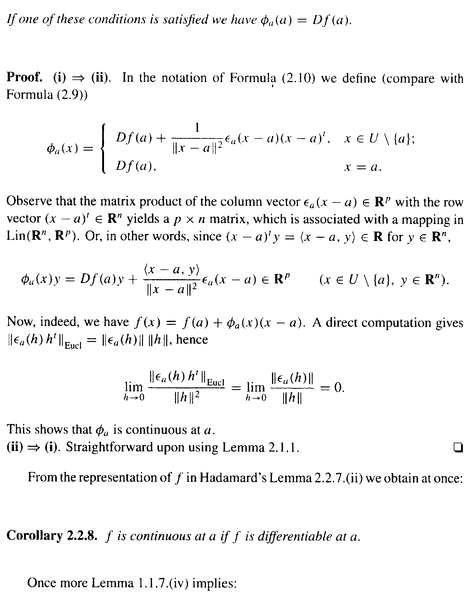
Near to the end of the above text D&K write the following:
" ... ... A direct computation gives ##\| \epsilon_a(h) h^t \|_{ Eucl } = \| \epsilon_a(h) \| \| h \|## , hence##\lim_{ h \rightarrow 0 } \frac{ \| \epsilon_a(h) h^t \|_{ Eucl } }{ \| h \|^2 } = \lim_{ h \rightarrow 0 } \frac{ \| \epsilon_a(h) \| }{ \| h \| } = 0## This shows that ##\phi_a## is continuous at ##a##. ... ... "
My questions are as follows:
Question 1
... how/why does the above show that ##\phi_a## is continuous at ##a##. ... ...?
Can someone please demonstrate explicitly, formally and rigorously that ##\phi_a## is continuous at ##a##. ... ...?Question 2
How/why does the proof of Hadamard's Lemma 2.2.7 imply that ##f## is continuous at ##a## if ##f## is differentiable at ##a## ... ?
Help will be much appreciated ... ...
Peter==========================================================================================
NOTE:
The start of D&K's section on differentiable mappings may help readers of the above post understand the context and notation of the post ... so I am providing the same as follows:
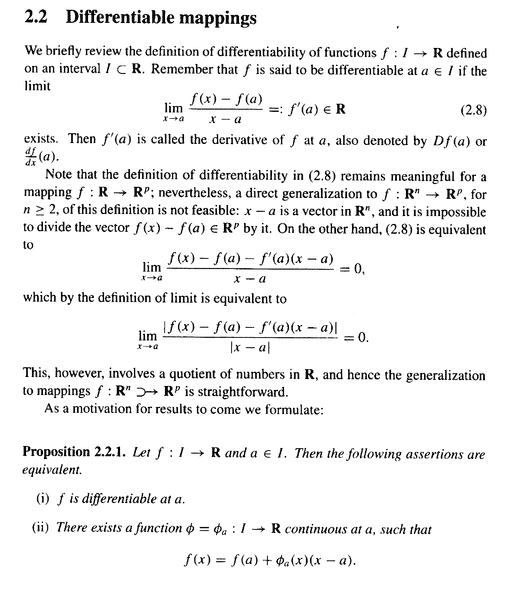
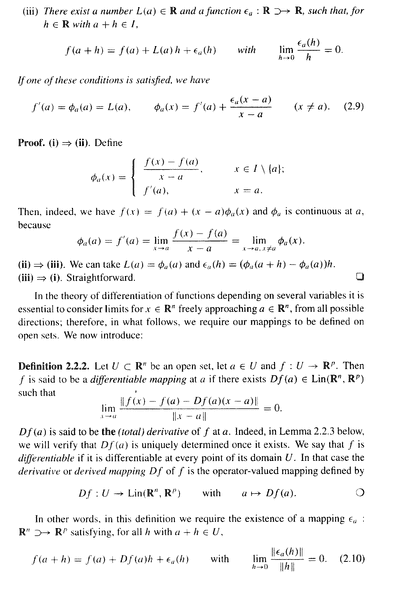
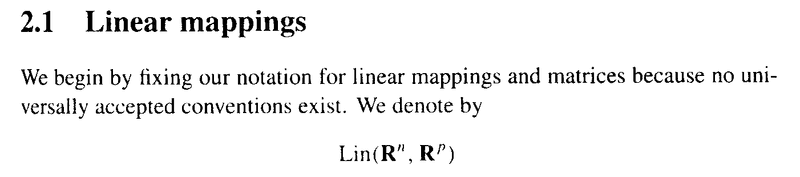
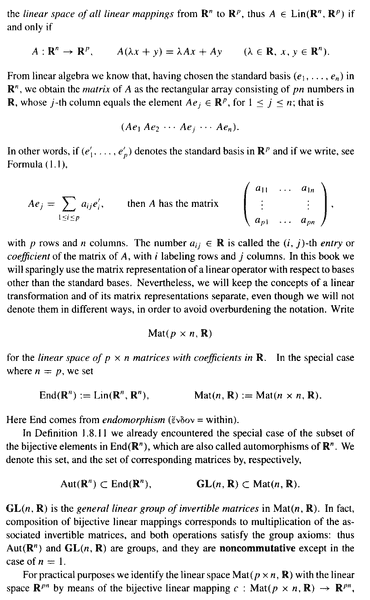
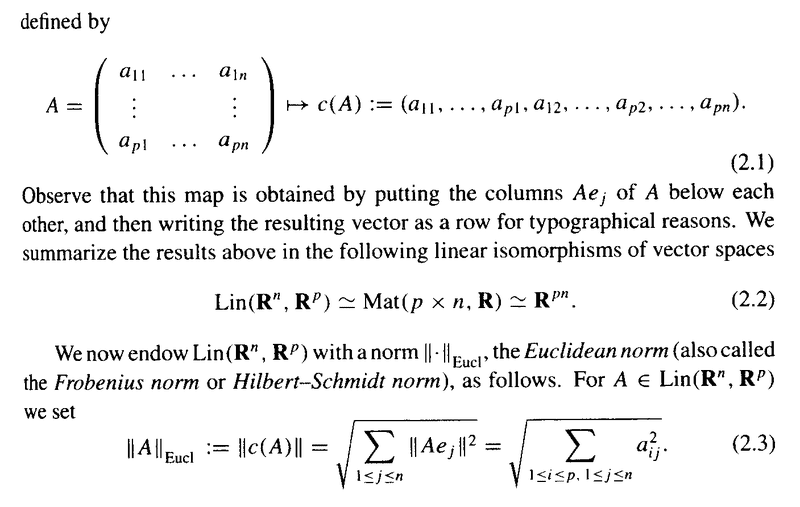
The start of D&K's section on linear mappings may also help readers of the above post understand the context and notation of the post ... so I am providing the same as follows:
Hope the above helps readers understand the context and notation of the post ...
Peter
I am focused on Chapter 2: Differentiation ... ...
I need help with another aspect of the proof of Lemma 2.2.7 (Hadamard...) ... ...
Duistermaat and Kolk's Lemma 2.2.7 and its proof read as follows:
Near to the end of the above text D&K write the following:
" ... ... A direct computation gives ##\| \epsilon_a(h) h^t \|_{ Eucl } = \| \epsilon_a(h) \| \| h \|## , hence##\lim_{ h \rightarrow 0 } \frac{ \| \epsilon_a(h) h^t \|_{ Eucl } }{ \| h \|^2 } = \lim_{ h \rightarrow 0 } \frac{ \| \epsilon_a(h) \| }{ \| h \| } = 0## This shows that ##\phi_a## is continuous at ##a##. ... ... "
My questions are as follows:
Question 1
... how/why does the above show that ##\phi_a## is continuous at ##a##. ... ...?
Can someone please demonstrate explicitly, formally and rigorously that ##\phi_a## is continuous at ##a##. ... ...?Question 2
How/why does the proof of Hadamard's Lemma 2.2.7 imply that ##f## is continuous at ##a## if ##f## is differentiable at ##a## ... ?
Help will be much appreciated ... ...
Peter==========================================================================================
NOTE:
The start of D&K's section on differentiable mappings may help readers of the above post understand the context and notation of the post ... so I am providing the same as follows:
The start of D&K's section on linear mappings may also help readers of the above post understand the context and notation of the post ... so I am providing the same as follows:
Hope the above helps readers understand the context and notation of the post ...
Peter
Attachments
-
 D&K - 1 - Lemma 2.2.7 ... ... PART 1 ... .png13.5 KB · Views: 599
-
 D&K - 2 - Lemma 2.2.7 ... ... PART 2 ... .png24 KB · Views: 681
-
 D&K - 1 - Start of Section 2.2 on Differentiable Mappings ... PART 1 ... .png29.9 KB · Views: 506
-
 D&K - 2 - Start of Section 2.2 on Differentiable Mappings ... PART 2 ... .png26.9 KB · Views: 488
-
 D&K - 1 - Linear Mappings ... Start of Section - PART 1.png8.6 KB · Views: 511
-
 D&K - 2 - Linear Mappings ... Start of Section - PART 2 ... ... .png33.7 KB · Views: 551
-
 D&K - 3 - Linear Mappings ... Start of Section - PART 3 ... ... .png40.3 KB · Views: 538