Handling Rotational Degrees of Freedom in Coordinate Transformations

Click For Summary
SUMMARY

The discussion focuses on handling rotational degrees of freedom in coordinate transformations, specifically transitioning from a source disturbance defined in one coordinate system (red) to another (green). The user initially attempted to convert the disturbance through a series of transformations involving spherical and Cartesian coordinates, but found the process tedious. The conversation highlights the potential for consolidating constant transformations into a single matrix and warns of the complications associated with Euler angles, particularly "gimbal lock," which may necessitate the use of quaternions for accurate representation of motion.

PREREQUISITES
  • Understanding of transformation matrices in 3D space
  • Familiarity with spherical and Cartesian coordinate systems
  • Knowledge of Euler angles and their limitations
  • Basic concepts of quaternions and their application in rotations
NEXT STEPS
  • Research how to create and utilize consolidated transformation matrices
  • Learn about the implications of gimbal lock in Euler angle representations
  • Study the mathematical foundations and applications of quaternions in 3D transformations
  • Explore alternative methods for coordinate transformations in dynamic systems
USEFUL FOR

Engineers, physicists, and computer scientists involved in dynamic system analysis, particularly those working with coordinate transformations and rotational motion in 3D environments.

chinmay
Messages
6
Reaction score
0
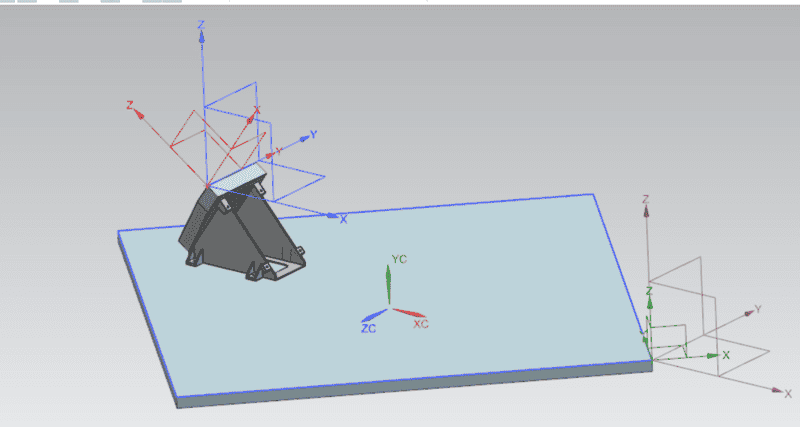
I am trying to analyse response of a dynamic system. The source disturbance is about x,y,theta (rotation about x ) & Phi of one coordinate system (red coloured coordinate system in the attached figure).

I need to get the response in another coordinate system ( green coloured coordinate system in the attached figure), whose all three axis is inclined to initial coordinate system.

In case of only x & y,it can be easily done using transformation matrix, but how to handle the transformation of rotational dof.

I tried to convert the source disturbance in spherical coordinate system , then cartesian, then transformation and finally again to (X, Y, Z, THETA, PHI, PSI,) new coordinate system; but this process is to tedious.

Is there any better alternative is available ?
Picture1.png
 
Engineering news on Phys.org
There is probably no easier way. If some of the transformations are constant, they can probably be combined into a consolidated transformation matrix. When using phi, psi, theta Euler angles, you need to be careful about "gimbol lock", where the angles are not well defined and it is hard to represent motion continuously. That can force you to use quaternions, which is a can of worms. Hopefully, you will not need to use quaternions.
 

Similar threads

  • · Replies 5 ·
Replies
5
Views
2K
  • · Replies 1 ·
Replies
1
Views
3K
  • · Replies 8 ·
Replies
8
Views
2K
  • · Replies 2 ·
Replies
2
Views
1K
  • · Replies 40 ·
2
Replies
40
Views
6K
  • · Replies 9 ·
Replies
9
Views
3K
  • · Replies 1 ·
Replies
1
Views
4K
  • · Replies 1 ·
Replies
1
Views
4K
  • · Replies 7 ·
Replies
7
Views
1K
  • · Replies 2 ·
Replies
2
Views
2K