Have You Heard of a Half-Male, Half-Female Bird?

  • Thread starter Thread starter Evo
  • Start date Start date
  • Tags Tags
    Bird
Click For Summary

Discussion Overview

The discussion centers around the phenomenon of bilateral gynandromorphism in birds, specifically a northern cardinal exhibiting both male and female plumage characteristics. Participants explore the implications of this rare occurrence, its biological significance, and related examples in nature.

Discussion Character

  • Exploratory
  • Debate/contested
  • Conceptual clarification

Main Points Raised

  • Some participants describe a cardinal observed in Illinois that displays red feathers on one side and brownish-gray on the other, identifying it as a gynandromorph.
  • Others express amazement at the flexibility of nature and draw parallels to other species, such as butterflies.
  • A participant humorously suggests that the bird could avoid conflict by turning to its less aggressive side.
  • Some participants challenge the classification of the bird, proposing that it may be leucistic rather than gynandromorphic, citing the appearance of the female side.
  • There is mention of a historical sighting of another gynandromorph cardinal with opposite plumage characteristics.
  • Concerns are raised about the lack of DNA sampling from the bird to confirm its condition, despite published articles on the subject.

Areas of Agreement / Disagreement

Participants do not reach a consensus on whether the bird is best classified as a gynandromorph or leucistic, with multiple competing views remaining on the nature of its coloration and biological classification.

Contextual Notes

Some discussions reference the need for further investigation, such as DNA sampling, to clarify the bird's condition and the implications of its unique coloration.

Evo
Staff Emeritus
Messages
24,032
Reaction score
3,277
I was not aware of such a thing.
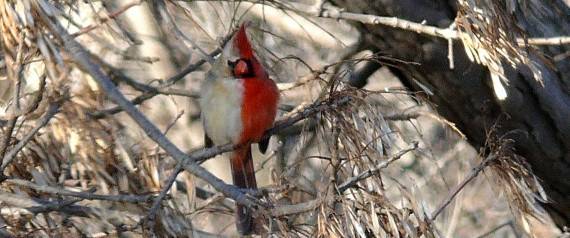
n-CARDINAL-large570.jpg


You don't have to be an ornithologist to know that red northern cardinals are male and brownish-gray ones are female.

But what about a Cardinalis cardinalis that sports red feathers on one side of its body and brownish-gray feathers on the other? Why, that cardinal is half-male and half-female, of course--and just such a rare bird has been observed in northwestern Illinois.

An example of a phenomenon biologists call bilateral gynandromorphism, the bird was observed for more than 40 days between Dec. 2008 and March 2010--and it certainly caught the attention of the scientists who spotted it.

http://www.huffingtonpost.com/2014/...dinal-plumage_n_6392336.html?utm_hp_ref=birds
 
  • Like
Likes   Reactions: Digitalism, PWiz, lisab and 6 others
Biology news on Phys.org
That's amazing, isn't it? I recently heard about it as well, butterflies are beautiful examples as well.
 
  • Like
Likes   Reactions: Greg Bernhardt and Evo
Like Frank Gorshin in Star Trek!
 
  • Like
Likes   Reactions: edward, dlgoff and Evo
If a male cardinal approaches on the red side and starts to pick a fight this little birdie only has to turn the other cheek. :D

Shades of the Starship Enterprise:

Intriguingly, another gynandromorph cardinal sighted briefly in 1969 had the opposite plumage, they note: the male’s bright red plumes on the right, the drabber female feathers on the left.

bold mine

http://news.sciencemag.org/biology/2014/12/half-male-half-female-bird-has-rough-life
 
Last edited:
Based on my observations and interactions with quite many people, I think most "gay" males of higher social positions in life share this feature.
edward said:
If a male cardinal approaches on the red side and starts to pick a fight this little birdie only has to turn the other cheek...
 
jbrussell93 said:
I know this is a relatively old post, but just thought I'd chime in. I think the term is actually 'leucistic' http://www.sibleyguides.com/2011/08/abnormal-coloration-in-birds-melanin-reduction/. It is not both male and female, it just has a reduction in melanin on one half of its body, for whatever reason. It's definitely not unheard of, but the symmetry is pretty spectacular.
No, the condition is a gynandromorph and is an organism that contains both male and female characteristics. Please read the information posted before replying.
 
Yes, I read that. I was only suggesting that it looks much whiter than a typical female cardinal. Females are not white, they actually have a fair amount of color, suggesting this bird might be leucistic instead of a gynandromorph.

Either way, it's surprising that they never actually caught the bird to sample its DNA, yet an article is apparently published in the Wilson Journal of Ornithology.
 
  • Like
Likes   Reactions: Silicon Waffle
  • #10
jbrussell93 said:
Yes, I read that. I was only suggesting that it looks much whiter than a typical female cardinal. Females are not white, they actually have a fair amount of color, suggesting this bird might be leucistic instead of a gynandromorph.

Either way, it's surprising that they never actually caught the bird to sample its DNA, yet an article is apparently published in the Wilson Journal of Ornithology.
Yes, it does look much whiter so there could be a reason for the lighter coloring for the female half as you state, but it's still half male/half female.
 
  • Like
Likes   Reactions: Silicon Waffle