Prove It
Gold Member
MHB
- 1,434
- 20
Use three iterations of the Secant Method to find an approximate solution of the equation
$\displaystyle \sin{\left( 1.8\,x \right) } =\frac{1}{2}\,x^2 - 10 $
if your initial estimates are $\displaystyle x_0 = 4.43 $ and $\displaystyle x_1 = 4.63 $.
The Secant Method is a numerical scheme to solve equations of the form $\displaystyle f\left( x \right) = 0 $, so we must rewrite the equation as $\displaystyle 0 = \frac{1}{2}\,x^2 - 10 - \sin{ \left( 1.8\,x \right) } $.
Thus $\displaystyle f\left( x \right) = \frac{1}{2}\,x^2 - 10 - \sin{ \left( 1.8\,x \right) } $.
The Secant Method is $\displaystyle x_{n+1} = x_n - f\left( x_n \right) \left[ \frac{x_n - x_{n-1}}{f\left( x_n \right) - f\left( x_{n-1}\right) } \right] $.
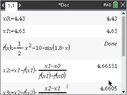
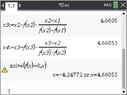
I have used my CAS to solve this problem.
View attachment 9651
View attachment 9652
So after three iterations your solution is approximately $\displaystyle x_4 = 4.66053 $.
I also included the calculator's answer, which matches.
Attachments