Help Me Prove Radius is Twice as Large for Bigger Circle

  • Thread starter Thread starter david18
  • Start date Start date
  • Tags Tags
    Circle Radius
Click For Summary

Homework Help Overview

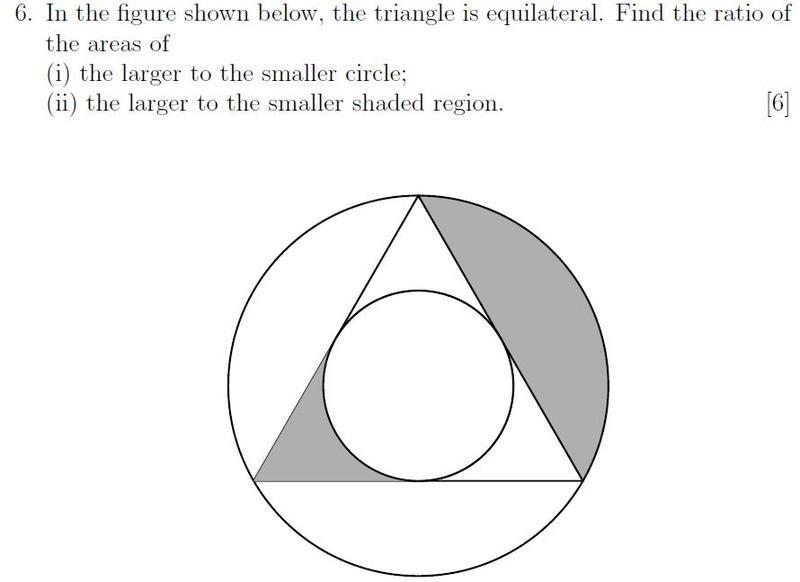
The discussion revolves around proving the relationship between the radii of two circles associated with an equilateral triangle, specifically questioning whether the radius of the larger circle is twice that of the smaller circle.

Discussion Character

  • Conceptual clarification, Mathematical reasoning, Problem interpretation

Approaches and Questions Raised

  • The original poster attempts to establish a relationship between the radii based on area comparisons but struggles with the proof. Some participants question the assumption that the radius of the larger circle is twice that of the smaller circle, exploring geometric relationships and the application of the Pythagorean theorem.

Discussion Status

Participants are exploring different geometric interpretations and reasoning. One participant has provided a detailed mathematical approach, while another is reflecting on the complexity of the solution and suggesting a simpler geometric interpretation involving right triangles.

Contextual Notes

There is an indication of potential confusion regarding the relationship between the radii and the areas of the circles, as well as the geometric setup involving the equilateral triangle and its properties.

david18
Messages
49
Reaction score
0
I'm having trouble with this question. For the first part I am guessing that the radius is 2 times larger for the bigger circle and therefore its area is four times as large, but I can't seem to prove that the radius is twice as large.I'd appreciate it if anyone could help me out on this question

circlequestion.JPG
 
Physics news on Phys.org
If you want a quick answer upload your image on imageshack...
 
No. The radius of the large circle is NOT twice the radius of the small circle. To find the ratio, Assume the length of each side of the equilateral triangle is L. If you drop a perpendicular from one vertex to the opposite side, it bisects that side. You now have a right triangle with hypotenuse of length L and one leg of length L/2. Letting "x" be the length of the other leg, by the Pythagorean theorem, you have L2= x2+ L2/4 or x2= 3L2/4. x= [itex]\sqrt{3}/2[/itex]. Now draw another line from another vertex to the center of the circle. Then you have another right triangle with hypotenuse of length R, the circumference of the circle, one leg of length L/2 and the other of length [itex]\sqrt{3}/2- R[/itex]. Now the Pythagorean theorem gives [itex]R^2= L^2/4+ ((\sqrt{3}/2)L- R)^2[/itex] which reduces to [itex]L^2/4+ (3/4)L^2- \sqrt{3}Lh= 0[/itex] (the "R^2" terms cancel) so [itex]R= L/\sqrt{3}= \sqrt{3}L/3[/itex].

Remember that the first vertical line has length [itex]\sqrt{3}L/2[/itex]. We now see that can be divided into a short distance of [itex]\sqrt{3}L/3[/itex] and a longer distance of [itex]\sqrt{3}L/2- \sqrt{3}L/2= \sqrt{3}L/6[/itex]. The length of the longer part is the radius of the larger circle, and the length of the shorter part is the radius of the smaller circle.
[tex]\frac{\frac{\sqrt{3}}{2}L}{\frac{\sqrt{3}}{6}L}= 3[/tex]
not 2.
 
thanks for the reply.

I was working through your solution and knowing the context of the question, thought it seemed a little too complicated.

What I eventually found is that if you draw a line from the centre to a corner of the triangle, and another line from the centre to the tangent, you form a right angled triangle with angles of 30 and 60 degrees. The line from the centre to the tangent is r, so knowing that sin 30 = 1/2, you say that the hypotenuse must be 2r.Sorry for the poor explanation, I can draw up a solution if you have any trouble going through the lengthy explanation.
 

Similar threads

Replies
17
Views
4K
Replies
11
Views
3K
  • · Replies 5 ·
Replies
5
Views
2K
  • · Replies 4 ·
Replies
4
Views
3K
  • · Replies 3 ·
Replies
3
Views
1K
Replies
7
Views
3K
  • · Replies 6 ·
Replies
6
Views
3K
Replies
5
Views
3K
Replies
7
Views
2K
  • · Replies 3 ·
Replies
3
Views
4K