Help me understand this table: Unstandardized Logit Coefficient and Beta?

Click For Summary

Discussion Overview

The discussion revolves around understanding a table that presents "Unstandardized Logit Coefficient" and "Beta" in the context of logistic regression. Participants seek clarification on the meaning and implications of these statistical measures, particularly in relation to voter turnout and independent variables (IVs).

Discussion Character

  • Exploratory
  • Technical explanation
  • Conceptual clarification

Main Points Raised

  • One participant expresses a need for a simple explanation of the terms "Unstandardized Logit Coefficient" and "Beta," indicating a limited background in statistics.
  • Another participant notes that both terms are measures used in logistic regression, suggesting that a higher unstandardized logit coefficient and a higher beta indicate a higher turnout for a certain variable.
  • A participant questions the interpretation of specific coefficients from the table, such as the negative effect of "mudslinging" on voter turnout and the ambiguous meaning of "tone of the commercials" in relation to its logit coefficient.
  • It is suggested that beta values are standardized versions of the unstandardized logit coefficients, which may be more useful for comparing different independent variables.
  • A participant acknowledges the clarification provided and expresses intent to further investigate the coefficients' meanings.

Areas of Agreement / Disagreement

Participants do not reach a consensus on the interpretation of the coefficients, and there remains uncertainty regarding the specific measures and their implications.

Contextual Notes

The discussion highlights limitations in understanding the coefficients without additional context about what they measure and how they are derived.

guss
Messages
246
Reaction score
0
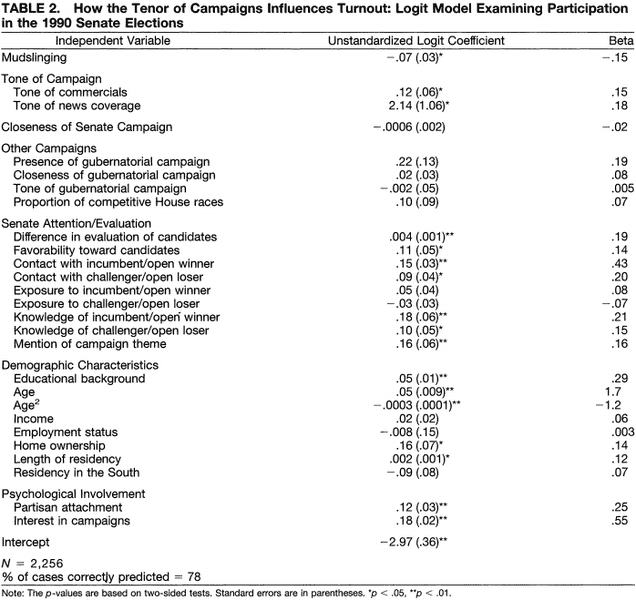
Hello, I am currently doing a project and trying to understand this table. I have a pretty good mathematical background but I know very little about statistics. Could someone explain, in simple terms, what this table is saying, specifically "Unstandardized Logit Coefficient" and "Beta"? Thanks so much!

zobyj.png
 
Physics news on Phys.org
Simon Bridge said:
They are logistic regression measures.
http://www.appstate.edu/~whiteheadjc/service/logit/intro.htm

Thanks. So, just so I'm clear, a higher unstandardized logit coefficient means what? And a higher beta means what?

I'm confused about the difference. It seems to me that both a higher unstandardized logit coefficient and a higher beta mean a higher turnout for a certain variable in the left-most column.
 
Can't tell what they are measuring from the chart alone.
eg.

IV: "mudslinging", ULC -0.07(0.03) ... would appear to be saying that mudslinging in the campaign has a slight negative effect on voter turnout but what are we to make of:

IV: "tone of the commercials" ULC 0.12(0.06) ... ?? I mean, what does "tone" measure and how was that measure turned into a logit coefficient?

You should look to see what they are "coefficients" to.

Whatver they are: the beta would be the same as the ULC only with their statistics standardized to unit varience. eg. they are showing the same thing in the sense that bigger numbers mean favorable ratios for the IV. The standardized measures are usually more useful for comparing different IVs to each other.
 
Simon Bridge said:
Can't tell what they are measuring from the chart alone.
eg.

IV: "mudslinging", ULC -0.07(0.03) ... would appear to be saying that mudslinging in the campaign has a slight negative effect on voter turnout but what are we to make of:

IV: "tone of the commercials" ULC 0.12(0.06) ... ?? I mean, what does "tone" measure and how was that measure turned into a logit coefficient?

You should look to see what they are "coefficients" to.

Whatver they are: the beta would be the same as the ULC only with their statistics standardized to unit varience. eg. they are showing the same thing in the sense that bigger numbers mean favorable ratios for the IV. The standardized measures are usually more useful for comparing different IVs to each other.

Thanks, that helps a lot. That's a good enough understanding for me right now, I'll look into what exactly those coefficients are. And yes, you are correct about what the chart is trying to say.
 

Similar threads

Replies
3
Views
3K
  • · Replies 4 ·
Replies
4
Views
4K
  • · Replies 7 ·
Replies
7
Views
3K
Replies
10
Views
3K
  • · Replies 3 ·
Replies
3
Views
9K
  • · Replies 1 ·
Replies
1
Views
2K
  • · Replies 5 ·
Replies
5
Views
4K
  • · Replies 4 ·
Replies
4
Views
5K
  • · Replies 24 ·
Replies
24
Views
3K
  • · Replies 1 ·
Replies
1
Views
2K