Help Needed: Solving Kinematics Problem in 10 Days!

Click For Summary
The discussion revolves around a self-study challenge for the Edexcel Mechanics 2 GCE A Level exam, focusing on a kinematics problem. The user initially struggles with a question about the perpendicular motion of two vectors, finding their answer of t = 1.726s does not match the book's t = 2s. After receiving hints, they realize the book's answer for part B regarding the position vector of Q is indeed correct, as it requires integration due to the non-constant velocity of Q. The user successfully derives the position vector of Q as (24i - 8j)m, confirming their understanding and resolving their confusion. The exchange highlights the importance of integration in kinematics and the need for clarity in problem-solving.
slakedlime
Messages
74
Reaction score
2
Hello :)
I'm self-studying for my Edexcel Mechanics 2 GCE A Level exam (it's in 10 days :S) and was having lots of trouble with one of the kinematics questions. I've uploaded photos of the problem and my solution for part (a) of the question. I couldn't use the math notation feature on the Physics Forum properly; I hope the photos aren't a problem for anyone!
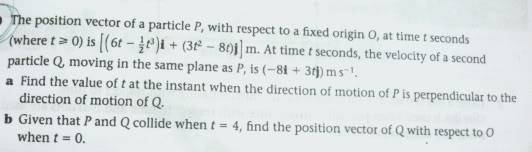
Homework Statement


question.jpg


Homework Equations


* When a and b are two perpendicular vectors, a.b = 0.

The Attempt at a Solution


My working out for part (a) of the question:
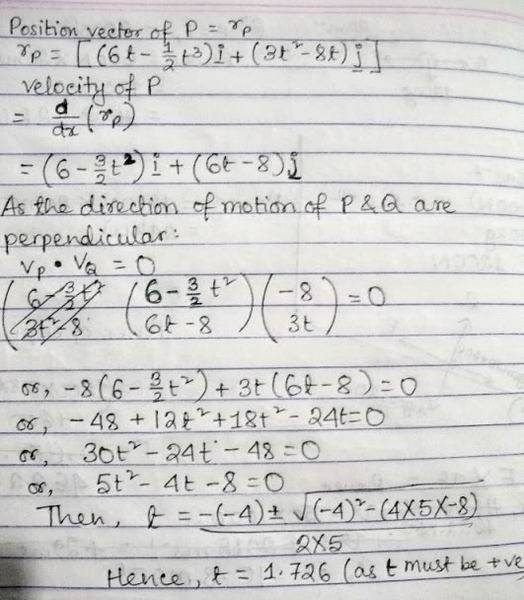
solution.jpg


My answer (t = 1.726s) doesn't match with the book's answer of t = 2s. As the book wants the 'instant' when the direction of motion of P is perpendicular to that of Q, I don't think that the book wants me to round off 1.726 to 2.

I'm completely clueless about part (b), so I would really appreciate it if someone could kindly provide some hints to get me in the right direction. I could try solving it then. If you need any further information, please ask and I'll try to provide it. I'm just very, very stumped with this question and have nobody who I can ask. :( Some fresh ideas might really help!
 
Physics news on Phys.org


I'm getting the exact same answer, yours seems spot on.

Unless we're crappy at taking derivatives, the given answer is just wrong.

\vec V_P (t=2 sec) = 4\hat y

\vec V_Q (t=2 sec) = -8 \hat x + 6 \hat y

And clearly these two are not perpendicular.

Have you taken a swing at part B yet? Do you know what to do?


Hi RoyalCat :) Thank-you for your help. I'm guessing my book is wrong, unless someone else shows us otherwise? :) I've finally come up with something for part B. My answer of (24i - 32j)m for the position vector of Q with respect to O when t=0 doesn't match the book's answer of (24i - 8j)m.

Here's my working out:
solutionB.jpg


Is my book wrong here as well? This is my examining body's (Edexcel) new and revised official coursebook for the Mechanics 2 exam :S :S


The book is right on this one, though.

The velocity of Q is not constant. It is a function of time.
The difference in position must be found by integration.
One approach is to take the indefinite integral, and set two constants for the initial x and y positions, which must then be found using the boundary conditions (The position at time t=4 sec is known).


Thank-you so much for your hints RoyalCat :) My answer finally matches the book's one:

Position vector of Q
= Integrating the velocity of Q
= (-8t + a)i + [(3/2)t^2 + b]j

As P and Q collide when t = 4, the position vector of Q = position vector of P at that time

Hence, position vector of Q when t = 4: -8i + 16j {worked this out in my first attempt at part B, above}

So,
-8t + a = -8
So, a = 24

And, (3/2)t^2 + b = 16
So, b = -8

Hence, position vector of Q = (-8t + 24)i + [(3/2)t^2 - 8]j

Therefore, when t = 0
Position vector of Q = 24i - 8j (The answer ^_^)


Spot on. :) Well done!
 
The book claims the answer is that all the magnitudes are the same because "the gravitational force on the penguin is the same". I'm having trouble understanding this. I thought the buoyant force was equal to the weight of the fluid displaced. Weight depends on mass which depends on density. Therefore, due to the differing densities the buoyant force will be different in each case? Is this incorrect?

Similar threads

  • · Replies 25 ·
Replies
25
Views
3K
  • · Replies 43 ·
2
Replies
43
Views
2K
  • · Replies 7 ·
Replies
7
Views
2K
Replies
18
Views
2K
  • · Replies 1 ·
Replies
1
Views
3K
  • · Replies 30 ·
2
Replies
30
Views
2K
  • · Replies 5 ·
Replies
5
Views
2K
  • · Replies 6 ·
Replies
6
Views
854
  • · Replies 4 ·
Replies
4
Views
2K
  • · Replies 6 ·
Replies
6
Views
2K