Help needed working out a zener diode circuit's total Voltage

  • Thread starter Thread starter Eisen
  • Start date Start date
  • Tags Tags
    Diode Voltage
Click For Summary

Homework Help Overview

The discussion revolves around a zener diode circuit and its behavior concerning voltage across a lamp in the circuit. Participants are exploring the implications of the zener diode's characteristics on the voltage distribution within the circuit.

Discussion Character

  • Conceptual clarification, Assumption checking

Approaches and Questions Raised

  • The original poster questions why the lamp maintains a voltage of 20V across it regardless of the power supply voltage, and whether the zener diode's behavior affects this. Other participants clarify the zener's function and its impact on the circuit's voltage distribution.

Discussion Status

Participants are actively discussing the behavior of the zener diode and its effect on the voltage across the lamp. Some guidance has been provided regarding the zener's role as a voltage clamp, but there is still uncertainty about the overall voltage in the circuit and how it adjusts with varying power supply voltages.

Contextual Notes

There appears to be confusion regarding the relationship between the zener diode's voltage regulation and the total circuit voltage, particularly in relation to Kirchhoff's Voltage Law (KVL). The original poster's assumptions about voltage drops and the behavior of the circuit components are under examination.

Eisen
Messages
14
Reaction score
0
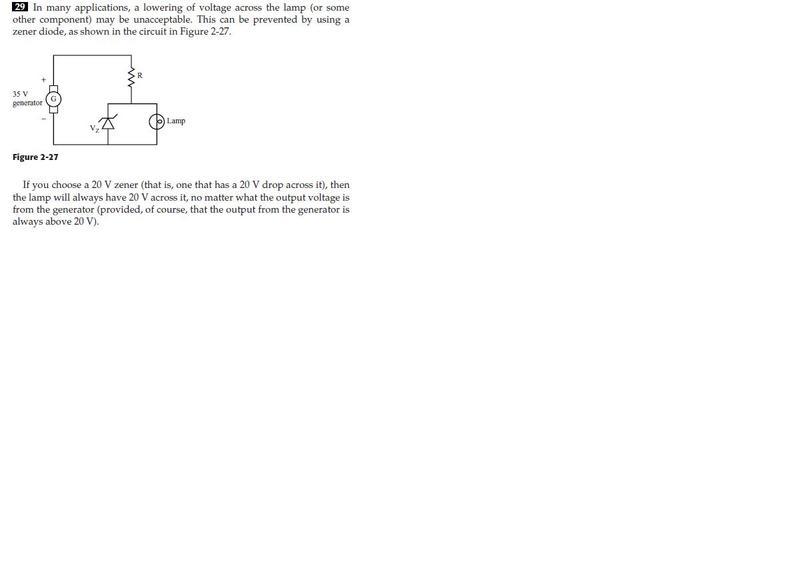
Here is the circuit-

zener diode.JPG


Can someone please tell me why the lamp will always have a voltage of 20v across it no matter how high the voltage is? Doesn't the zener diode allow voltage through it after 20v? So then only the voltage after 20v has been dropped should go through the lamp right? For example a 35 volt power supply means 15v goes across the lamp. Apparently 20v goes across the lamp but I don't see why that is. Also what will the total voltage of the circuit be in this circuit if the power supply is 35v? If the power supplu was 20v surely that would mean the voltage across the lamp would be 0v?
 
Physics news on Phys.org
Anyone?
 
The zener diode begins to conduct when the potential across it reaches 20V. The voltage across the zener (at least an ideal zener) will not go higher than 20V. In this respect it behaves somewhat like a regular ideal diode in series with a 20V power supply, and will only begin to conduct current after the applied voltage surpasses this "internal" supply voltage and becomes forward biased.

Since the lamp is in parallel with the zener, it must share the same potential drop: no more than 20V. The zener acts like a "voltage clamp". It conducts however much current is required in order to maintain that 20V drop across itself. If the power supply voltage alters, the difference shows up in the potential drop across the series resistor R.
 
So does the voltage through the whole circuit drop down to 20v?
 
Eisen said:
So does the voltage through the whole circuit drop down to 20v?

No. The voltage across the zener and anything in parallel with it will be maintained at no more than 20V. Everything else has to adjust accordingly to make KVL work out.
 

Similar threads

Replies
3
Views
1K
  • · Replies 1 ·
Replies
1
Views
2K
  • · Replies 11 ·
Replies
11
Views
1K
  • · Replies 3 ·
Replies
3
Views
2K
  • · Replies 5 ·
Replies
5
Views
1K
  • · Replies 6 ·
Replies
6
Views
3K
Replies
5
Views
3K
  • · Replies 7 ·
Replies
7
Views
4K
Replies
2
Views
2K
  • · Replies 15 ·
Replies
15
Views
2K