Higgs Boson: Decay, Proton Remnants & Detection

Click For Summary
SUMMARY

The discussion centers on the decay of Higgs bosons (HB) and their detection through interactions with proton remnants in high-energy collisions. It is established that Higgs bosons decay in approximately 10^-22 seconds, as supported by observations from the Large Hadron Collider (LHC), which align with the predictions of the Standard Model of particle physics. The conversation highlights the importance of quantum mechanics and quantum field theory in understanding these phenomena, while emphasizing that personal theories and speculation are not permitted in the forum context.

PREREQUISITES
  • Basic understanding of quantum mechanics
  • Familiarity with quantum field theory
  • Knowledge of the Standard Model of particle physics
  • Awareness of Higgs boson properties and decay processes
NEXT STEPS
  • Study the decay mechanisms of Higgs bosons in detail
  • Explore the principles of quantum field theory
  • Research the experimental methods used at the Large Hadron Collider (LHC)
  • Learn about the implications of the Standard Model in particle physics
USEFUL FOR

This discussion is beneficial for physicists, particle physicists, and students of quantum mechanics seeking to deepen their understanding of Higgs boson behavior and detection methods in high-energy physics experiments.

Trevor Hulette
Messages
1
Reaction score
0
I am concerned about the idea of decay of HB... when two photons collide in Hadron .. exploding outward.. as the proton remnants leave trails in the field surrounding .. revealing a smaller particle field which quickly disappear... My contemplations lead me to think they do NOT quickly decay.. as we cannot see them prior to proton annihilation , it is the interaction with the proton remnants that create a state of excitation in the HB causing them to be detectable .. but QUICKLY fall back into their base state and disappear from detection as they fill the zone blown out by the proton remnant... the proton remnant shoots through the field spreading it but compressing the HB field as it pushes these tiny base field particles to the side causing them to bunch up around the area the proton traveled.. ghost trails... which revealed them..
Picture it like this.. a really thick oil... you swipe a spoon through it and it doesn't automatically fill in behind but accumulates around the edge the spoon traveled.. that accumulation is where it reveals itself to detection.. but quickly fills the void behind proton remnant path.. thinning out and disappearing from equipment detection
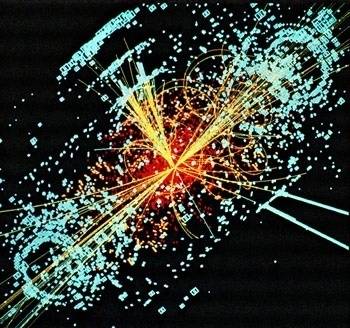
Higgs-Boson-story.jpg
 
Last edited by a moderator:
Physics news on Phys.org
The interactions of protons that create Higgs bosons are very well understood and well described by the standard model of particle physics. The observations made at the LHC are in good agreement with the expectations for the standard model Higgs boson, which decays in about 10-22 s. Unfortunately, your contemplations have very little to do with this description and the basic ingredient in understanding what is going on is a basic understanding of quantum mechanics and quantum field theory as well as an understanding of what the picture you have linked represents.

Also be advised that we do not allow speculation or personal theories at Physics Forums. I am therefore closing this thread.
 
  • Like
Likes   Reactions: mfb and vanhees71

Similar threads

  • · Replies 13 ·
Replies
13
Views
5K
  • · Replies 8 ·
Replies
8
Views
2K
  • · Replies 11 ·
Replies
11
Views
3K
  • · Replies 4 ·
Replies
4
Views
4K
  • · Replies 9 ·
Replies
9
Views
3K
  • · Replies 4 ·
Replies
4
Views
4K
  • · Replies 3 ·
Replies
3
Views
2K
  • · Replies 7 ·
Replies
7
Views
3K
  • · Replies 9 ·
Replies
9
Views
4K
  • · Replies 6 ·
Replies
6
Views
4K