High background radiation on Ludlum Model 3 survey meter
- Level: Undergrad
- Thread starter dlgoff
- Start date
-
- Tags
- Radiation
Join the discussion
Registration is free. Start your own thread to ask a follow-up.
31 replies · 4K views
Physics news on Phys.org
Discussion
Science Advisor
Gold Member
- 4,458
- 3,266
It's a NaI(Tl) scintillator, 2.5 cm (1 in) dia. x 0.1 cm (0.04 in) thick*gleem said:What kind of probe do you have? GM or scintillator?
*From this link: https://ludlums.com/products/all-products/product/model-44-3
That link does show that Typical Background is 300cpm, so maybe what I'm seeing is normal.
Science Advisor
Education Advisor
- 2,886
- 2,350
Ok. I have used this probe for contamination surveys. It is used primarily for low-energy gamma/Xrays. Being thin its response for high energy gammas is fairly low. 2-3k counts per minute is definitely high. Is this a new instrument for you? Did it come with a check source?
Science Advisor
Gold Member
- 4,458
- 3,266
Actually, I've only had it for a short time. I purchased it on Ebay and there are no calibration stickers. I guess it needs to be calibrated correctly, which I don't know how to proceed.gleem said:Duh, sorry about that question. That sounds reasonable. How does it compared to the reading when you first got the instrument?
BTW: Thanks for your time with this.
Science Advisor
Education Advisor
- 2,886
- 2,350
The problem with this particular probe is that it is meant for low-energy gammas. Most sources of radiation that you might be interested in are fairly high. The problem is the sensitivity and therefore the cpm/ millisievert is dependent on the radiation energy.
Here is an energy response curve from Ludlum
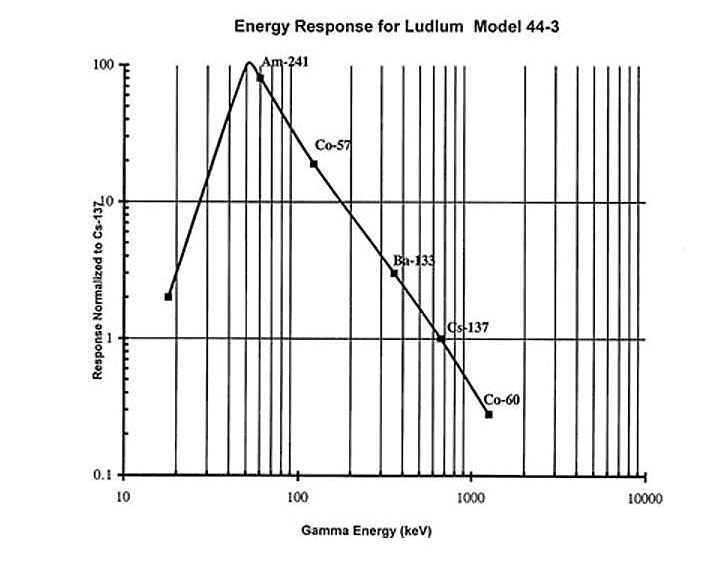
As you can see the cpm varies significantly for the energy of the gamma so radiation exposure rate for a given isotope will not be the same for a given cpm reading.
Here is an energy response curve from Ludlum
As you can see the cpm varies significantly for the energy of the gamma so radiation exposure rate for a given isotope will not be the same for a given cpm reading.
Science Advisor
Gold Member
- 4,458
- 3,266
I understand, but I'm seeing these high readings from just the background.gleem said:The problem with this particular probe is that it is meant for low-energy gammas. Most sources of radiation that you might be interested in are fairly high. The problem is the sensitivity and therefore the cpm/ millisievert is dependent on the radiation energy.
Here is an energy response curve from LudlumView attachment 291421
As you can see the cpm varies significantly for the energy of the gamma so radiation exposure rate for a given isotope will not be the same for a given cpm reading.
edit: Still could be a good calibration is needed.
Science Advisor
Gold Member
- 4,458
- 3,266
Let me try reading the check source then subtracting the background. I've got someone coming for dinner, so I'll check later and reply here.gleem said:Then you said you had 1 Kcpm from the check source. Did you get that number by subtracting the background reading from the check source reading? Where was the check source when you initially read the background?
The check source was in a lead pig when I looked at the background.
You've been very helpful. Thank You
Science Advisor
Gold Member
- 4,458
- 3,266
Will do. I moved around in my trailer thinking there might be a source somewhere. But outside it is. :)gleem said:Take the meter outside away from any buildings to check the background. If the reading is still high there may be a problem with the meter.
Science Advisor
Gold Member
- 4,458
- 3,266
Science Advisor
Gold Member
- 4,458
- 3,266
Inside, the background is now showing 200 to 300 counts/minute. So all's good, right?gleem said:Sounds like the detector is fine. Go back in the house with the detector on and watch the background as you get closer. Does it stay about the same 200-330 cpm?
Science Advisor
Gold Member
- 4,458
- 3,266
That's what I was thinking when I wrote, Are we having above normal rates lately?, in the OP. So there is a solar flare going on? I tried googling about that, but couldn't find a reliable site. Thanks.gleem said:Maybe what you observed was radiation from a solar flare that is occurring presently.
Science Advisor
Education Advisor
- 2,886
- 2,350
Lots of Aurora Borealis seen fairly far South.
https://www.cnn.com/2021/10/29/weather/northern-southern-lights-us-europe-wx-scn/index.html
https://www.cnn.com/2021/10/29/weather/northern-southern-lights-us-europe-wx-scn/index.html
Science Advisor
Gold Member
- 4,458
- 3,266
Wish it would be visible here in Kansas.gleem said:Lots of Aurora Borealis seen fairly far South.
https://www.cnn.com/2021/10/29/weather/northern-southern-lights-us-europe-wx-scn/index.html
Eric Reiter
- 1
- 1
Count rate depends on how the pulse-height discriminator is set. What electronics are you using on the Ludlum detector? I have not seen anyone here talk about pulse-height. The graph that Gleem posted is not counts per minute; it is energy of the pulses, which is proportional to pulse-height.
The detector you purchased is more of an x-ray detector than a gamma detector, because it is only 1 mm thick. You should use Am-241 from a smoke detector as a check source. There is both a gamma and x-ray from Am-241 to use to calibrate how to set your discriminator level. You can look up the eV; the gamma is near 59KeV if I remember correctly. So, you should see the two peaks and then you know what you are looking at. Set the discriminator to see only the larger peak (the gamma) on a pulse height analyzer. If you do not have a pulse height analyzer it is very difficult to make sense of these counts.
If you do not have the ability to set the pulse-height on a discriminator, you will not make any sense from these counts; you might be looking at noise. The detector might be bad. These thin detectors go bad from water leaking in over time. From reading only the gamma pulses, then you can calculate from the 1 uCi source and the distance from it the expected count rate and compare to your experimental rate. The half-life of Am-241 is so long that it should be close to what is marked on the smoke detector (~1 uCi). You will need to tear the smoke detector apart to get the radioisotope close to your detector.
The detector you purchased is more of an x-ray detector than a gamma detector, because it is only 1 mm thick. You should use Am-241 from a smoke detector as a check source. There is both a gamma and x-ray from Am-241 to use to calibrate how to set your discriminator level. You can look up the eV; the gamma is near 59KeV if I remember correctly. So, you should see the two peaks and then you know what you are looking at. Set the discriminator to see only the larger peak (the gamma) on a pulse height analyzer. If you do not have a pulse height analyzer it is very difficult to make sense of these counts.
If you do not have the ability to set the pulse-height on a discriminator, you will not make any sense from these counts; you might be looking at noise. The detector might be bad. These thin detectors go bad from water leaking in over time. From reading only the gamma pulses, then you can calculate from the 1 uCi source and the distance from it the expected count rate and compare to your experimental rate. The half-life of Am-241 is so long that it should be close to what is marked on the smoke detector (~1 uCi). You will need to tear the smoke detector apart to get the radioisotope close to your detector.
Science Advisor
Education Advisor
- 2,886
- 2,350
The instrument that is used with the probe is the Ludlum model 3 which is just a pulse counter/HV supply which can also be used with GM tubes. The graph which I posted is to indicate the sensitivity to various energies of his probe. The threshold setting is fixed.
As far as check source is concerned any source that can produce a response is sufficient as long as the count rate is adequate, the counting geometry remains the same for the checks and the source is sufficiently long lives.
The OP was alerted to the problem of the meaning of the reading.
As far as check source is concerned any source that can produce a response is sufficient as long as the count rate is adequate, the counting geometry remains the same for the checks and the source is sufficiently long lives.
The OP was alerted to the problem of the meaning of the reading.

Similar threads
Undergrad Some questions about Cosmic Microwave Background radiation
- PainterGuy
- · Replies 13 ·
- Astronomy, Astrophysics, Cosmology
- Replies
- 13
Undergrad Has cosmic background radiation been measured underground?
- Simon B
- · Replies 13 ·
- Astronomy, Astrophysics, Cosmology
- Replies
- 13
Graduate Significance of the 3K cosmic microwave background radiation
- cakeislife
- · Replies 9 ·
- Astronomy, Astrophysics, Cosmology
- Replies
- 9
High School Natural Sources of Background Radiation for A-Level Physics
- transit442003
- · Replies 1 ·
- High Energy, Nuclear, Particle Physics
- Replies
- 1
Graduate Hawking radiation and cosmic microwave background radiation
- Orion1
- · Replies 5 ·
- Astronomy, Astrophysics, Cosmology
- Replies
- 5
High School Cosmic Microwave Background Radiation and Photography
- paddys09
- · Replies 15 ·
- Thermodynamics
- Replies
- 15
Graduate Determining background radiation in a decay spectrum
- physguy09
- · Replies 1 ·
- Atomic and Condensed Matter
- Replies
- 1
How to Derive the Energy Density of Neutrino-Antineutrino Background Radiation?
- Beer-monster
- · Replies 17 ·
- Advanced Physics Homework Help
- Replies
- 17
Graduate Background radiation and intensity
- peleus
- · Replies 2 ·
- Astronomy, Astrophysics, Cosmology
- Replies
- 2
Undergrad Background radiation and photons
- Theraven1982
- · Replies 6 ·
- Astronomy, Astrophysics, Cosmology
- Replies
- 6